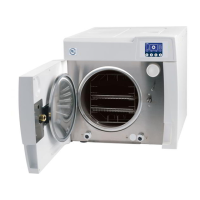
EXACTA
9
INTRODUCING THE AUTOCLAVE
With the steam, the heating process isn't in-
stantaneous in any case, and the time needed
to reach the balance at the required tempera-
ture varies according to the sizes of the auto-
clave, the load quantity and the steam penetra-
tion speed. With liquids and materials, such as
surgical medications and glassware in which the
penetration is difficult or the thermal capacity
is high, the time factor is very important, and
due account should be taken in the treatment
program. The sterilization time may be ex-
tremely short compared to the heating period.
Both European and American Scientific Com-
munity have established and defined three
temperatures, 115°C, 121°C and 134°C, and
relative exposures by which to manage the var-
ious materials according to their heat re-
sistance. It has also verified the effectiveness of
the treatment at 105°C with an appropriate
exposure that can be used to disinfect the more
thermally unstable materials having no contact
with the patients.
With distilled water, the most commonly used
sterilization programs are:
– 134°C/4 minutes for miscellaneous
loads and 12 minutes for porous
loads;
– ; 121°C/15 minutes for miscellaneous
loads and 30 minutes for porous
loads;
– 115°C/30 minutes for miscellaneous
loads and 45 minutes for porous
loads.
The programs at lower temperatures are clearly
the only ones that guarantee a high safety mar-
gin for the thermally unstable materials About
the disinfecting, it is generally used the cycle of
105°C/20 minutes for miscellaneous loads, and
of 30/40 minutes for porous loads.



 To Next Page