05/06
•
55
ROUTINE MAINTENANCE
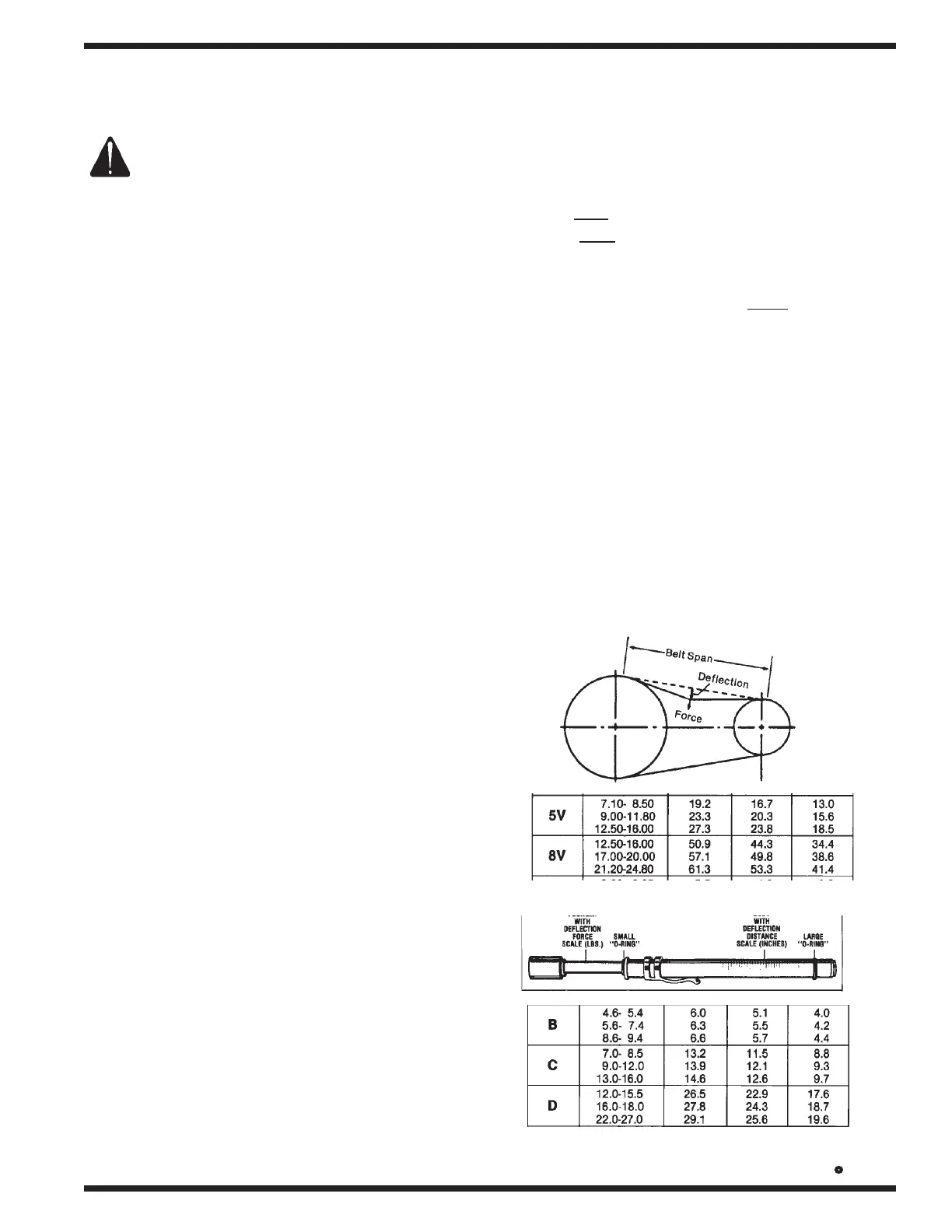
HOW TO USE A V-BELT TENSION GAUGE
WARNING: Before doing mainte-
nance or tensioning on belt drives,
turn equipment off and lock out the
power source.
Install a new matched set of belts. Take
up the slack until the belts appear fairly
tight.
Measure the belt span length of your
drive (see table 1.) Set the rubber O-
ring on the body of the tension gauge
(S/N 29841-093) at the dimension
equal to 1/64" for every inch of span
length. For example, the deection for
a 32" span is 1/64" x 32-1/2".
Set the O-ring on the plunger at 0
against the body of the tension gauge.
With the tension gauge perpendicu-
lar to the span, apply a force to a belt
in the center of the span. Deect the
belt until bottom of the large O-ring is
even with the top of the next belt or the
bottom of a straightedge laid across
the top of other belt(s) on the drive.
Release pressure and read pounds of
force used at O-ring on plunger
Note: When new belts are installed on
a drive, the tension will drop rapidly
during the rst few hours. Thus, for
new belts, tighten to the initial installa-
tion deection force shown in the table.
Check tension frequently during the
rst 24 hours of operation. Subsequent
retensioning should fall between the
minimum and maximum forces shown
in the tables.
Compare the force required in step 4
with the ranges in table 2. Tighten or
loosen belts to bring them into the rec-
ommended range.
Note: The proper tension for V-belt drive is
the lowest tension at which the belts won't
slip under peak load conditions.
1.
2.
3.
4.
5.
Note: All belts can be found in the Parts
Book supplied with your machine.
Note: A
new belt for tension purposes is a
belt with zero running time.
Note: After a belt has been in operation for
two minutes it is considered used.
Note: The best set of matched belts will
not perform well if either the drive or driv-
en sheaves are worn out. These sheaves
should be inspected any time the belts are
replaced. If the sheaves show signs of ex-
cessive wear they should be replaced so
that maximum belt life can be obtained.
CAUTION: Failure to follow these guidelines
could result in premature belt failure, belt
rollover and P.T.O. bearing failure.
1.
2.



 To Next Page