1
Introduction
Protection for Life
General Monitors’ mission is to benefit society by providing solutions through industry
leading saf ety products, services, and systems that save lives and protect capital
resources from the dangers of hazardous flames, gases, and vapors.
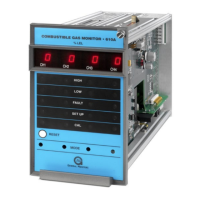
This manual provides instruction for installing and operating the General Monitors Model
610A Four Channel Control Module for Combustible Gas Applications. While t he 610A
system is easy to install and operate, this manual should be read in full and the
inf ormation contained herein understood bef ore attempting to place the system in
service.
The saf ety products you have purchased should be handled caref ully and installed,
calibrated, and maintained in accordance with the respective product instruction manual .
Remember these products are f or your safety.
Special Warning
Through engineering design, testing, manufacturing techniques, and rigid quality control,
General Monitors (GMI) supplies the finest gas detection systems av ailable. The us er
must recognize his responsibility for maintaining the gas detection system in operational
condition.
The Model 610A Four Channel Combustible Gas Monitor contains component s, which
can be damaged by static electricity. Special care must be taken when wiring the system,
to ensure that only the connection points are touched.
Only catalytic bead sensors designed by General Monitors will work with the Model 610A
Controller. Any attempt to use a sensor that has not been approved by General Monitors,
will void the warranty.
General Monitors cautions, as with all equipment of this type, t hat high levels or long
exposure to certain atmospheres will “poison” the sensor catalyst and event ual ly affect
sensitivity. Please see Section 2.6.5 for specific information. Use in s uch at mos pheres
requires calibration checks on a more frequent schedule than normal. General Monitors
should be consulted for an application feasibility determination, before installing a system
in such atmospheres.
General Monitors’ sensors and sensor housings are designed and tested f or use in
certain classes of hazardous atmospheres. Explosion-proof integrity cannot be
maintained, if sensors and sensor housings are operated in other than the “as designed”
condition. Terminal access covers of sensor housings must be securely fastened. Sensor
housing must be installed in accordance with National Electrical Code acceptable
practices, for the class of hazardous atmospheres.


 To Next Page