© 2005-2016 Nira Control AB 24
Definition of a Trig and Maximum Voltage
Occurs when a falling pulse flank passes zero
0,4 V between peak and ground at 100 rpm. 2,5
V at 6 000 rpm
3.1.1 The Pulse Wheel
NIRA i7x works with the majority of standard pulse wheels
that has one or two pulses “removed” as a reference point. On engines
where such a pulse wheel is factory fitted it is recommended to keep the
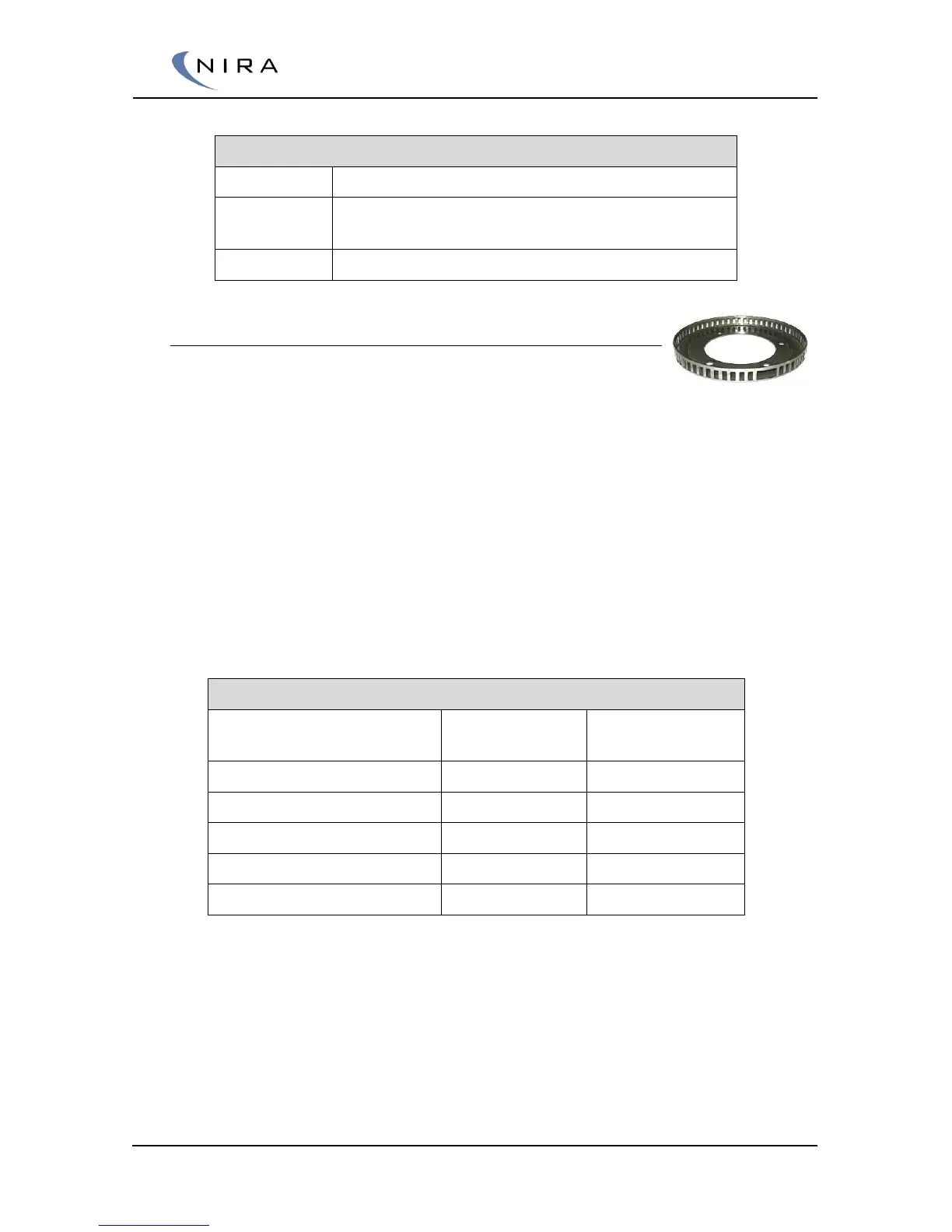
factory installation. The picture above and right is showing a pulse wheel of
the type “60 – 2 lost” that is a standard pulse pattern. This pulse wheel has
58 teeth and a gap that is created by the removal of 2 teeth in the otherwise
symmetrical pattern. Hence the name “60 – 2 lost”. NIRA i7x is designed to
handle pulse wheels of the types “60 – 2 lost”, “60 – 1 lost”, “ and
symmetrical pulse wheels down to “16 – 2 lost” and “16 – 1 lost”.
Symmetrical pulse wheels have teeth that are equally distributed around the
pulse wheel with the exception of a reference point where one or two teeth
are missing. The table below describes the pulse wheels that are compatible
with NIRA i7x.
Pulse Wheels Compatible with NIRA i7x
No of teeth, including
”missing teeth”
Pattern no 1 (1
tooth removed)
Pattern no 2 (2
teeth removed)
60 (each tooth + gap is 6°)
NIRA i7x reads symmetrical pulse wheels that are split into a maximum of 60 sections (60 – 1
lost, 60 – 2 lost) and a minimum of 16 sections (16 – 1 lost, 16 – 2 lost). All symmetrical
patterns in between are compatible with NIRA i7x.
As shown in the table above, NIRA i7x handles the most common types of
factory fitted pulse wheels, such as “60 – 2 lost” found on European cars
(Volvo, Saab, Audi, BMW, Mercedes, etc), Ford’s “36 – 1 lost” and “24 – 1
lost” found on many motorcycle engines. There must not be any doubts
regarding what type of pulse wheel that is fitted on the engine. The pattern


 To Next Page