Fast wavelength modulation
40
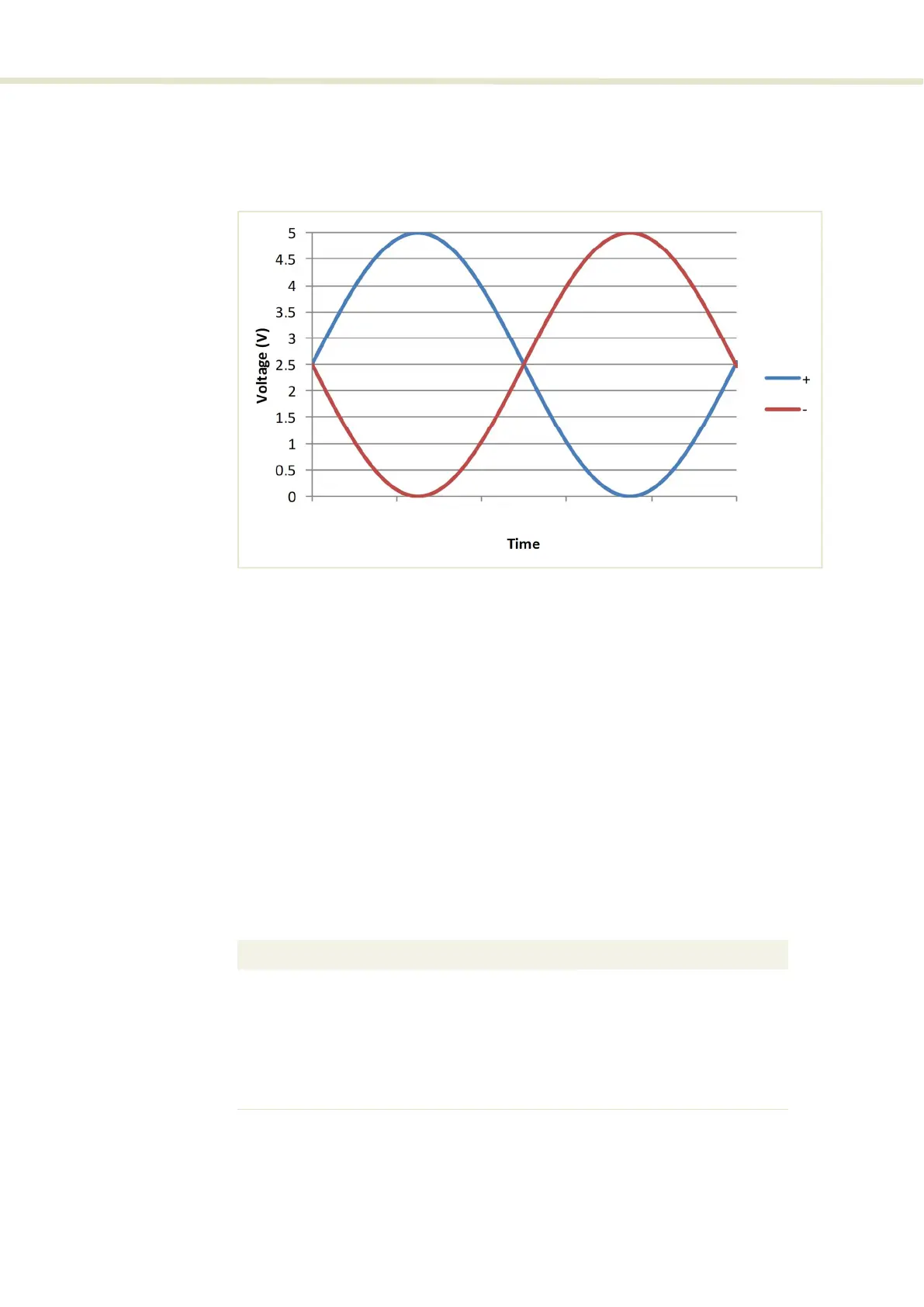
Differential output If the Wavelength+/- pins are configured as an output, a differential signal will be
present at the pins as shown in Figure 16. The differential signal amplitude can
be up to 2x 5 Vpp with a common mode voltage of 2.5 V.
Figure 16 Differential output signal
The differential output signal can be used for example, as the input signal for
other Koheras BASIK modules.
Wavelength
modulation
coupling
You can select either internal AC or DC coupling of the modulation signal. If AC
coupling is chosen, the module’s high pass filter function has a cut-off frequency
of 1.6 Hz. Setting the Koheras BASIK X15 to DC coupling allows the laser to lock
to an external reference signal that for example, uses the Pound Drever Hall
technique. In this mode, the module adjusts its wavelength so the differential
error signal level on the Wavelength+/- input leans towards 0 V.
Narrow vs. Wide
modulation range
You can set the wavelength modulation operation to either narrow or wide
range. As detailed in Table 7, the operation characteristic of each range depends
on the module type (X15 or E15/C15/Y15).
Table 7 Narrow vs wide band wavelength modulation
Frequency
response
For X15 modules, the frequency response of the wavelength modulation feature
differs from that of the E15/C15/Y10 modules. The graphs in Figure 17 (X15) and
Koheras BASIK X15 Koheras BASIK E15/C15/Y10
Narrow Very limited modulation can be
obtained, i.e. maximum ~30
MHz. The extremely low phase
noise is maintained in this mode.
Maximum 0.8 GHz modulation
for E15/C15 and 1 GHz for Y10.
Wide Maximum 500 MHz modulation,
but its extremely low phase
noise is NOT maintained in this
mode.
Maximum 8 GHz modulation for
E15/C15 and 10 GHz for Y10.
Small negative impact on low
frequency phase noise.


 To Next Page