HeatWater.com | WaterService@nyle.com | (800) 777-6953 IM-e360-122023 IM-e360-122023 HeatWater.com | WaterService@nyle.com | (800) 777-6953
27
Additional Notes for Individual Wired Control
Points
Remote Enable Contacts
When “External Demand” mode is enabled during
conguration, these contacts will place a heat demand
on the heat pump when an external controller closes a
set of dry contacts. No tank sensor is wired to the heat
pump in this mode.
In “Tank Sensor” mode, these contacts can be
jumped, or this can be used as a permission signal
by external dry contact controls to allow/disallow com-
pressor operation.
Remote enable contacts ship with a factory installed
jumper.
Run Signal Contacts
This dry set of contacts close whenever a heat de-
mand is present. External devices that need to run in
response to the heat pump can use this as a trigger,
such as louver motors and/or booster pumps.
Alarm Status Contacts
This dry set of contacts close whenever the compres-
sor will not run because of lockout, outdoor tempera-
ture, or defrost. Backup heat sources can use this as
an enable trigger.
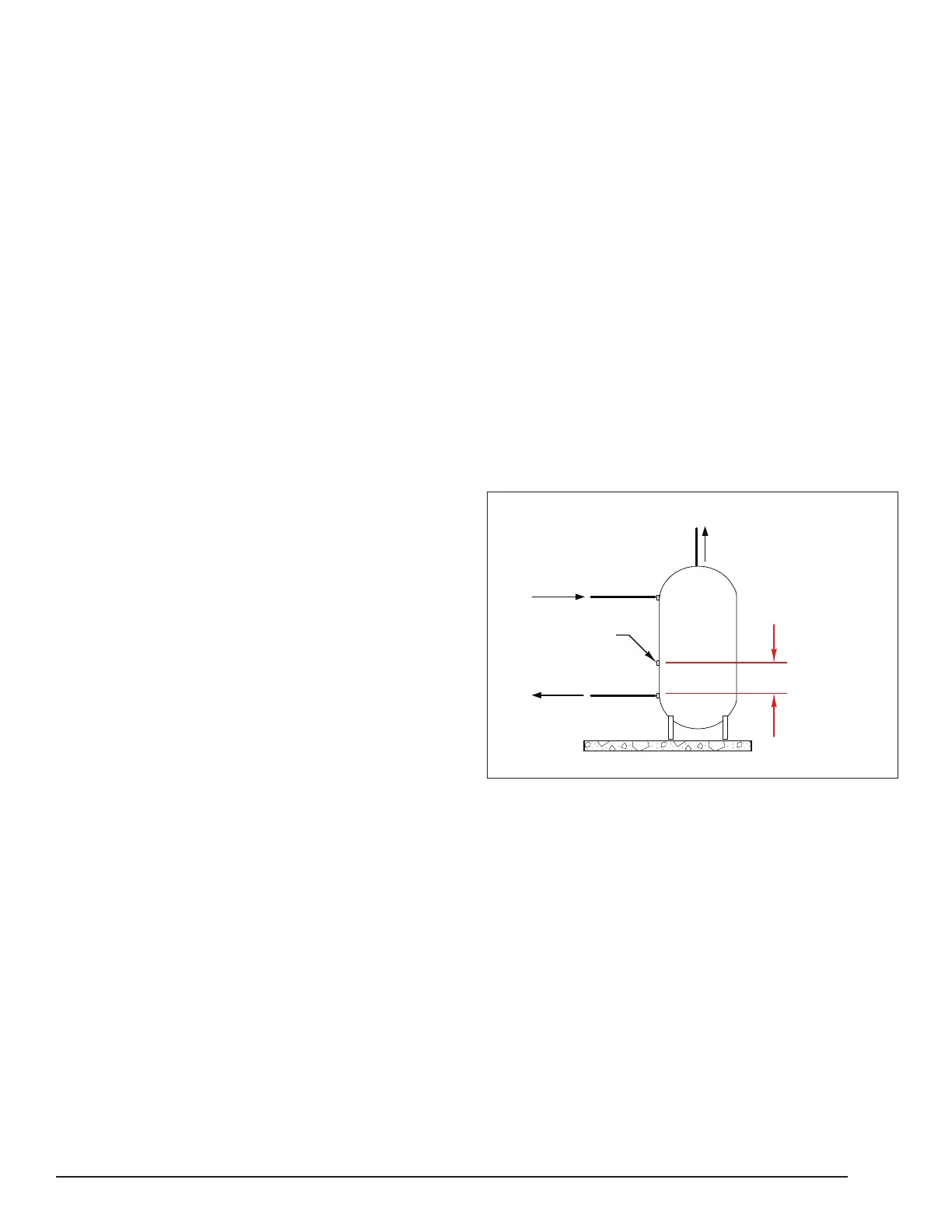
Tank Sensor 1
When “Tank Sensor” mode is enabled during congu-
ration, this sensor input allows the heat pump to moni-
tor and control the tank temperature. Take care that the
Tank sensor is installed such that the “Minimum Tank
Cycle Volume” or greater volume is between the sen-
sor location and the heat pump intake water pipe near
the bottom of the storage tank. Greater cycle volumes
will reduce system wear and tear, but also reduce avail-
able storage for peak demand periods. Be sure the siz-
ing and system design provide for adequate storage to
service peak demands..
Ethernet
Ethernet cable is not necessary for standalone opera-
tion. Ethernet is used for various accessories, service
laptop connections, and will be necessary for future
products and functionality. Roughing in a CAT-5 or
CAT-6 cable at installation is recommended.
Figure 14: Tank Sensor Installation
To Heat Pump
From Heat Pump
Tank Sensor or
Aquastat
DHW Out
Min. Cycle Volume


 To Next Page