HeatWater.com | WaterService@nyle.com | (800) 777-6953 IM-e360-122023
28
IM-e360-122023 HeatWater.com | WaterService@nyle.com | (800) 777-6953
Optional Ducting and Ventilation
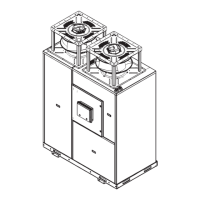
e-Series heat pumps draw air in through the evapo-
rator coil, and discharge air from the top of the unit at
the fans. A standard installation would discharge this
area to the front of the unit, using the ductless cowl
accessory. This is typical of outdoor installations.
CAUTION
Heat pumps with exposed fans on top of the unit must
always be covered to protect the fans. This is achieved
with ducting or with a ductless cowl accessory. Failure
to cover the fans can result in damage to the unit and/
or severe personal injury or death. NEVER operate the
fans if they are not covered and protected.
e-Series units can be installed indoors. Highly venti-
lated areas, such as below grade parking structures,
can often be installed without ducting. Likewise, areas
with pervasive and signicant heat gains from exter-
nal sources may be able to replace the heat that the
e-Series unit removes in real time, such as in large
commercial mechanical rooms or server farms.
CAUTION
Interior, ductless applications require very close consider-
ations to heat gains and losses to avoid overcooling the
space, and/or reducing the heat pump efciency or per-
formance. These calculations should be undertaken by a
qualied engineer, and should take into account current
and future uses of the space. For example, if the heat
gain from a large steam boiler allows the siting of a large
heat pump in a mechanical room, the lifespan and likely
replacement plan for that boiler needs to be considered.
While air source heat pumps do cool their discharge
air, cooling is entirely dependent upon the need for hot
water production. Since the unit cannot be controlled
to any particular setpoints for cooling, it can only be
considered as a supplement for another, primary cool-
ing system.
In most indoor installations, ducting will be required to
operate safely and efciently. Ducting allows the unit to
draw in outdoor air, and/or to discharge air to the out-
doors, or to control both intake and discharge air move-
ment. Ducting can signicantly reduce freeze risks, and
it can simplify maintenance access and/or provide supe-
rior protection to many potential outdoor locations.
Check the unit’s performance specications for maxi-
mum airow volume (CFM) and available static pres-
sure (In. W.C.). These values form the basis of a duct
design, and all duct designs should be undertaken by
qualied duct designers.
CAUTION
Guidance offered in this manual is intended to provide
context for the designer, and DOES NOT replace the
need to have duct designs created by qualied de-
signers of commercial grade ducting. Inadequate duct
systems can result in premature system failure, under-
performance, unacceptable noise, condensation, and
water damage.
Ducting Requirements
CAUTION
When ducting intake air, it will be necessary to install the
optional “Remote Outdoor Air Temperature Sensor” ac-
cessory, to allow the heat pump to detect actual intake air
conditions before it attempts to run. Be sure to locate and
follow all instructions and guidance with that accessory
to ensure proper operation of the system.
1. Insulation – all ducting in conditioned spaces re-
quire insulation for energy and condensation con-
trol. Insulation thickness is dictated by local energy
codes, climate, and the conditioned space’s indoor
climate conditions. Reective insulation duct wrap
is not sufcient insulation by itself. Air temperature
in discharge ducting can be signicantly below
minimum operating ambient temperatures.
2. Sealing – all ducting and insulation should be well
sealed along all joints and seams, to air condition-
ing standards for condensation control. Use seal-
ants rated for the full range of intake and discharge
air temperatures. Refer to “Table 8: Duct Specica-
tions” on page 29.
3. Coil Access – the heat pump evaporator coil and
condensate pan are service items that require pe-
riodic access for cleaning. Intake ducting, if used,
should include an access door to allow for inspec-
tion and cleaning of the entire coil and drain pan.
4. Dampers – in very cold climates, motorized damp-
ers or louvers can reduce freeze risks signicantly,
preventing cold outside air from migrating to the
unit in between heating cycles. Louver/damper
motor speeds need to be 30 seconds or less. Insu-
lated dampers are recommended.


 To Next Page