The requirements for a modern beekeeper
A location for your bees - Honey bees can be kept anywhere from
country orchards to urban gardens to city roof tops. It is a common
misconception that you need a large garden or the countryside on your
doorstep. Although lots of space can make siting your bees easier, urban
gardens are arguably better. Nectar and pollen can be gathered from
a wide variety of plants that will give your honey a wonderful flavour.
This means that there is often a constant source of food throughout the
summer and a lack of harmful pesticides. Wherever you live, you can be
sure that a colony of bees will enhance you and your surroundings.
Time - Keeping honey bees requires small amounts of regular time with
the bees. During the summer (March - September) you typically have
to spend around one hour per week with a hive. You can do this at the
weekend or, if the weather is still good, when you return from work. Most
beekeepers would like to spend more time with their bees rather than
less, as beekeeping is highly addictive. Unlike keeping other animals, the
bees mostly look after themselves and will not notice if you go on holiday.
From October through to February you don’t need to inspect your bees
at all as they over-winter in the hive. In all, you might spend 20-30 hours
over the course of a year with the bees.
Support and learning more - Beekeeping is an interesting hobby with
lots to learn and it is often helpful to have someone friendly to support
you. You can find someone to help by attending an Omlet Course and
meeting follow beekeepers (see www.omlet.co.uk/courses for more
information).
You can also become part of the beekeeping community on the Omlet
Club Forum (see www.omlet.co.uk/club). It’s also a good idea to join
your local Beekeeping Association (see www.britishbee.org.uk for more
information).
Before we get started, it’s good to know just a little of how the honeybee
came to be, as well as how humans developed a way of keeping them for
our own benefit.
The honeybee is a highly sophisticated insect that has evolved over millions
of years. The earliest recorded bee was found in Myanmar, Burma. It was
perfectly preserved, encased in amber, and has been dated as 100 million
years old. In those early days, bees were more like wasps, with a diet that
consisted mainly of other insects. Although this worked quite well, it did
mean that bees were restricted to regions that were warm all year round
and an unappealing diet of flies. In order to prosper bees needed a new
source of food.
As luck would have it, flowers were in need of a new way of pollinating.
In order to reproduce most plants must mate but this is a bit tricky when
you’re rooted in the ground and your partner is on the other side of the
field. In the early days they did this by sending out lots of pollen on the
wind in the hope some would land on another plant. This wasn’t efficient
and required a huge effort to produce lots of pollen. A much more accurate
system for delivering the pollen would mean less effort for the plant and a
higher chance of successful mating.
Although nature didn’t have a Fed Ex account, it did have a daughter called
innovation and she put bees and flowers together in the most brilliant way.
Flowers evolved with bright colours and markings to attract bees who were
much more likely to transport the pollen to the next plant to pollinate it.
The bees were happy to perform this
courier service because in return they
received nectar and pollen to eat. This
relationship between bees and plants
has proved an extremely fruitful one.
In fact, scientists believe that bees are
responsible for most of the rich flower
diversity we enjoy today.
By reducing the water content in the
nectar and storing it in a sealed wax
cell, bees could prevent it fermenting
and provide themselves with a
nutritious food for the winter. This
innovation allowed the honeybee to
spread throughout the world as they
could now survive the cold winters
found in more northern climates. It
also meant that bees had a unique
attraction for man.
This evaporated nectar is known more
commonly as honey. Discovering honey
must have been almost as exciting
as when the first sticks were rubbed
together to produce fire and until the
invention of the beesuit it probably
produced a similar sensation when you
got too close. For thousands of years
honey provided the only sweetness
in human’s diet and beeswax, turned
into candles, the only means of light.
Bees were accordingly highly valued
by all the great ancient civilisations
but it wasn’t until the Eygyptians
that people stopped robbing wild
bees nests and started keeping bees
at home. The Egyptian hive design
was a simple upturned straw basket
called a skep. These are still used
today although mainly for temporarily
housing a colony of bees that has
recently swarmed.
Early beehives, such as the skep, were
not designed for long term use. The honey couldn’t be extracted without
destroying the hive and therefore the colony. The system only worked if the
colony produced enough bees to create a swarm, which would be caught
and go on to provide the honey in the following year. Otherwise, each year
a new swarm of bees had to be caught.
Egyptian hives were straw baskets.
These are still used today and are
called skeps.
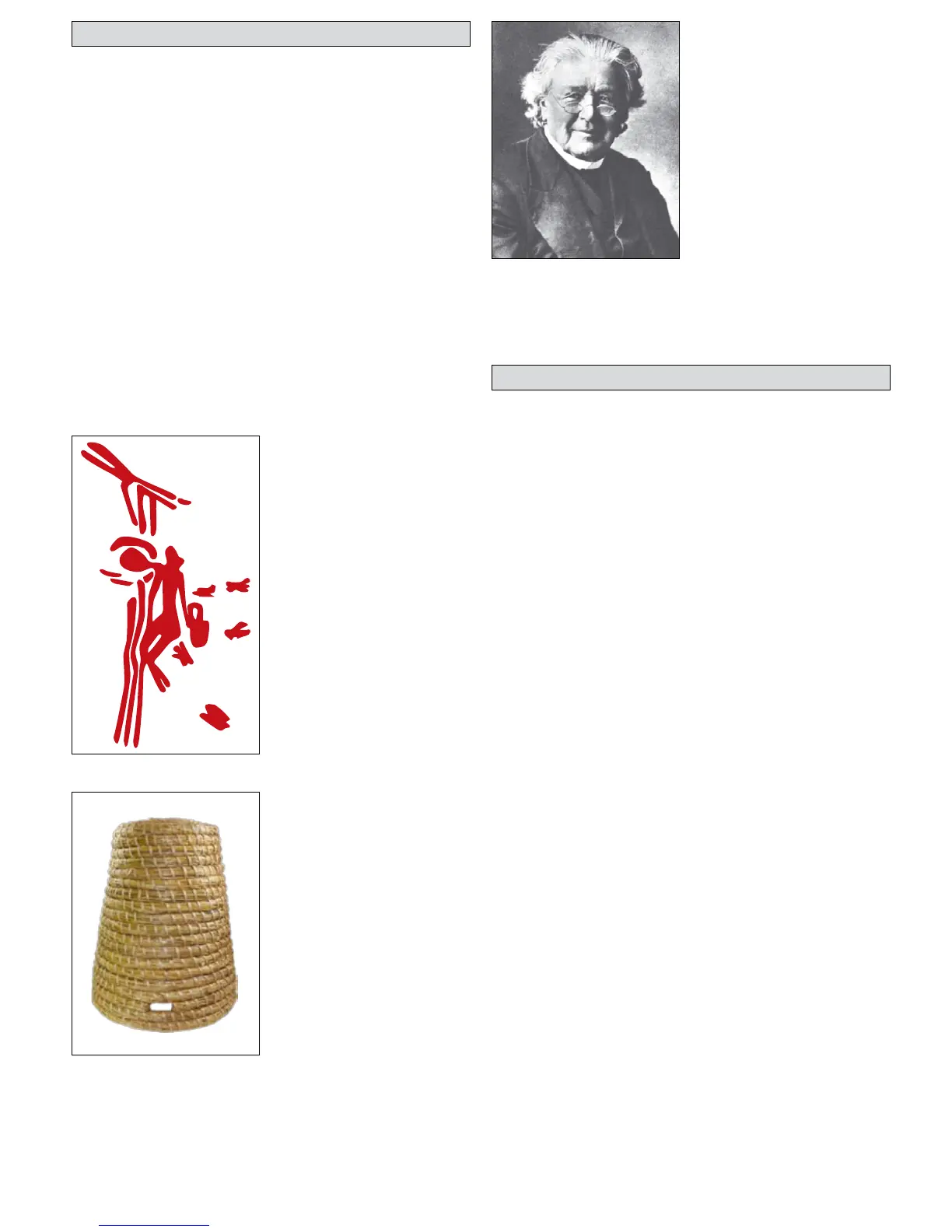
Spanish cave painting dated around
6000 BC.
The history of honey bees and beekeeping
There was a desperate need for a way
of keeping the same colony of bees year
after year so that more honey could be
produced and the apiary expanded. In
the 1851, a breakthrough discovery
in beekeeping was made by a man
called Lorenzo Langstroth. He
discovered that bees would keep
a ‘bee sized’ pathway clear within
a hive if it was between 6 and
8mm wide.
He named the discovery ‘spazio di
ape’ (or ‘bee space’ in English). This
discovery was important because
it led to the development of hives
with moveable frames of comb. This
allowed the beekeeper to remove
comb and honey without destroying
the hive. It also enabled the beekeeper to start manipulating the colony;
helping it develop and grow. This discovery is often cited as the start of
modern beekeeping.
‘Spazio di ape’ was Lorenzo
Langstroth’s famous discovery.



 To Next Page