The drones – up to 1000 per colony
Live for 22 days in the Summer
None are left in the hive over winter
A drone is a male bee, he is about
the same length as the queen
but, to put it politely, much more
squarely built. Less politely, he
looks quite dumpy with a large,
round abdomen and two big eyes
which meet at the top of his head.
The drones are quite often to be
found hanging around the honey
where they lazily feed themselves
or let themselves be fed by the
workers. As they have no sting,
they cannot defend the hive, they
never offer to help keep the place
clean and surprisingly (given their
taste for it,) have never learnt how
to make honey. In fact, the drones only purpose in life is to mate with
new queens, which they do on sunny days on mating flights - what a life!
The one sting in the tail for this happy existence is that, having mated,
they promptly die.
The colony always keeps a few hundred to a thousand drones in case a
new queen needs to be mated throughout the spring and summer. But
once autumn arrives, the workers literally drag any remaining drones out
of the hive and leave them outside to die. Suddenly being a drone doesn’t
seem quite seem so appealing.
Interestingly, in some countries, drones are considered a delicacy and are
said to be a potent aphrodisiac; if you’re in the mood for love you could
test this - please let us know if it works.
How does the queen lay eggs?
Bee eggs are parthenogenetic, which means they will hatch even if not
fertilised. Fertilisation is the deciding factor as to whether the egg that
hatches is a male or female bee. Unfertilised eggs will produce males, known
as drones. Fertilised eggs will produce females, which will be either workers
or queens. There is no difference between queen eggs or worker eggs,
they are exactly the same; the difference occurs in how they are fed when
they hatch. An egg that is selected to be a new queen will be fed only
royal jelly - an extremely protein rich food produced by the bees. Because
the queen is larger the bees construct a special cell for a new queen which
is larger and quite easy to spot.
It is believed that the queen measures
the cell size with her front legs. A
large cell is for a male drone bee and
a smaller cell is for a female worker
bee. To produce a worker bee the
queen adds sperm to fertilise the egg
in her vagina. If it’s a male drone cell
then she simply lays an unfertilised
egg. When the egg hatches
into a larva, it looks like a little
maggot and the nurse bees start to
feed it.
The nurse bees feed the larvae with
bee milk. This is masticated pollen
and is an extremely nutritious protein
rich food. The cell is regularly topped
up for the first three days, thereafter
it is fed less frequently until the cell
is capped. Drones are thought to be
fed a similar ration to the workers.
Days after
egg is laid
QUEEN DRONE WORKER
Hatching of egg 3 3 3
Cell sealed 8 10 8-9
Spinning of cocoon 9 12 10
Moult of pupa to adult 15 22 20
Emerges from cell 16 24 21
Ready to mate 20 37 N/A
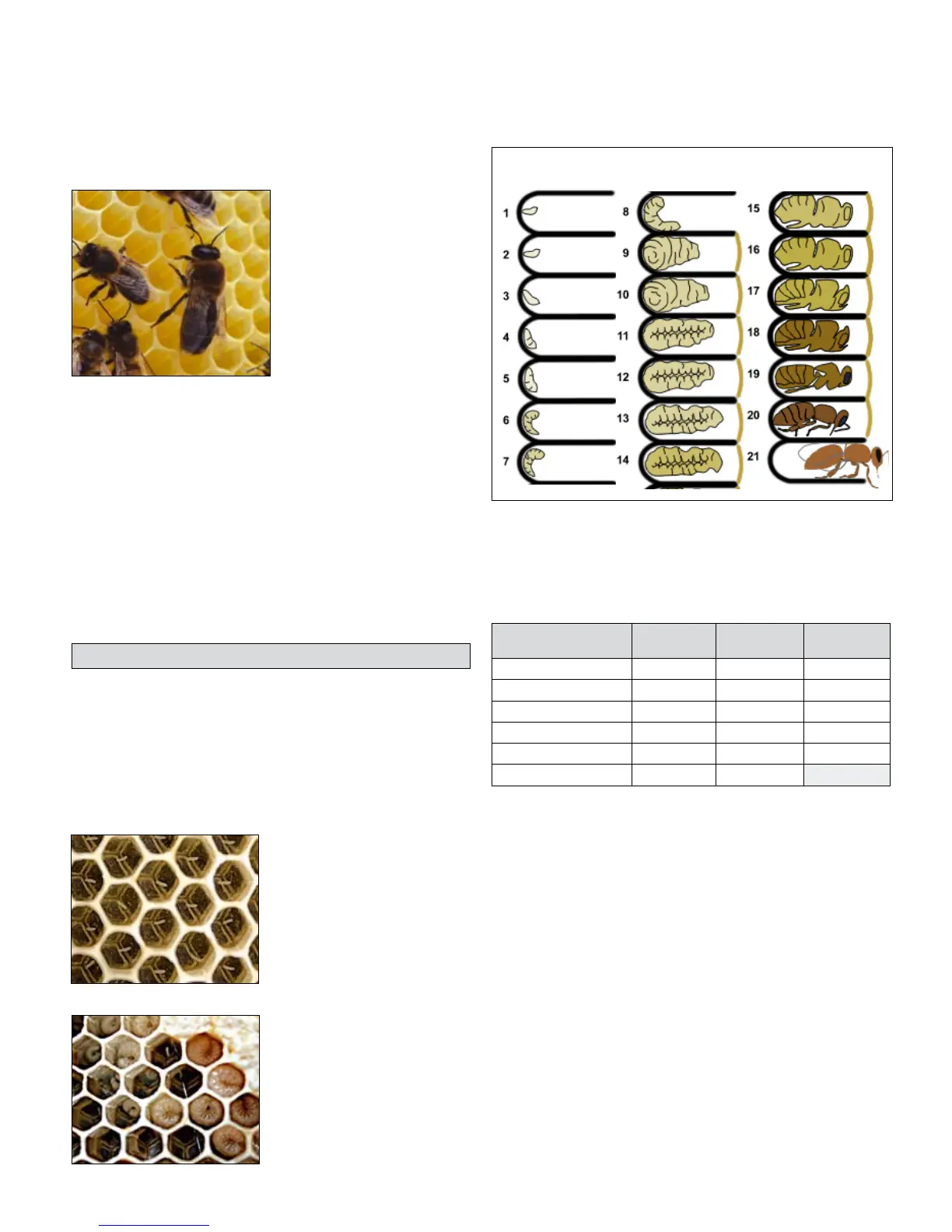
In the diagram above you can see how the egg changes daily in the cell until it
finally emerges as a fully formed bee.
Fresh eggs! But a bit small for frying.
Larvae at different stages. Note the wire
running through the foundation.
The queen, drones and worker bees take different amounts of time to
complete the stages of development. This is useful to know when you
come to inspect your hive as you can tell how long ago the queen has laid
a particular type of egg.
Is it possible for a worker bee to lay eggs?
Worker bees do occasionally lay eggs. This only happens if you have a
failing queen or a queenless hive and the bees have been unable to
requeen, perhaps because it’s the wrong time of year for a new queen
to be able to mate. Worker bees can only lay drone brood because they
haven’t mated and are not carrying any sperm. You can spot eggs laid
by worker bees because they will often be on the side of the cell rather
than on the bottom and there may be more than one egg per cell. If this
happens you will need to either unite the colony with one that has a queen
or introduce a new queen.
The drone bee is larger than the workers
and has bigger eyes.
Worker Bee Development in Days
Some worker bees are assigned to the duty of ensuring the hive is not
penetrated by unwanted guests, these can range from wasps, mice and
occasionally the beekeeper! The guard bees can be seen at the entrance
to the Beehaus, checking in the arriving bees. The smoke will placate
them too but if you stay too long these are the bees that you will first
notice buzzing around your veil urging you to close up the hive and come
back another day.
The queen cell is fed bee milk with a higher sugar content than worker
larvae. This super bee milk is called “Royal Jelly” and the queen larva is
fed as much of this as possible until the cell is capped. This difference
produces a strong queen with properly developed ovaries. Incidentally,
the cell caps are a mixture of pollen and wax which is porous, unlike the
airtight wax caps for honey. This is a great bit of trivia to use to impress
a school teacher.



 To Next Page