Bee health
Best health practices
Pests
Bees are, by nature, very house proud and take their personal hygiene
seriously. They are constantly removing any dirt or debris from within
the hive, sterilising cells with propolis and cleaning themselves and each
other. Unfortunately however this is not enoughto protect them from
a range of diseases and parasites. Some of these affect only adult bees,
others affect the developing larvae and are called brood diseases.
The beekeeper has a great responsibility to help the colony to
thrive by keeping an eye out for any signs of disease or parasite, and
acting accordingly.
Most diseases and parasites can be treated and, as so often with these
things, the earlier they are tackled the more successful and less stressful
they are for the bees. There are a very small number of diseases which, if
you suspect them, you must notify the local bee inspector who will come
andcheckyourbees.Quiteoften,it’sdifculttocorrectlyidentifydisease
in your colony and it’s therefore a good idea to have your bees routinely
inspected. Bee inspectors are highly trained at spotting diseases and can
also perform tests in the field to identify any suspected problems. They
can then advise you on the best treatments. It’s a free service so don’t
hold back!
Bees are obviously highly mobile creatures and disease can be spread
from one colony to another over a 5 mile radius. Therefore keeping your
bees healthy is not only important for your own colony but for other
beekeepers as well.
You can reduce the chances of your bees becoming ill by some simple
best practices.
•Changeyourbroodframesandfoundationeveryyear.Thisisoneof
the single most important things you can do to maintain a hygienic
hive. At the start of the season, put 3 new frames in front of and
behind the colony and feed your bees syrup. Your bees will draw out
the new frames with foundation ready for the queen to lay in. As soon
as any brood has hatched in the old frames and before the queen can
lay in them again, remove the old frames. The wax can be melted down
and swapped for new foundation.
• Aim to keep strong colonies that are able to protect themselves
against disease. It’s better to have one strong colony than two
weak ones.
•Ifyoususpectdiseaseinyourhives,itsgoodetiquettetonotifyother
beekeepers in your area so that they can also check their bees.
•Regularlykeepyourbeehealthknowledgeuptodate
by visiting https://secure.fera.defra.gov.uk/beebase/
•Ifyouhavemorethanonehive,youshouldaimtosetthemupinaway
to reduce drifting of bees from one hive to another.
• Do not transfer combs between colonies without rst checking for
signs of disease.
•Regularlywashyoubeeveilandglovestostopthespreadofdisease
through your clothes.
• If you are inspecting multiple beehives in a visit, you should use
disposable gloves between hives and clean the hive tool.
•Avoidsecondhandequipmentunlessfromatrustedpreviousowner-a
good ebay rating is not sufficient.
• Quarantine any new swarms and check for disease. Do not simply
place a new swarm next to your existing hives.
•Donotfeedyourbeesusinghoneythatisfromotherbees.
There are a few pests that can attack your colony of bees. This normally
happens in winter when you bees are hibernating and not guarding the
entrance 24hr a day.
Mice
A nice warm sheltered beehive seems like a great home to a mouse in
winter. In the summer the hive is busy with bees, which stops the mice
from entering. However, in the winter the hive entrance is often left
open to mice. If a mouse does get in the hive the bees will most likely not
attack it. So, the best treatment is prevention. In the winter, you make
the hive entrance as small as possible.
Woodpeckers
This is not a problem with modern plastic hives. However, wooden
beehives are susceptible to attack from woodpeckers, who create a hole
in the side of the hive and eat the honey.
Wasps
In the summer (August - October), wasps will start getting interested in the
hive and its contents. You will often see the odd one or two flying around
inquisitively when you are going about the weekly inspection. Wasps are
opportunistic hunters and if they discover a weak colony, especially one
that is queenless or has a failing queen, they will attack the de-motivated
bees and rob it of its stores and larvae.
A strong colony will defend the hive, killing any wasps that try to gain
access through the entrance. However, as wasps continue flying later
in the evening than bees, the hive is at risk when the entrance is not
being so actively guarded. Therefore, you should always have the frames
pushed up towards the entrance of the hive so that the colony is above
the entrance and ready to instantly respond to any intruders.
You can set up a wasp trap - take a plastic drinks bottle and cut the top
quarter off. Turn the top piece upside down and jam it into the bottom
piece. Now fill it with some sugary pop to attract the wasps. To stop bees
falling into the trap you should add a good slosh of vinegar which will
deter them but not the wasps. A drop of washing up liquid will break the
surface tension enabling the wasps to be wetted easily and prevent them
from escaping.
Varroaisaparasiticmitethatlivesonadultbeesandlarvae.Unlessthey
are controlled, the mites can eventually cause the colony to collapse.
Varroa are extremely widespread throughout the world and your bees
will be affected by them. The good news is that there are lots of ways of
treating varroa and by monitoring the number of mites in the hive you
can keep the mites at a level that is not harmful to the colony.
How to spot a varroa mite:
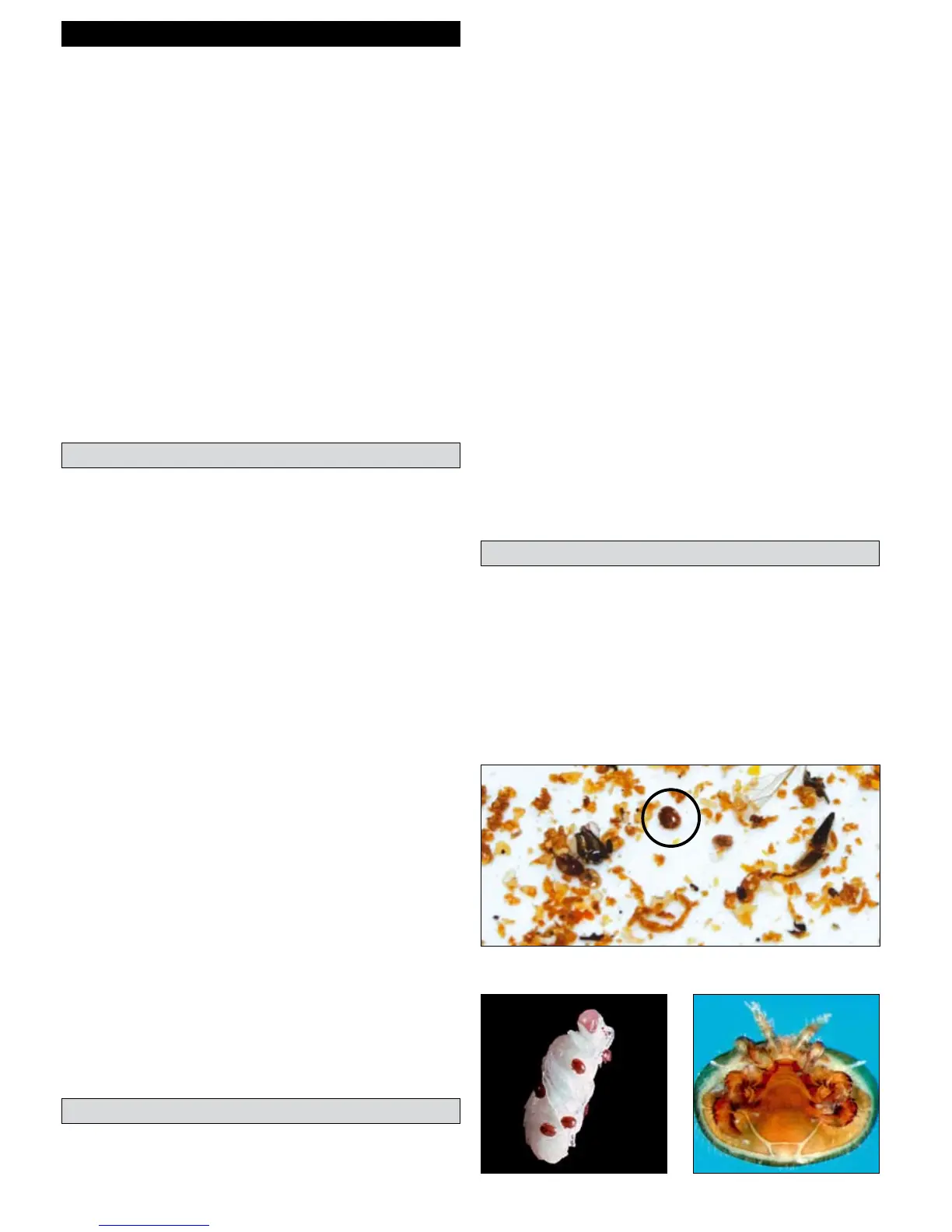
A female varroa mite is visible with the human eye. They are dark brown
and have a hard, shiny, domed exoskeleton. The picture below shows an
adult female varroa mite. Nasty looking thing, isn’t it? You will see them
on the inspection tray and if your bees are heavily infested you can also
spot them on adult bees.
A varroa mite that has fallen onto the inspection tray. They look like a shiny
miniature crab. Note the bee’s leg to the right for scale. The other ‘crumbs’ in the
picture are bits of pollen and wax that have fallen through the mesh.
A lava covered with varoa mites.
The underside of a varoa mite.
Varroa



 To Next Page