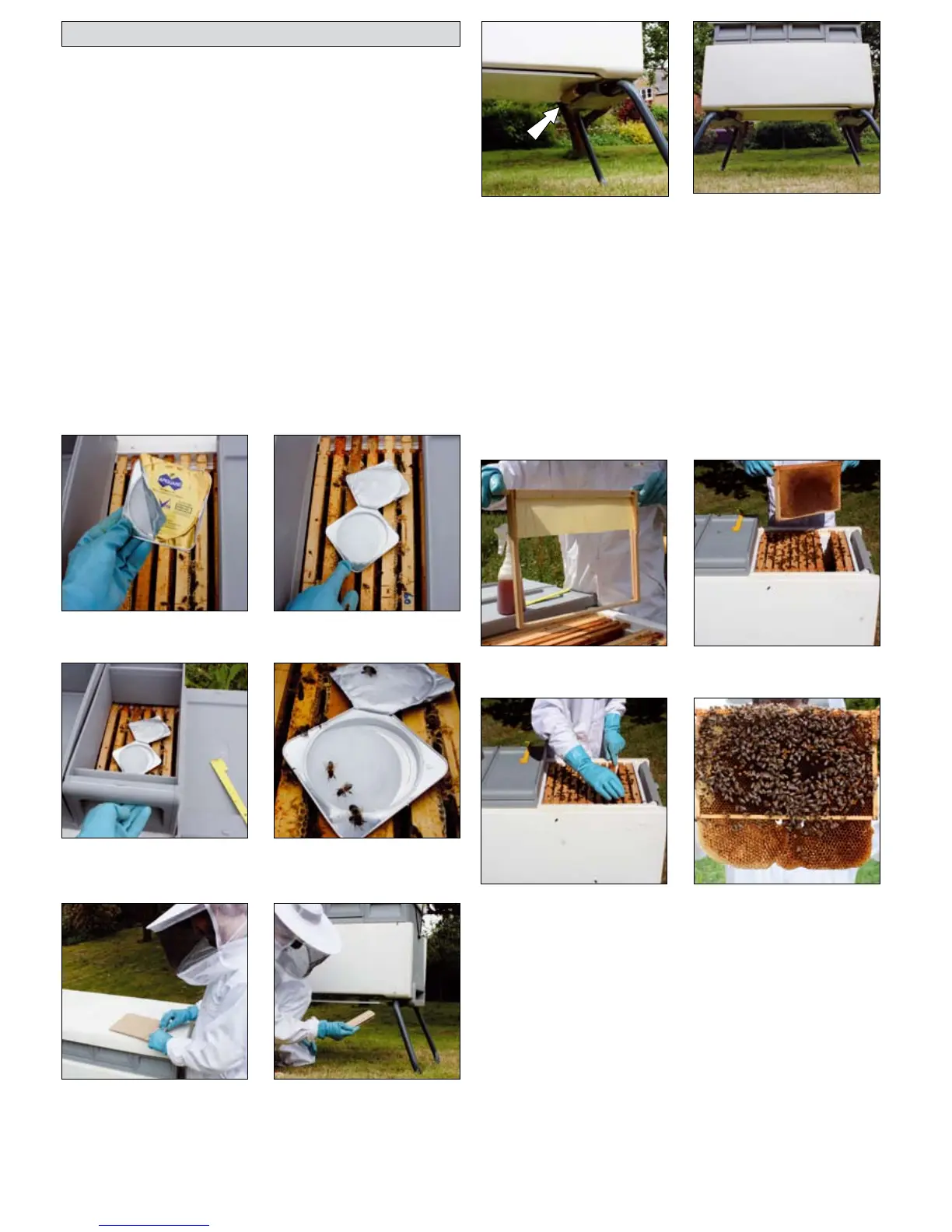
The cardboard holds the tray
up securely
The inspection tray now in place and
ready for a varroa treatment
Roll up a piece of cardboard Wedge the cardboard between the
tray and the ledge underneath at
both ends of the beehaus.
Put a super over the top so the bees
can access the apiguard.
Remove a cover board above
the brood.
The bees pass the apiguard around
the hive by contact.
Place the varroa tray on the frames.
Treating Varroa
At the moment, there is no treatment proven to completely eradicate
the varroa mite. Beekeepers need to use a combination of treatments to
keep the level of the mite down to an acceptable level. The reproductive
rate of the mite means that the population can double every four weeks
through the summer so even if the mite level is just 200 mites in April, this
will have increased beyond 1000 mites by the end of June.
There are two ways to kill varroa: chemical and mechanical. The best
practice is to use both.
Chemical Control
Chemicals that kill mites are called varroacides. These are applied in feed,
directly on adult bees, as fumigants, contact strips or by evaporation.
Apiguard
The most common and currently most effective varroacide is called
Apiguard. This is a slow release gel, whose active ingredient is thymol
derived from Thyme. It’s used in Spring or late Summer after the honey
harvest, and is very easy to use. To use, place the tray on top of the brood
frames, where the heat from the brood will evaporate it. The bees will
also spread it by contact with and by eating the gel. Because it works
by evaporation it’s very important to close the mesh floor, which you
can do by taping the inspection tray up against the Beehaus, as in the
photograph. After 2 weeks you remove the first tray and put a second
one on.
Varroa treatment
Mechanical Control
The mite population can also be reduced through physical means alone.
Many of the most popular and effective methods involve trapping the
mites in combs of brood, which are then removed and destroyed.
Culling drone brood
Add one shallow frame containing only a starter strip of foundation at the
front of the brood nest. Bees will draw drone cells both in the frame and
under the bottom bar. Remove 21 days later (max 23 days) and cut out all
the sealed drone brood. Uncap 100 drone cells as a check on effectiveness.
If the frame contains areas of uncapped drone brood, consider replacing
the cut frame for a further week to allow more larvae to be sealed. The
cut drone brood can be fed to birds or chickens or simply destroyed. The
wax can be melted for re-use.
Divide the colony for swarm control
When you perform an artificial swarm, you neatly divide the colony by
moving all the frames with brood into one half of the Beehaus leaving
the other half without any brood. The broodless half can then be treated
for varroa as any mites will be on the adult bees. Then, to complete the
process, the other colony is treated when all the brood has hatched and
before the new queen will have had a chance to lay. This technique is
covered in detail in the section on swarm control on Page 42.
Open mesh floor
The open mesh floor on the Beehaus is a useful all year round way of
ensuring that any mites that are knocked off the adult bees fall out of the
hive and can’t get back in.
Adding a brood frame with only a
starter strip of foundation.
A frame for drone brood should be
placed at the edge of the brood nest.
A shallow frame can also be used to
encourage drone cells.
Drone cells have been built under
the frames. Once they are capped
they must be removed.



 To Next Page