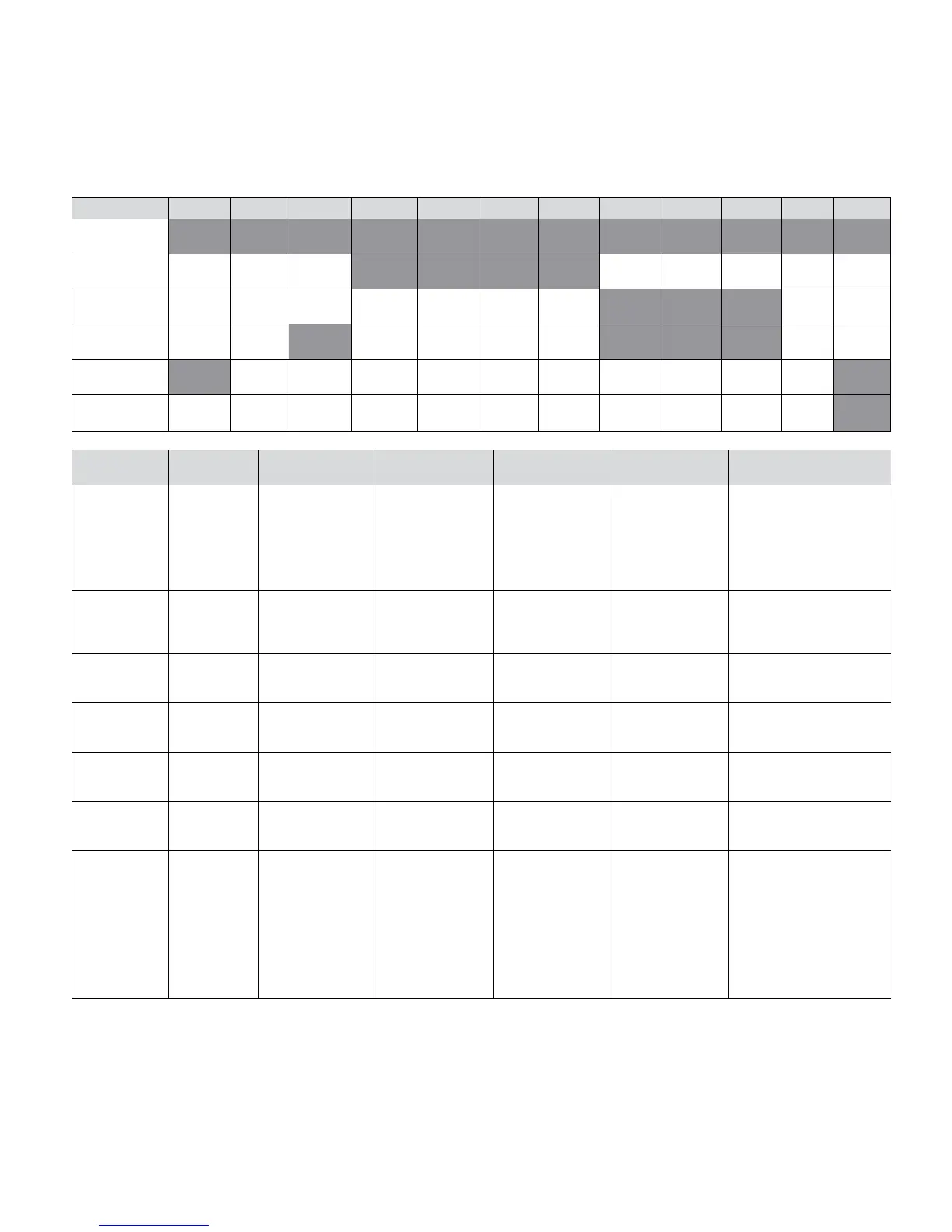
Name Authorised Active ingredient
(a.i)
How applied How spread within
the bee colony
When normally
applied
Significant features
Apiguard®
(Vita Europe)
UK thymol
(terpene)
Slow release gel
matrix (25% a.i.);
two 50g pack
treatments with
10-15 day interval
Evaporation,
contact, ingestion
Spring or late
Summer after
honey harvest for
4-6 weeks
90-95% efficacy with
optimum conditions; de-
pends on temperature and
bee activity. When using,
ensure varroa mesh floors
are closed and vents in
crownboards are covered
Apilife-VAR®
(LAIF)
Not UK thymol, eucalyptol,
menthol, camphor
Vermiculite carrier
matrix
Evaporation Autumn for
8 weeks
Temperature dependent;
high efficacy up to 70-90%
but some variability; Easy
to apply
Apivar®
(Biove)
Not UK amitraz Plastic strips hung
between brood
combs
Contact / systemic Autumn or Spring /
early Summer for 6
weeks
Highly effective; can be
used during honey flow
Exomite Apis®
(Exosect)
Not UK thymol in
electrostatically
charged powder
Powder in
application tray
at hive entrance
Contact Spring or Autumn
after honey
harvest for 24days
Efficacy not fully evaluated
Perizin®
(Bayer)
Not UK coumaphos
(organophosphate)
Solution trickled
over bees
Contact / systemic Late Autumn /
Winter and
broodless periods
Ideally needs broodless
conditions
Lactic acid
(generic)
Not UK
(Note 2)
lactic acid solution Acid solution
sprayed over
combs of bees
Contact Winter and
broodless periods
Ideally needs broodless
conditions; causes skin
burns; respiratory irritant
Oxalic acid
(generic)
Not UK
(Note 2)
oxalic acid solution 3.2-4.2% acid
solution in 60%
sucrose trickled
over combs of
bees;2.5ml per
brood comb
Contact (not
ingestion, despite
sugar presence).
Sublimation
Winter and
broodless periods
Ideally needs broodless
conditions; 90% average
efficacy possible; sugarless
solutions have poor ef-
ficacy; danger of significant
colony weakening; more
scientific trials needed;
highly toxic by inhalation,
ingestion or skin
absorption
Control Jan Feb Mar Apr May Jun Jul Aug Sep Oct Nov Dec
Open Mesh
floor
Drone brood
removal
Apiguard®
Exomite Apis
Lactic Acid
Oxalic Acid
Summary of Varroa control methods and when to use them
The best approach to varroa control is a combination of chemical and
mechanical measures. No varroacide should be applied for varroa control
during the honey harvest period, as the quality of honey may be affected.
In spring, mechanical measures, such as the cutting out of the drone brood,
or artificial swarming can be used. These operations reduce the Varroa
population approximately by a half or a third, so a chemical treatment is
also always required.
There are several other varroacides which are used in Europe and they are
given along with Apiguard which is licensed for use in the UK in the table
below. The licensing situation may change as more research and evidence
about their safety and effectiveness is carried out. For an up to date list,
please visit the National Bee Unit’s website. For full instructions on how to
use chemical treatments on your colony, please refer to the manufacturers
guidelines.
Table of varroa control methods and when to use them.
Note 2 - Not authorised in any EU Member State, but tolerated in many countries.
Contact the Defra Veterinary Medicines Directorate for up-to-date information on which varroacides are authorised for use in the UK.



 To Next Page