A colony of honey bees is made up of 1 queen bee several hundred male
bees called drones and thousands of female worker bees.
The Queen - 1 per colony.
Lives up to 4 years.
The queen bee is head of the entire
colony. Her character determines
the behaviour and mood of all
the bees in the hive. She achieves
this remarkable level of control by
producing pheromones which, to
the worker bees, must be like the
Lynx effect and Chanel No. 5 rolled
into one. They pass these complex
scents around the hive by touch.
Within 30 minutes all the bees in
the hive are aware of any change in
the queen.
As the queen grows old she produces less pheromones and this is the
trigger for the bees to produce a new queen. They will also do this if she
is accidentally lost or killed by the beekeeper.
Brood
As well as managing her subjects, the queen is also responsible for giving
birth to them. A queen honeybee only needs to mate once in her life
and she does this a few days after she hatches. On a warm sunny day she
leaves the hive escorted by some of her workers to minimise the chance
of her getting lost or eaten by a bird. The queen flies high and fast so that
only the very fittest drones have the chance of mating with her. She may
be mated by one or several drones and then returns to the hive where
she is greeted back by the colony. The fully mature queen is now capable
of laying up to 2000 eggs per day, which would take a chicken 6 years to
produce.
However for all her skills, she is a terrible mother, having completely lost
any instinct to care for her young and the queen therefore relies on the
female worker bees to raise her young. Beekeepers refer to the eggs and
larvae collectively as brood.
The queen is physically quite different from the other bees in the hive.
She is long and slender, with a much smoother, less hairy body. Her
abdomen is quite pointy and her head is proportionally small. Despite this
she can be difficult to spot in amongst 50,000 other fast moving bees and
so it’s normal to mark her with a small bright dot of paint. This technique
is described later in the guide. The queen does have a sting but she only
ever uses it against a rival queen.
A marked queen surrounded by workers.
Queens, worker and drones
The next part of this guide will give you a good understanding of the
biology of honeybees, their organisation within the hive and in particular
the life cycle of the colony so that, with a little well-timed help, you can
ensure it not only survives, but prospers.
About honey bees
Honey bee anatomy
The head - The head contains the eyes, mouth and antennae, which
are used for communicating. Bees have very highly developed senses.
They have a sophisticated tongue to taste the quality of nectar and will
automatically choose the nectar with the highest sugar content. They can
see colour and have excellent ‘noses’ for smelling.
Their compound eyes only see detail up close but they can also see in slow
motion. Unlike humans their eyes are tuned into the ultraviolet end of
the spectrum, so they see many more shades of blue than we do whereas
reds look black to bees. Perhaps not surprisingly, scientists have found
that flowers of all colours that attract bees have petals which strongly
reflect ultraviolet light. For example a flower that just looks yellow to us,
appears to have a very distinctive pattern to a bee. In a field with many
colourful flowers, the ultraviolet patterns help a fast flying bee pick out
those that will provide pollen and nectar. In this way the bee is more
efficient when foraging.
Flowers also have particular odours, which even the crude human nose is
able to appreciate. Bees of course have a much more sophisticated sense
of smell. Instead of a nose, they have many thousand sensor cells in their
antennae. It has been shown that bees will actually use this sense of smell
to lead them to flowers. They also use smell to recognise the queen and
the other bees in their hive, who all have the same odour. The antennae
are used to assess temperature and to communicate messages by touch.
Bees who damage their antennae are severely handicapped, and can
perform far fewer duties inside and outside the hive.
The Thorax - The thorax consists of 3 segments each bearing a pair of
legs. The second and third segments also have a pair of wings. The wings
move at an amazing 11,000 beats per minute and give the bee a top
speed of 12 miles per hour (which explains why it’s not easy to outrun a
bee). The thorax is covered in hairs which are long and feathered in the
worker for collecting pollen. The drones have shorter hairs and the Queen
very few.
The Abdomen - The abdomen contains the bee’s digestive system, honey
sac and, in the females, the reproductive organs and sting. The honey sac
can hold approximately 0.25ml - so it takes a lot of flights (approximately
20,000) to create a single jar of honey.
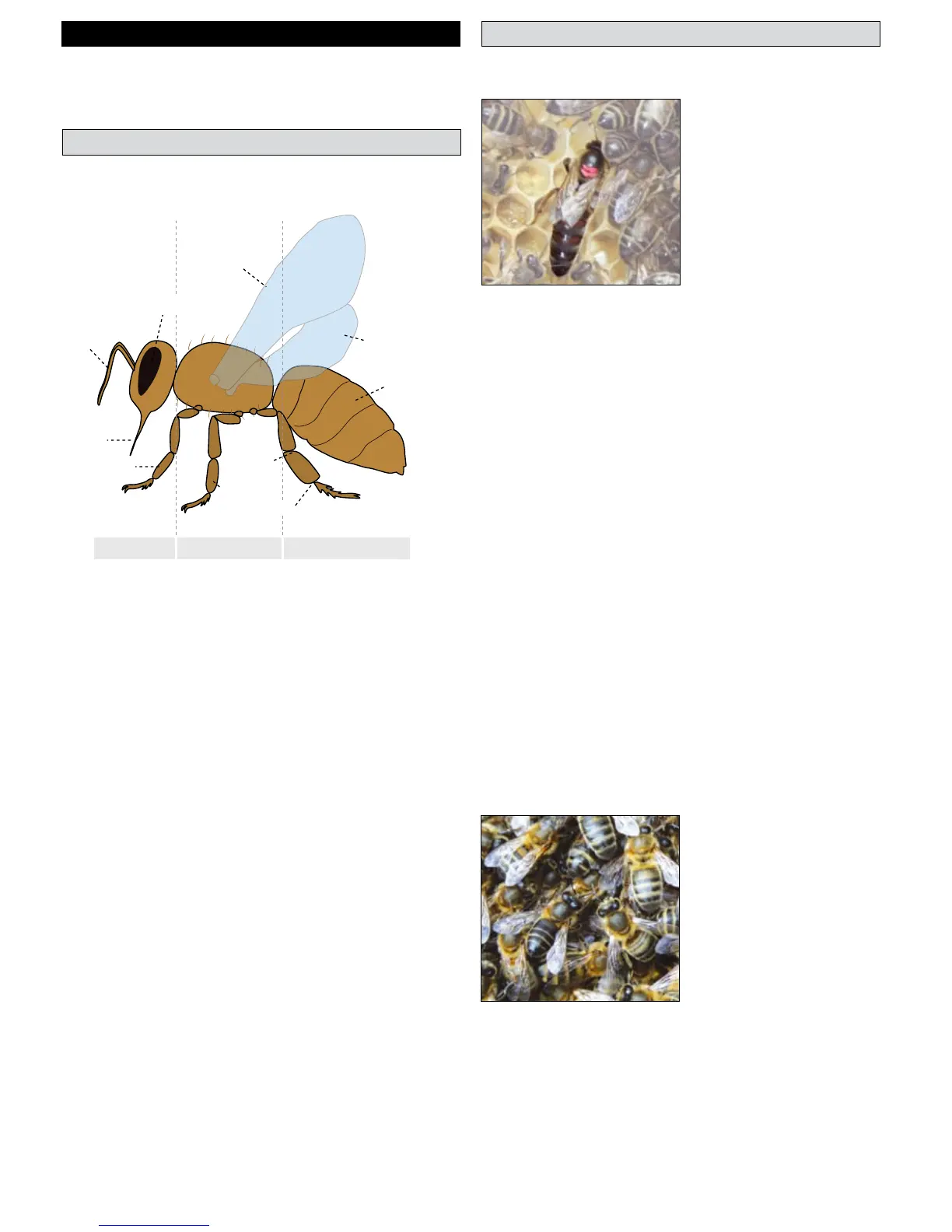
All bees are made up of three distinct parts, the head, thorax and
abdomen. Like most insects, the bee has a strong exoskeleton (a skeleton
on the outside of its body). Here are the main parts of a bee.
The workers – 10,000-60,000 per colony
Live for 36 days in the summer
Live for 5- 6 months over winter
Although the queen may be the
single most important bee in the
colony, it is the collective force
of the worker bees which make
it such a successful species. Every
single worker bee born in the hive
follows a strictly laid path from
the moment it hatches to the day
when it makes its final flight for
honey. Worker bees are all female
and those born in the spring and
summer will live for only 36 days.
They begin their working lives
inside the hive providing food for
larvae, drones and the Queen. Next they build the wax honeycomb that
forms the hives integral structure. As they get older they clean, heat,
ventilate, defend and repair the hive. Finally with just 7-10 days of life
left they graduate to become flying bees. After taking a few short
orienteering flights to establish the exact position of the hive they leave
to search up to 3 miles away for nectar and pollen. A single bee can make
up to 3000 flights a day and most will die away from the hive, on the
wing, with one last belly full of honey.
Female worker bees.



 To Next Page