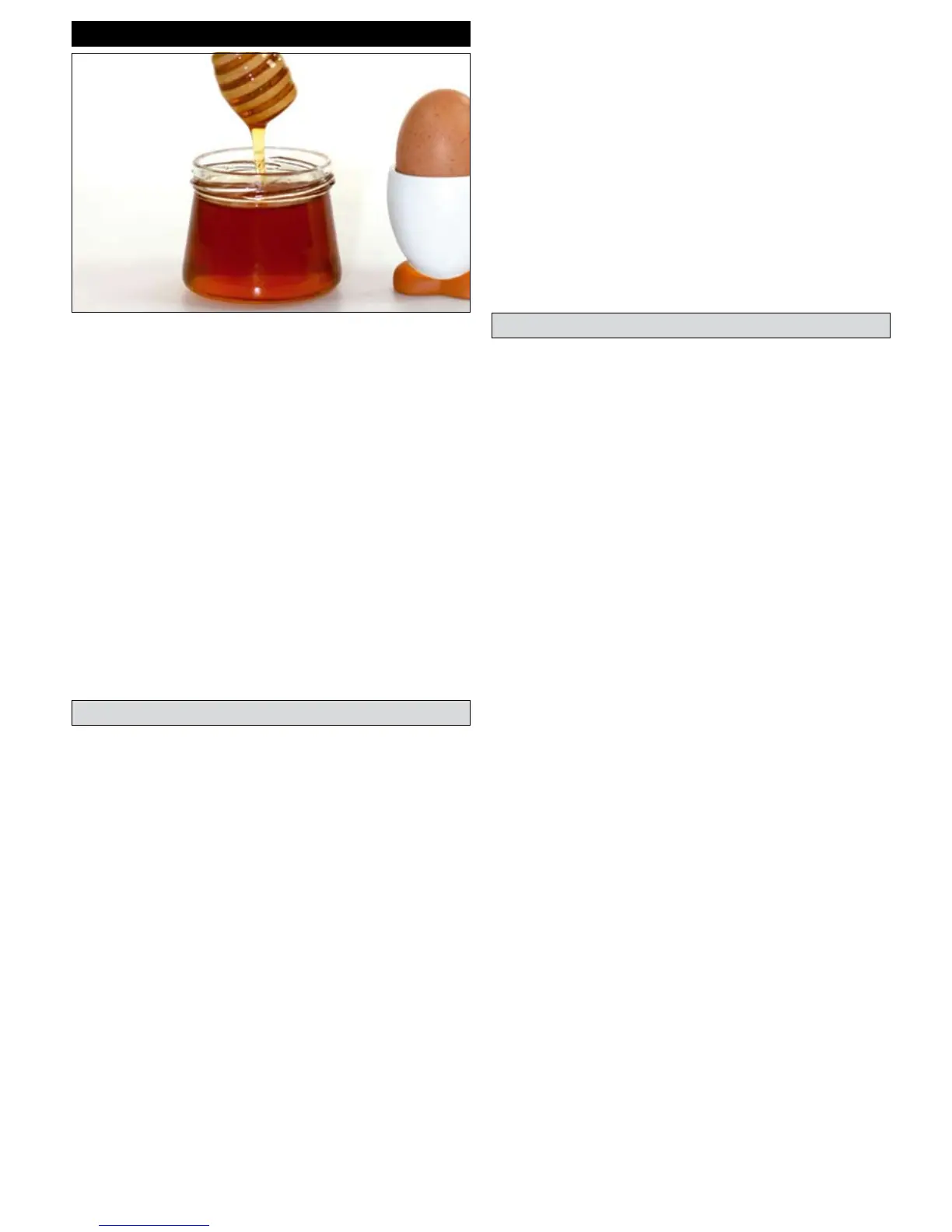
Have you ever wondered how a tiny little insect like a bee could ever fill
a jar of honey? If it were just down to one bee it would be a mighty task
but the work is shared by many thousands of bees and is a great example
of what can be achieved by a co-ordinated effort. Think of it in terms of
humans creating something like a pyramid.
A jar of honey weighs 454g and a bee can carry about 0.04g of nectar.
But nectar is only about 40% sugar and honey needs to be about 80%
sugar so the bee actually only carries about 0.02g of honey on each trip.
So how many bees would we need to fill a jar of honey? The answer is 454
/ 0.02g which equals =
22,700 bee trips are required to fill a single jar of honey.
This sounds impressive enough but of course a colony of bees doesn’t just
make one jar of honey. Over the year the queen will produce between
100,000 and 200,000 bees that will each spend between 10 and 20 days
collecting nectar. At its most productive a single colony of bees could
theoretically produce around 800kg of honey, that’s almost a tonne!
The reason that beehives aren’t the size of warehouses to accommodate
all this honey is that it is being continually used up by the bees as fuel,
primarily to keep the brood warm. So at any given time there may only be
between 10 and 20kg of honey in the hive.
Honey
Harvesting your honey
There is no rule for when you can and can’t collect honey provided that
the bees have enough stores for themselves. As the flavour of the honey
the bees store varies throughout the year it’s interesting to taste the
difference yourself and to try to figure out which flowers contributed to
it. If the bees haven’t filled a whole super you can collect a single frame.
Choose a frame which has been completely capped or if not all the honey
is capped then you can do a simple test to see if it’s ok to take. Shake the
frame over the hive, if liquid spills out then the honey is not yet ‘ripe’ and
should be left in. If the liquid is too thick to shake out then the honey can
be harvested. If you were to collect unripe honey it would ferment and
go off. To remove any bees from the frame either brush off using a bee
brush or shake off and then quickly put the frame in a bee proof bag.
Clearing bees from a super
Collecting a whole super full of honey is made a lot easier by the clearer
boards. These handy devices fit underneath the supers and have a one
way valve fitted so that bees leaving the super can’t find their way back
in. They should be put on the day before collecting and usually 24hrs is
sufficient time for all the bees to have cleared the super so that it can be
collected.
A good tip if clearing more than one super at once, ie a super stacked on
another super with a clearer board at the bottom, is to separate them
first to to expose any brace comb. The bees will clean up any spilt honey
from the brace comb leaving the frames clean when you come to remove
them.
What can go wrong with collecting honey from the supers?
If you forgot to put the queen excluders on and the queen has been
allowed to lay in the super frames then you must first wait for the brood
to hatch before using the clearer boards as the bees won’t leave the
brood. You should put the queen excluders in place to prevent any more
eggs being laid. Once the bees have hatched you can remove the supers
and extract the honey.
Any spilt honey around the hive can attract other bees and wasps who are
after a free lunch, they will soon find the spilt honey and then also try to
take honey from inside the hive. Be really careful not to drip honey from
frames. It’s also best to collect the honey in the evening when the bees
are no longer flying to reduce the chance of other bees or wasps being
attracted to the honey which can start robbing. Remember wasps fly
later than bees and can be a real nuisance . You should use the entrance
adapter placed in the wasp position in the beehaus from August onwards
to prevent robbing.
It’s a good idea to put a new super with frames underneath the clearer
board if you are collecting supers early in the season. At this time of year
the colony is large and removing supers can cause congestion in the hive
which can lead to swarming.
Extracting your honey
The easiest way to harvest your honey is by hand. You can buy extractors
which work by spinning the honey out of the frames but this is probably
only worth investing in if you have more than 5 beehives.
The basic principle of harvesting honey by hand is to scrape the honey off
the frames and then filter it to remove the wax. How much you filter it
will depend on whether you want to remove all the wax or just a bit.
Equipment
You should be able to find all the equipment you need in your kitchen.
However, one bit of kit worth investing in is a proper honey strainer that
you can buy from the Omlet shop.
Essential equipment
• 2 Large bowls or big baking trays
• A knife
• A large sieve
• A table spoon
• A large spoon or spatula
Option extras
• A piece of muslin or cheese cloth
• A deep bucket with a honey gate
Before you start make sure your windows are shut to prevent any
unwanted insects stealing your honey. Also, it’s a good idea to put
newspaper on the floor and make sure dogs and cats can’t get into the
area you’re working. Even if you’re really careful some honey will drip
and it’s sticky stuff to get off again.
Step 1 - Take each frame in turn and place it in a bowl. If the foundation
you used wasn’t wired then you can just cut the comb out completely by
running the knife around the edge. if the foundation was wired, scrape
off the honey using the spoon down to the foundation. In these photos,
the foundation was wired. Place the empty frames into the second bowl/
baking tray so that any honey left can run off.
If the bees have stored some pollen in the supers then you can avoid these
cells or if you’re not fussy add the pollen to the honey. it’s actually good if
you’re a hay fever sufferer to eat this pollen as it desensitizes you to it.
Step 2 - Repeat for all the super frames you are harvesting and then crush
the collected honey and wax using a large spoon to break down all the
wax cells so that the honey inside can flow out.
Step 3 - Strain this wax and honey mixture through a sieve or you can
stretch a piece of cloth over a large bowl, even a clean tea towel or pair
of nylon stockings will do the job. Then leave covered overnight to
allow gravity to do the work. The next day the honey will have drained
from the wax, you’ll be amazed at just how effective this is. If you used
a sieve to drain the honey and you then decide you’d like to strain it
some more then you can do this now through a piece of muslin or some
nylon stockings.
Step 4 - The honey that has filtered through can now be bottled or put
into sterilised jars. Honey absorbs moisture from the air so it’s important
that the jars have a good fitting lid.



 To Next Page