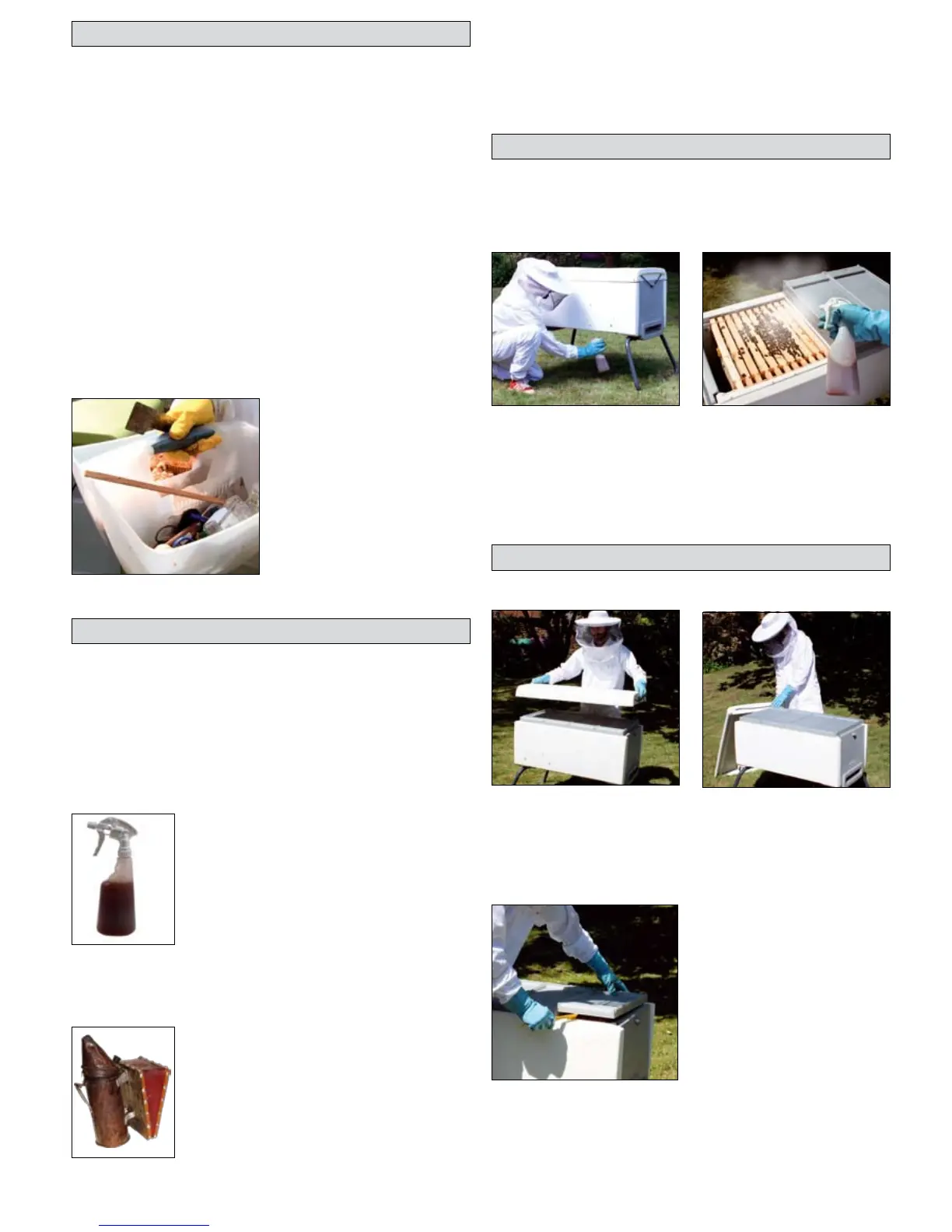
Preparing your equipment before inspecting your hive is always a good
idea. Firstly, you should make sure you have all the tools and equipment
together that you need for the inspection. The list will depend on what
you are about to do but as a minimum you will need:
Essential Items:
•Protectiveclothing(beesuitandgloves)
•Hivetool.
•Smoker(liquidorame)
•Recordbook
Additional items: (Depending on the purpose of the inspection)
•Beebrushorgoosefeather.
•ExtraFrames.
•Supers.
•QueenExcluders.
•ClearerBoards.
•Feed(eitherliquidorsolid).
•Queencatchingapparatus.
•Queenmarkingcageandpaint.
•Medicationsfortreatinganyhealthproblems.
Its worth having a box to keep all your equipment together.
Preparing your equipment
A toolbox to keep all your beekeeping
kit is really useful.
Temperament
Not every colony reacts the same to being inspected. Some are very docile
and will hardly need smoking at all, some will benefit from being smoked
through the mesh and then by lifting one corner under the cover board
and giving a few more puffs of smoke a few minutes before the hive is
fully opened.
How to use a smoker
You should puff a little smoke through the mesh floor of the hive about 3
minutes before you open it. It’s very important to wait to give the bees a
chance to fill themselves with honey so they are calm when you open the
hive. Once inside the hive - you should smoke a little on the tops of the
frames as you inspect the colony if the bees start coming up.
Puffing smoke through the mesh floor. Puffing smoke onto the frames.
Bees have a natural reaction when they smell smoke which you can use
as a simple, effective way of calming them while you inspect them. The
smell of smoke makes the bees think that the colony is in danger and they
instinctively react by eating as much honey as possible. Honey is their
most precious resource and if they had to evacuate, would mean they had
time to find a new place to live. Eating all this honey has a side effect of
making them quite docile and lethargic, a bit like when you have a big
Sunday lunch. The smoke has no long term effect on the bees.
Smoking your bees
There are two main types of smoker:
Liquid Smoke - This is made by condensing the
smoke given off by wood as it smoulders. It is
completely natural and will not harm you or your
bees. It should be diluted at a ratio of 1 part liquid
smoke to 15 parts water. It should be used with a
plant mister which produces a fine spray.
The advantages of liquid smoke over a traditional
smoker are:
•Requiresnolighting.
•Cannotgooutjustwhenyouneedit.
•Nodangerofburningyourselforyourbees.
•Economical.
Liquid smoke.
Traditional Smokers - A traditional smoker is
simply a metal container with bellows attached in
which you light a small fire. The aim is to get the fuel
to burn badly - producing lots of thick cool smoke.
You can use a variety of materials such a old hessian
sacking, dried leaves, cardboard or tightly packed
dry grass. It is important that the smoke is cool and
does not burn the bees.
Mastering the traditional smoker is perhaps the hardest part of
beekeeping and you should practise starting and keeping it alight. If you
are using a traditional smoker, you should light it before putting on your
veil (there have been instances of beekeepers peering into the smoker
to see if it’s alight only to find that it is, when the mesh of their veil has
caught fire!).
Traditional smoker.
Place lid to one side.
Do not cover entrance.
Opening your Beehaus should be done delicately and gently. You should
move more slowly than normal and avoid sudden movements.
Taking the lid off.
Opening your Beehaus
When you take the roof off, place it to one side, don’t put it in front
of the hive entrance, as anything in the path of returning bees will
annoy them.
Looking out for the queen
Once the cover board is removed,
check it to make sure that the queen
is not on it. Although this is unlikely,
if she is then you should return her
to the hive. The best way to do this
is to walk her back into the hive
by guiding her in with your finger.
Alternatively let her walk up onto
your hive tool by placing it in her
path. Once on the tool, you can
then return her, ideally to a brood
frame. Most likely she will quickly
scuttle between the frames. Take
great care doing this as any damage
to the queen’s legs can severely
impair her ability to lay eggs. You should also make sure that you never
touch her abdomen.
At this point you may need to apply a little smoke to the top of the
frames as bees make their way back up to see what’s happening. You may
You can use the hive tool to lift
the cover board.



 To Next Page