Feeding your bees
What to feed your bees?
When to feed?
Feeding a nucleus colony or swarm - Syrup
If you have purchased a nucleus colony or have caught a swarm of bees
you can help them get established by feeding them syrup. This helps the
bees draw out frames of foundation so that the queen can start laying.
You should use syrup as this is most quickly converted by the bees. You can
feed up to 8kg of syrup but most nucleus colonies will be well established
by the time they have taken around 5kg of syrup.
There are two main types of feed for your bees – sugar syrup or fondant.
The sugar syrup is easier and faster for the bees to handle than fondant.
However, you should never use syrup when there is a chance of it freezing.
As a general rule, you should feed your bees sugar syrup in the autumn
and spring. At other times, you can use fondant.
Making your own or pre-prepared?
You can make your own sugar syrup by melting refined caster sugar in
water. There are instructions on the quantities and how to do this on
Page 38. You can also buy fondant from bakers.
However, the best feed to give your bees is specially made syrup or
fondant that has the same composition as nectar - the bees natural food.
Pre-prepared bee food is composed exclusively of sucrose, fructose and
glucose in the right ratio and is very easily digested by the bees.
Another advantage of pre-prepared syrup is that the high fructose content
prevents the feed from crystalising in the comb, even at low temperatures.
Bees find crystallised feed much harder to consume over winter when they
can’t collect water to dilute it and this can be a cause of them starving.
The pre-prepared syrup remains liquid in the cells throughout the winter
and can be instantly eaten by the bees.
Feeding your bees is a vital part of beekeeping. You may need to feed
them at any point in the year when their supply of food is low.
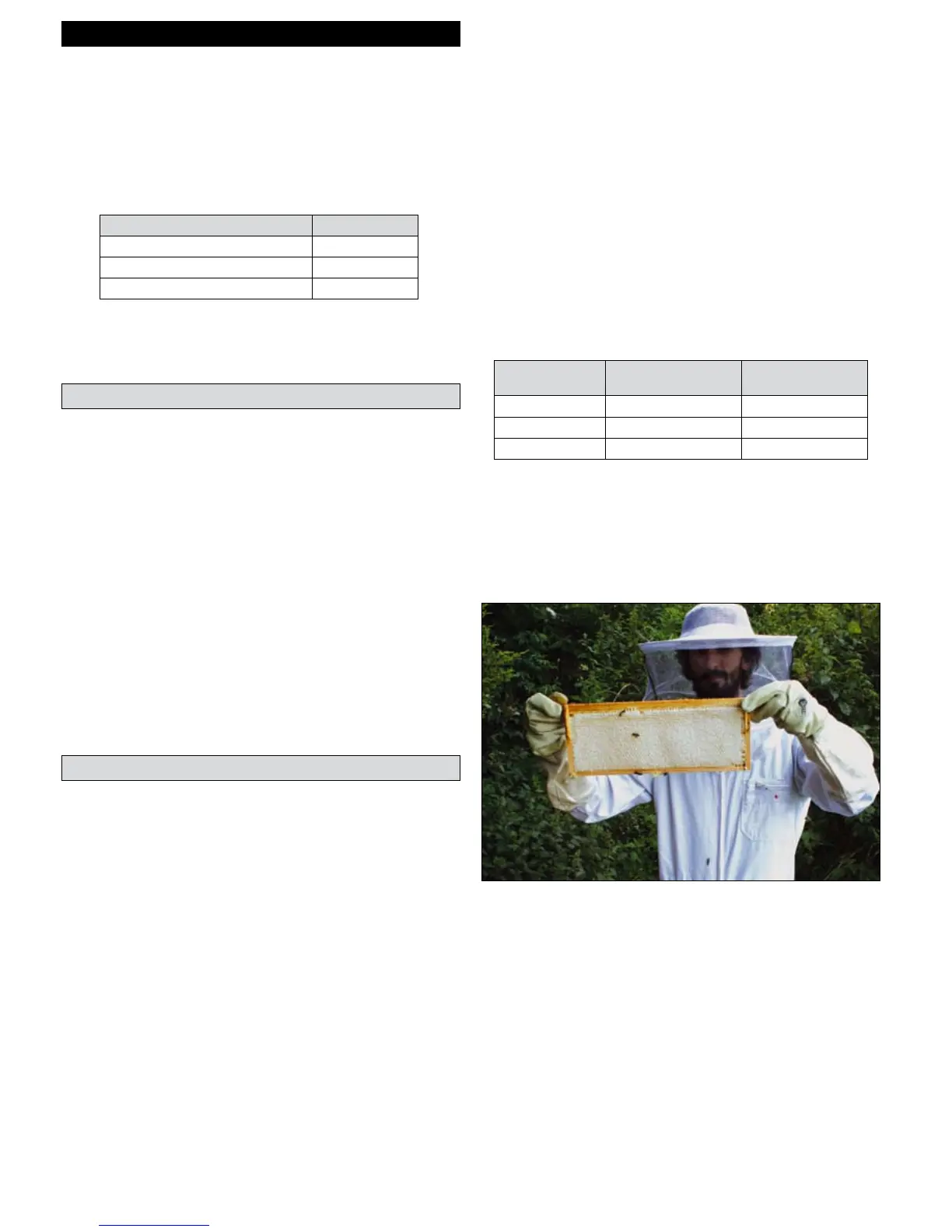
When you inspect your bees, you can make a good estimation of how
much honey they have stored by looking at the frames. Note down the
rough percentage of honey in each of the frames. You can then use the
chart below to estimate the amount of honey that they have. Note: The
Beehaus comes with standard Super frames and Deep National brood
frames. However, we have included the weights for the Standard National
frames which you might have purchased with a nucleus brood colony.
FRAME SIZE HONEY WEIGHT
Super Frame 1kg
Standard National Brood Frame 2kg
Beehaus Brood Frame 3.5kg
Typically there are four main times of the year when you may need to
feed your bees.
1. Spring Feeding - Syrup
After the winter, the bees supply of honey may be running low. The
bees will have eaten most of their stores and there will only be a small
number of flying bees in the colony to collect the early spring nectar.
Added to this, if the spring is late or very wet the bees can quickly starve.
To avoid this you can feed your bees. You can also feed your bees in
the spring to encourage the queen to start laying quickly. The amount
you feed will depend on the weather and how strong the colony is. As
a minimum, feed 2.5kg of syrup. The more you feed, the faster your
colony will grow.
2. Summer Feeding - Syrup or Fondant
It might seem unusual to need to feed your bees in the height of summer,
but sometimes it is necessary. If the summer is wet and cold, your bees
can run out of nectar sources and might well starve. There is something
called the ‘June gap’ – in many areas there is a gap in the supply of nectar
in June. If you have taken honey off after the spring flow, your bees may
run out.
A full colony needs about 10kg of honey per week so by adding up what’s
on the frames you can tell if your bees are running short. If they are, you
can either give them some of their honey back if you haven’t extracted it
or feed them some sugar syrup.
3. Autumn Feeding - Syrup
This is the primary feeding time of the beekeeping year. At the end of
the season you need to ensure that your bees have enough food to last
the winter. The amount of stores the bees need will depend on the breed
of bee. The chart below shows the estimated amount of stores that your
bees need in the summer and winter.
Your bees will over winter on 9 brood frames and you should aim to
have all the stores in these brood frames. You should not leave supers
on over winter. Once you have taken the honey off in August, you should
immediately start to feed your bees with syrup until they have stored
enough in the brood frames to see them through the winter.
If you start feeding too late, then the bees might not have time to
evaporate excess water from the syrup and it could be stored uncapped
and ferment. This would cause the bees digestive problems.
4. Winter Feeding - Fondant
If your bees run low of supplies in January you can feed them emergency
rations of fondant to keep them going. You should add a 2.5kg block
of fondant directly above the bees on a clearer board without the
bee escape.
TYPE OF BEE WINTER
(HONEY OR SYRUP)
SUMMER
(HONEY OR SYRUP)
Italian Bees 30kg 10Kg
Carniolan Bees 20kg 10Kg
British Black Bees 20kg 10Kg
Once you know roughly how much honey the bees have stored, you can
then make a decision about how much to feed them and this will depend
on what time of year it is.
A full Super frame - contains about 1kg of honey.



 To Next Page