3 Weeks Later - You should inspect your colony once a week. However,
three weeks after the original separation all the sealed brood in the
frames that were moved to the rear of the hive will have now hatched,
and these can be treated for varroa using the icing sugar method.
4 Weeks Later - A virgin queen should emerge from her cell after about
four weeks. She will have flown from the entrance to mate and come into
lay. You can check for a compact patch of brood one month after the
original division and, if satisfactory, the rear brood combs are re-united to
the main stock by simply removing the division board and the new queen
is moved to the front to head the colony. The old queen is removed if seen
– although in natural supersedure the mother and daughter queens lay
alongside each other for a time. You should leave the rear entrance open
as some bees will still be using it.
6 Weeks Later - All the bees should be using the front entrance and you
should close the rear entrance.
What can go wrong?
The new queen may fail to mate satisfactorily in a cold spring. If so, she
is removed, and a frame with eggs transferred from the ‘swarm’ into the
‘parent’. The process re-starts, with queen cells being raised this time
under the ‘emergency’ impulse as the parent is now queenless.
If you are lucky enough to see or hear about a swarm of bees, you can
attempt to catch it. If you are a new beekeeper and have not kept bees
before, it is not recommended that you start out with a swarm because
you will not know the health or temperament of the bees. That said, only
a small number of swarms survive in the wild and by catching and hiving
a swarm you are helping the bees.
What is a swarm like?
A swarm is like a large cloud of bees moving through the sky. The
bees will often leave their hive on a bright, sunny day before midday
and take about 20 minutes to settle near by. The swarm will first
cluster within about 10 meters of the original colony. They will often
move in the direction from the hive that the bees most often fly. They
normally settle on a branch or a tree, wall or sometimes deep in the
bushes. However, most will be easily visible as the bees need to fly to and
fro easily.
The swarm starts when scouts drive the bees from the hive and the queen
follows. The bees then cluster and the queen joins it – if the queen fails
to do so, the cluster breaks up after about 20 minutes and the bees return
to the hive.
Once the swarm cluster has settled down, the scouts search for a suitable
site for the new nest. The bees
need a dry cavity protected from
the weather, large enough for the
combs to house the larvae and the
stores of honey and pollen (40 to
100 litres), with an entrance small
enough to be defended. The bees
are said to prefer the entrance to
face south – perhaps because the
dark hole shows up more strongly
in sunlight.
What is the cluster like?
A cluster can range from the size of
a pint glass to that of a rugby ball.
Most swarms are quite calm – they
have eaten enough honey to survive for three days. Amazingly, most
swarm clusters are hollow. The bees make a wall around an empty space
where the queen can move about. If the cluster remains for some time,
the bees will actually build combs inside the cluster and the queen starts
to lay. If you look closely at the cluster you can see dark patches which
indicate passages for returning bees to go inside. Returning scout bees
can be seen arriving and going in. Scout bees dance on the surface of
the cluster to report finding a possible new home. When the bees have
decided which scout to follow, the cluster will take to the air and is then
lost to the beekeeper.
A swarm of bees in a tree.
Wild swarms
Step 5 - As you do this, you should move the first 11 frames including the
original nine brood combs that the bees will have stayed over winter on,
to the far end of the hive.
Step 6 - When you come to the last three frames, return them so that they
are right at the front of the Beehaus (these were added earlier in the year
as foundation frames and now contain new drawn comb) and move them
so they are up against the front of the hive (i.e. nearest to the entrance).
A diagram of the colony showing the Beehaus after the swarm control.
Step 7 - Add a further six empty frames behind (ideally three drawn plus
three foundation frames), on which the bees will develop a new brood
nest. The Beehaus will now be completely full of frames.
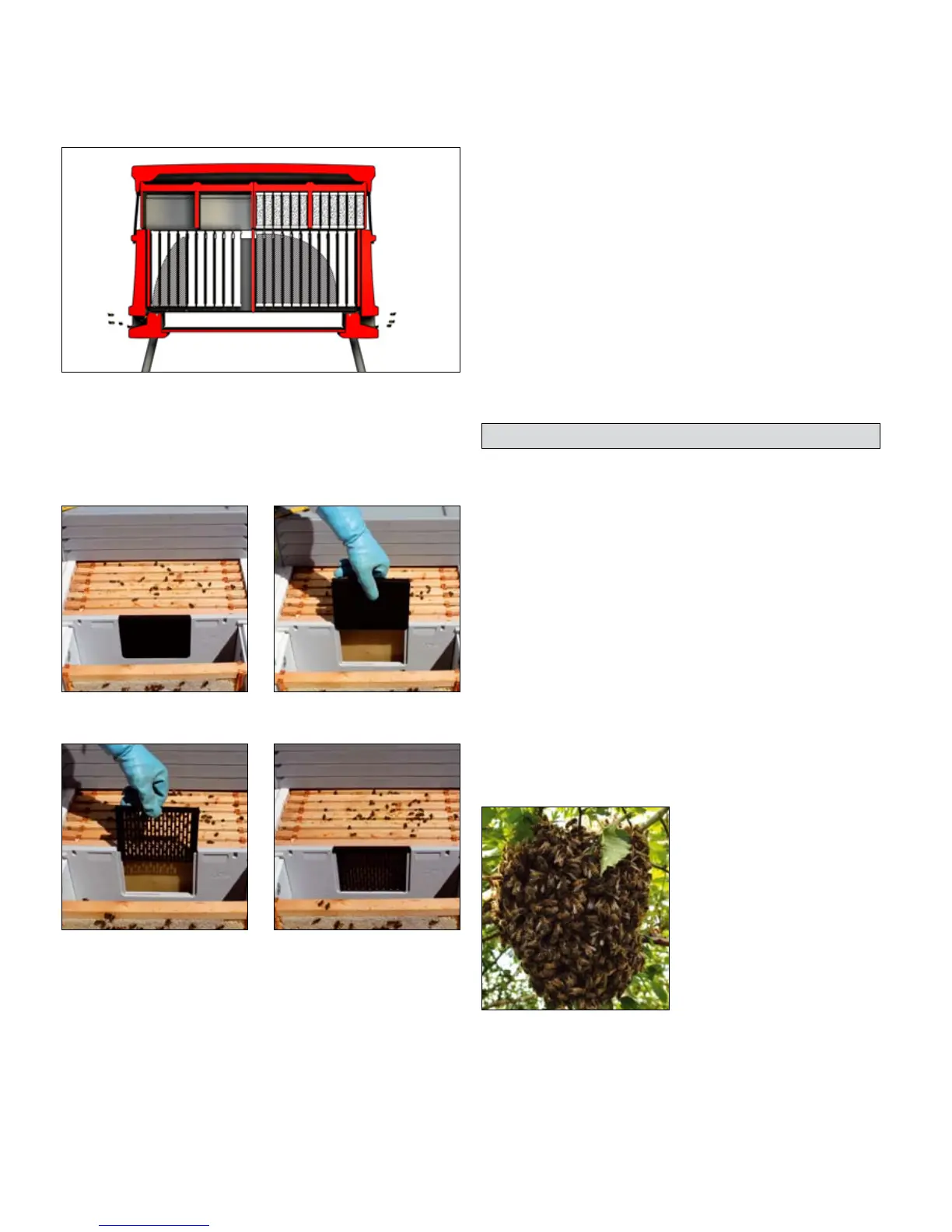
Step 8 - Add the divider board to completely separate the two halves of
the colony and replace the central section with the queen excluder.
Queen
Front Rear
The divider board should be in the
central position.
Put the queen excluder in place.
Remove the central section of
the divider board.
Leave for up to 24 hours then replace
with the solid central section.
Step 9 - Now place the lid up against the front entrance to the Beehaus
and tip the bees out onto the board. The bees will walk up the the board
and into the hive. All the young nurse bees will return to the brood
frames at the back of the hive.
Step 10 - Release the queen on to the top of the front three frames. The
flying bees will all return to the frames at the front of the hive.
Step 11 - 2-3 hours later, you should remove the queen excluder and
replace it with the solid central section. You can leave the queen excluder
in for up to 24 hours but the bees won’t start making a queen cell if you
don’t separate them completely.
Open Open



 To Next Page