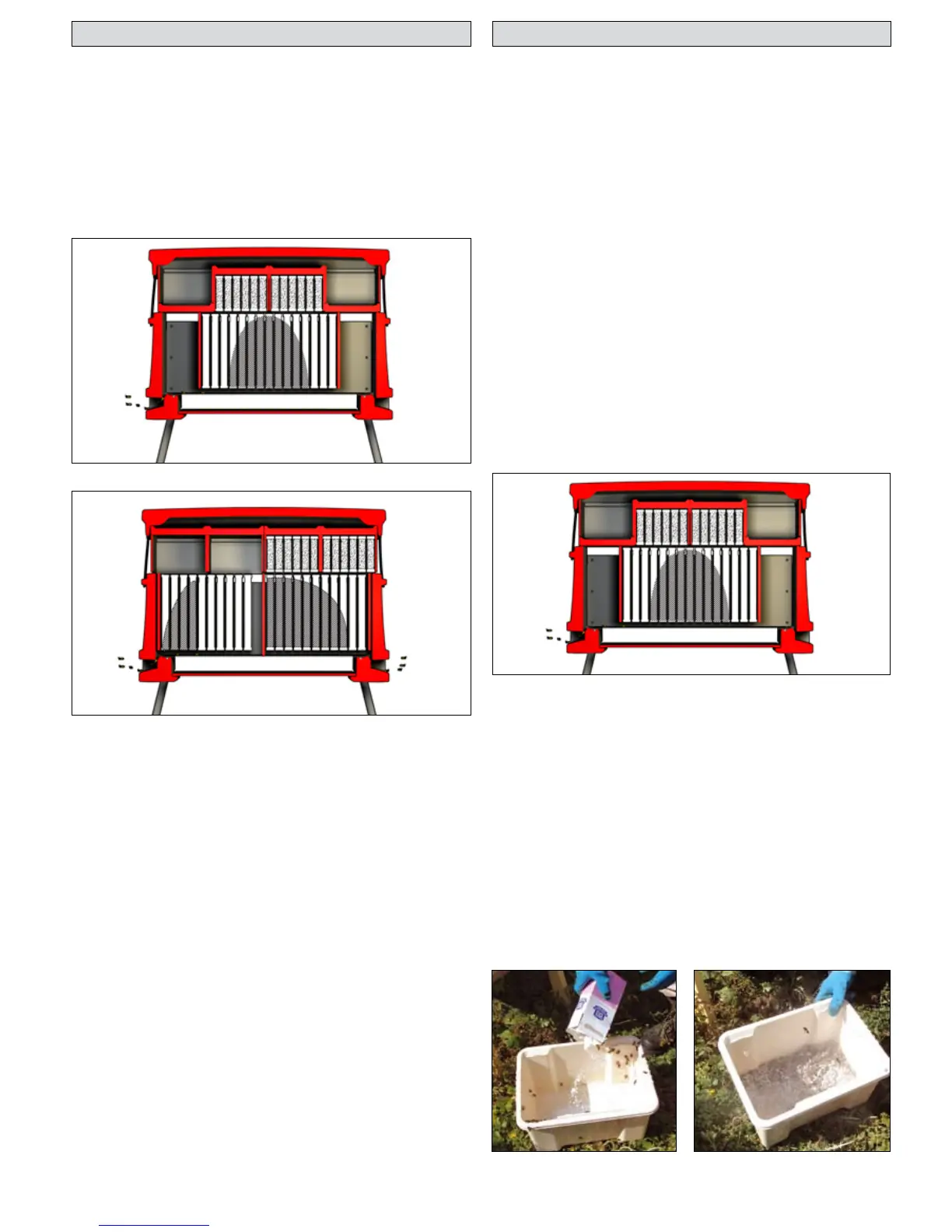
Eggs to front, queen and brood to back - This method is very easy
to do and is very effective since it leaves all the ‘swarmy’ bees without a
queen. Bees without a queen are unable to swarm, so instead they raise
a new queen who will stay to head the entire colony.
What you will need - 6 new brood frames with foundation
Starting point - At this point in the year your Beehaus may have a total
of 15 frames so this is what the description is based on. There should be
3 new frames in front of the 9 frames the bees over-wintered on and a
further 3 frames behind. You should also have a couple of supers over the
brood. The Beehaus should look like this.
Swarm control method 2 - Easy but better
Method
Step 1 - Divide the colony by moving all but the first four frames to the
rear of the hive. Make sure that the queen is on the brood frames that
are moved to the rear of the hive.
Step 2 - Add the divider board to completely separate the two halves of
the colony.
Step 3 - Open the entrance block at the rear of the hive. The older,
flying bees will all return to the front entrance. These are the bees that
would swarm, however the queen will remain.
Step 4 - Four frames are left at the front. Check that they contain some
nurse bees on open brood and eggs. If there are no eggs in the front
four frames, then another frame must be brought forward from the back,
which does have eggs in it. Again, make sure the queen isn’t on this
frame.
Step 5 - Insert six new brood frames with foundation behind the front
four frames. Replace the supers and the cover boards. Put the lid on top
and relax!
One week later - The bees at the front of the hive are queenless and
will have begun to create queen cells. You should remove all but one
queen cell. When the new queen emerges, allow up to three weeks for
her to mature and mate and then remove the divider board. Remove
any frames containing just stores from in between the two brood nests.
You can now remove the old queen. If you leave her to lay alongside the
new queen, the bees will cease to feed the old queen over time and she
will die, however you have to be lucky for this to occur and it’s safer to
remove her.
Swarm control method 3 - Harder but best
Queen to front, brood to back - The basic idea of this method of
swarm control is to mimic a natural swarm by removing all the brood
framesthat contain the nextgenerationof bees fromtheQueen. The
bees that stay with the queen have to spend all their time building new
comb for the queen to lay eggs in while the bees in the other half of the
hive have to raise a new queen.
It’s a very good way of managing your colonies urge to swarm and, although
a bit more complicated than the first method, is still quite straightforward
to do. Division of the colony also creates a good opportunity to remove
varroa mites. There is no sealed brood in the ‘swarm’ (the brood frames
at the front with the original queen on), so all the mites are exposed
on the adult bees and can be dislodged by applying icing sugar. Three
weeks later, all the sealed brood will have hatched out in the ‘parent’ (the
brood frames you moved to the far end of the hive) and none of the new
queen’s brood will be old enough to be sealed. The ‘parent’ can therefore
be treated in turn.
What you will need - 6 new brood frames with foundation, 1kg of
Icing sugar and a match box with holes in.
Starting point - At this point in the year your Beehaus should have a
total of 15 frames. There should be 3 new frames in front of the 9 frames
the bees overwintered on and a further 3 frames behind. You should
also have a couple of supers over the brood. The Beehaus should look
like this.
Method
Step 1 - Place a large plastic box in front of the hive and sprinkle a 1kg
box of icing sugar into it.
Step 2 - Find the queen and put her into a queen cage or a matchbox with
lots of holes in. This will keep her safe throughout the operations. Place
this in the entrance to the Beehaus.
Step 3 - Starting with the frame at the back of the hive, lift out
and shake the bees off the frame into the box with the sugar
in. The bees that fly out are older bees and are the ones who
are preparing to swarm. They are also less likely to have varroa
on them. The nurse bees will stay in the sugar.
Step 4 - After every 2 or 3 frames give the box a shake to make sure
the bees are well coated.
Before division the colony looks like this inside.
Queen
Front Rear
A box of bees coated in icing sugar.A box of filled with icing sugar.
Rear
A diagram of the colony after being divided for swarm control.
Queen
A diagram of the colony before being divided for swarm control.
Queen
RearFront
Open Closed
RearFront
Open Open
Open Closed



 To Next Page