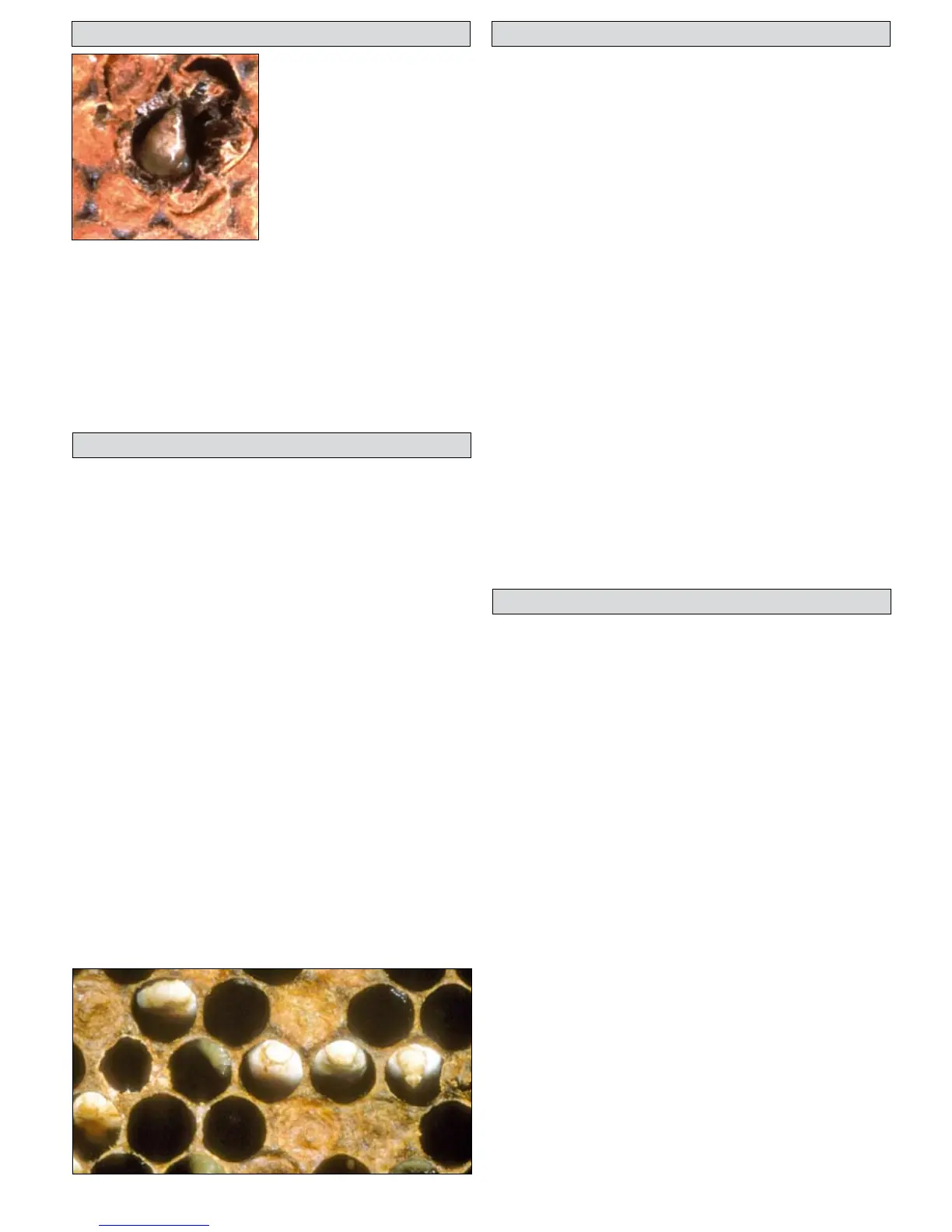
Sacbrood is a viral infection of brood
and was one of the first insect viruses
to be identified.
Symptoms
Initially during an infection, the virus
particles replicate in the developing
larvae, which appear to develop
normally until after being capped
over. The infected larvae then turn
a pale yellow colour; they remain
stretched out on their backs, heads
towards the top of the capped cell.
Liquid accumulates between the body
of the larva and its unshed skin, the
larvae become fluid-filled sacs, hence the name. The larvae will eventually
die and begin to dry out, turning a dark brown to black colour, giving rise
to the characteristic ‘Chinese slippers’ or ‘gondola-shaped’ scales. As the
larvae die, the workers will uncap the cells to expose them.
Treatment
There are no treatments available for sacbrood, but the virus will not
usually be a large problem, only tending to affect small areas of brood.
However, in cases where there are large areas of brood clearly affected, it
would be best to requeen the colony.
Sacbrood
Chalkbrood. Picture credit Crown copyright.
Chalkbrood will probably be seen in most colonies at some time but
at varying degrees of severity. It is caused by the fungal pathogen
Ascosphaera apis.
Symptoms
Spores of the fungus enter the developing larvae through the cuticle or
orally with contaminated food. These spores germinate and the hyphae
of the fungus invade the cells, killing the larvae (usually after it has been
capped over). Initially the dead larvae will be covered with a white cotton
wool-like growth and may swell to fill the cell, taking on its shape. After
a time, these will dry out and shrink to give the characteristic ‘mummies’
that are chalk-like at first turning to a greyish black colour as the fungal
fruiting bodies develop. Worker bees uncap the cells of dead larvae so the
mummies will be clearly visible; they will also be removed by the workers
and may be seen in high numbers on the floorboard or at the entrance to
the hive. In very heavily infected colonies, the workers will not be able to
uncap all of the affected cells and, if a comb is shaken, the mummies may
be heard rattling in the cells.
Each Chalkbrood mummy produces millions of spores that will adhere to
cells and adult bees. It is these spores that are the infective stage of the
fungus and may remain viable for up to 15 years. The spores can be spread
from hive to hive by drifting bees or by the beekeeper, on equipment and
frames moved between colonies.
Treatment
A good, strong healthy colony will usually be able to tolerate chalkbrood
and it is not usually a serious disease. However, in smaller colonies or those
under stress (for example suffering heavy varroa infestations), chalkbrood
can be a problem. The best method for keeping chalkbrood to a minimum
is the maintenance good strong stocks of bees, although in particularly
bad cases the problem may be solved by re-queening with a young and
vigorous queen from a chalkbrood-free colony. Choice of apiary site is also
important and you should avoid damp sites.
You may find a lot more drone cells in the hive than normal. There are
two possible causes:
• Failing/Drone-laying Queen
• Laying Workers
Symptoms
Queens lay two types of eggs, those that are fertilised and develop into
worker bees and unfertilised ones that develop into drones. The eggs are
fertilised as the queen lays them, however, if the supply of sperm runs out,
or the queen is poorly mated or not mated for some reason, then only
unfertilised eggs will be laid and these will develop into drones.
Also, when colonies lose their queen and have no young worker brood
from which to rear a replacement, the workers may develop functional
ovaries and begin to lay eggs (these are laying workers). These eggs,
being unfertilised, develop into drones; the signs are similar to those
of the drone-laying queen, except that the brood pattern is often less
compact. Also, there will be multiple eggs present in some cells, often on
the side walls as well as at the bottom of the cell.
The larger domed cappings of drone brood can normally be seen
throughout the height of the season, usually at the edges of the brood
nest. This irregular brood has extended cappings drawn out from worker
cells to accommodate the larger drone larvae. The brood pattern will be
poor, with larvae of all stages of development throughout the comb and
the surface of the comb may appear very uneven.
Treatment
It is usually older queens that become drone layers but it may also be
apparent in younger queens that did not mate successfully. The best option
in this instance is to re-queen with a young, prolific, recently mated queen.
Unlike colonies with a failing or defective queen, those with laying
workers are very difficult to re-queen. The best course of action is usually
to unite the colony with a stronger colony.
Chalkbrood
Drone brood in worker cells
Honeybees are affected by a number of diseases, but two of the most
serious affect the developing brood. They are American foulbrood (AFB)
and European foulbrood (EFB). Despite their names, both occur in the
UK. Both diseases are notifiable under the Bee Diseases and Pests Control
Order 2006, so if you suspect that you have either of these diseases,
you must inform the National Bee Unit (NBU); either contact them
directly or more usually via your local inspector. Further details about
these diseases can be found in the advisory leaflet published by the
NBU, but a summary of the disease characteristics can be found below.
Precautions to take if you suspect foul brood in your hive:
1. Reduce the hive entrance to prevent robbing.
2. Disinfect your beekeeping equipment and gloves before examining
other colonies, or if you use disposable gloves, select a new pair.
Then either, contact the NBU immediately. An inspector will contact you
as soon as possible and arrange a visit to your apiaries if necessary.
Alternatively, you can send a whole comb , well wrapped to prevent
leakage of honey, or a tube (available from the NBU, your Appointed
Bee Inspector (ABI) or some local associations) containing suspect diseased
larvae to the NBU. Don’t forget to include your name, address, apiary
location (OS map reference) and the hive identity.
If you have confirmed the presence of AFB/EFB using a Lateral Flow Device
(LFD kit), send the positive kit and a larval sample to the National Bee
Unit.
Do not remove any hives, bees or equipment from the site until the disease
(if confirmed) has been controlled. This is a self imposed ‘Standstill’ which
is a requirement under the legislation.
Foulbrood
Sac Brood Infected Larva.
Picture credit Crown copyright.



 To Next Page