PG DRIVES TECHNOLOGY NEWVSI TECHNICAL MANUAL – PROGRAMMING
SK80151-1 45
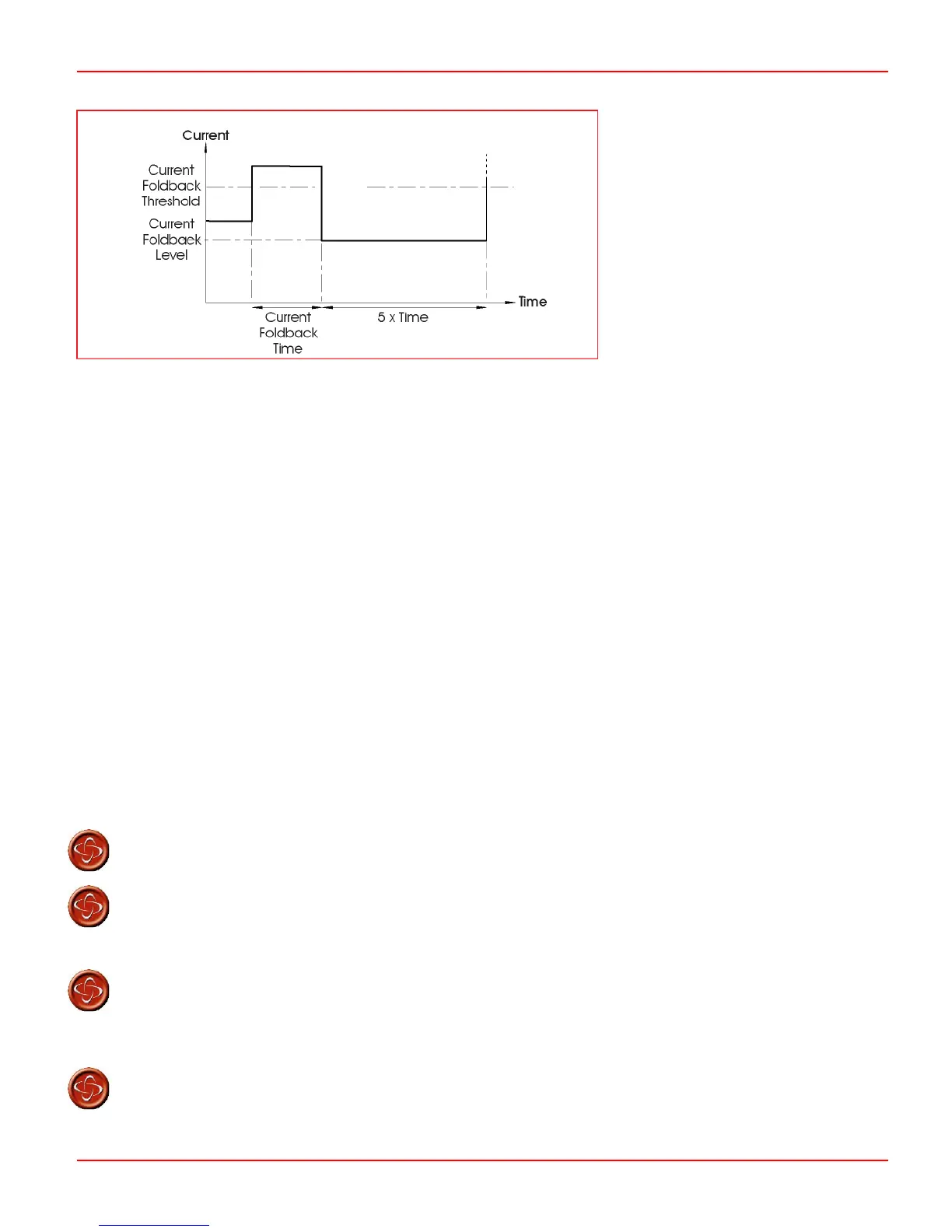
Settings: newVSI is programmed to:
Current Limit Max. = 50 Amps
Current Foldback Threshold = 40 Amps
Current Foldback Time = 15 Seconds
Current Foldback Level = 25%
This is useful for protecting motors against potential damage when the wheelchair is being used on a long gradient. After 15
seconds the current output of the newVSI will reduce to 25% of 50A = 12.5A. After 5 x 15s = 75s, the current output will return to
50A.
If no timed foldback is required, simply set Current Foldback Level to 100%.
7.2 Motor Compensation
This matches the newVSI to suit different motor types in order to achieve optimal performance and drive control. This value should
be set in accordance with the armature resistance of the motor and all cables and connectors between the newVSI and the
motor. The value is set in milli-Ohms (mOhms). A recommended value is:
• 70% of the (armature resistance + cables and connectors)
Motor manufacturers should be able to supply figures for armature resistance and cable and connectors may typically be
40mOhms.
Example: Motor has armature resistance of 200mOhms
Cables and connectors are 40mOhms
Set Motor Compensation to 0.7 x (200 + 40) = 170mOhms
Never exceed the 70% relationship described above.
The chair manufacturer is responsible for ensuring that the controller is matched to the motor
resistance. Failure to do this may result in poor control characteristics, which in extreme instances
can make a chair uncontrollable and potentially unsafe. PGDT accepts no liability for losses of any
kind arising from failure to comply with this condition
.
The chair manufacturer is responsible for always ensuring that any replacement motors or
gearboxes are fully compatible with the originals that the controller was designed to match. Failure
to do this may result in poor control characteristics, which in extreme instances can make a chair
uncontrollable and potentially unsafe. PGDT accepts no liability for losses of any kind arising from
failure to comply with this condition.
Users must not move a controller from one chair type to install it on a different chair type.
controllers with different part numbers may have both hardware and software differences to
ensure that they are compatible with the electrical and dynamic characteristics of their specific


 To Next Page