Therapy
4-24 LIFEPAK 20 Defibrillator/Monitor Operating Instructions
NONINVASIVE PACING
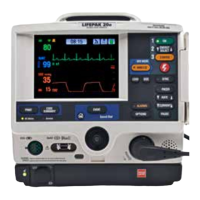
The LIFEPAK 20 defibrillator/monitor provides noninvasive pacing using QUIK-COMBO electrodes.
The following paragraphs include:
• Noninvasive Pacing Warnings
• Demand and Nondemand Pacing
• Noninvasive Pacing Procedure
• Troubleshooting Tips for Noninvasive Pacing
For information about noninvasive pediatric pacing, refer to the Physio-Control Therapy Electrodes
Operating Instructions MIN 3200346.
Noninvasive Pacing Warnings
Demand and Nondemand Pacing
The noninvasive pacemaker can be used for either demand (synchronous) or nondemand
(asynchronous) pacing modes.
The demand mode is used for most patients. In the demand mode, the LIFEPAK 20 defibrillator/
monitor/pacemaker inhibits pacing when it senses the patient’s own beats (intrinsic QRSs). In demand
mode, if the ECG amplitude is too low to detect the patient’s beats, or if an ECG lead becomes
detached so that the ECG rhythm is not present, the pacemaker generates pacing pulses
asynchronously. This means that the pacemaker generates pacing pulses at the selected rate,
regardless of the patient’s ECG rhythm.
Asynchronous or nondemand mode can be selected if noise or artifact interferes with proper sensing
of QRS complexes. Press the
OPTIONS button to access the nondemand mode. (Refer to page 2-7.)
The LIFEPAK 20 defibrillator/monitor has an integrated pulse oximeter that can be used in conjunction
with a noninvasive pacemaker to help confirm capture. To confirm capture, compare the pulse rate
measured by the oximeter to the set pacing rate of the pacemaker.
Noninvasive Pacing Procedure
ECG monitoring during pacing must be performed with the ECG electrodes and patient ECG cable.
Pacing therapy electrodes cannot be used to monitor ECG rhythm and deliver pacing current at the
same time. Be sure to place the therapy electrodes in the proper locations as described in the pacing
procedure. Improper electrode placement may make a difference in the capture threshold.
WARNINGS!
Possible inducement of ventricular fibrillation.
Sinus bradycardia may be physiologic in severe hypothermia (i.e., appropriate to maintain sufficient
oxygen delivery when hypothermia is present), and cardiac pacing is usually not indicated.
Possible interruption of therapy.
Observe the patient continuously while the pacemaker is in use. Patient response to pacing therapy,
e.g., capture threshold, may change over time.
Possible inability to pace.
Using other manufacturers’ combination therapy electrodes with this device could cause a decrease in
pacing efficacy or the inability to pace because of unacceptably high impedance levels.
Possible patient skin burns.
Prolonged noninvasive pacing may cause patient skin irritation and burns, especially with higher
pacing current levels. Discontinue noninvasive pacing if skin becomes burned and another method of
pacing is available.



 To Next Page