


 Need help?
Do you have a question about the Physio Control LIFEPAK 15 and is the answer not in the manual?
Details the required qualifications for service technicians, including education and experience.
Defines DANGER, WARNING, and CAUTION terms used to indicate hazard levels and potential consequences.
Provides general danger, warning, and caution statements related to electrical hazards, fire, and device performance.
Provides functional descriptions of the device design and assists in troubleshooting to the subassembly level.
Describes performing manual defibrillation, synchronized cardioversion, pacing, and ECG monitoring.
Details automated ECG analysis and prompted treatment protocols for patients in cardiac arrest.
Allows changing factory default settings and defining custom settings for operating functions.
Enables qualified service personnel to perform device calibration routines and tests.
Provides a chart of observed symptoms and suggested corrective actions for various device areas and tests.
Explains how the device detects and reports improper operation or malfunction using error codes.
Lists corrective action codes referenced in error code tables and their corresponding descriptions.
Shows the schedule for preventive maintenance activities like PIP, TCP, and cleaning procedures.
Provides instructions for charging LIFEPAK 15 Li-ion batteries and recommended ambient temperatures.
Provides general warnings and cautions applicable to all maintenance actions, including shock hazards.
Detailed steps for removing the system/therapy PCBs as a single unit from the rear case.
Step-by-step instructions for installing the system/therapy PCB assembly back into the rear case.
Provides steps to remove the power PCB from the rear case, including disconnecting cables.
Provides steps for installing the power PCB into the rear case, including connecting cables and securing it.
Details steps for removing the OEM PCB from the rear case, including disconnecting cables and shields.
Provides instructions for installing the OEM PCB into the rear case and reconnecting cables.
Details steps for removing the transfer relay assembly from the rear case, including safety precautions.
Provides instructions for installing the transfer relay assembly into the rear case and reconnecting components.
Details steps for removing the energy storage capacitor from the rear case, including safety warnings.
Provides instructions for installing the energy storage capacitor and interconnect bracket into the rear case.
Details steps for removing the SpO2 PCB from the rear case, including disconnecting cables and CAUTIONS.
Provides instructions for installing the SpO2 PCB into the rear case, connecting cables and mounting bracket.
Details steps for removing the interconnect bracket from the rear case, including safety precautions.
Provides instructions for installing the interconnect bracket into the rear case and securing it with cable ties.
Details steps for removing NIBP and CO2 modules as a unit from the rear case.
Provides instructions for installing NIBP and CO2 modules into the rear case, including routing and connections.
Details steps for removing the biphasic module and inductive resistor from the rear case.
Provides instructions for installing the biphasic PCB and inductive resistor into the bracket and rear case.
Details steps for removing the rear case, involving disassembly and removal of multiple components.
Provides instructions for installing the rear case, including transferring parts and installing new labels.
Lists repair kits that include components for specific replacement activities.
 General
| Defibrillator Waveform | Biphasic |
|---|---|
| Pacing Rate | 30 - 180 ppm |
| SpO2 Monitoring | Yes |
| NIBP Monitoring | Yes |
| EtCO2 Monitoring | Yes |
| IBP Monitoring | Yes |
| Temperature Monitoring | Yes |
| Battery | Lithium-ion |
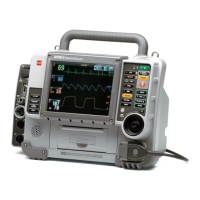
| Type | Monitor/Defibrillator |
| Defibrillator Type | Manual, AED |
| Pacing Mode | Demand, Asynchronous |
| ECG Monitoring | 3, 5, 12-lead ECG cable |
| Display | Color LCD |
| Printer | Integrated thermal printer |
| Data Management | Data storage and transfer capabilities |
| Connectivity | Wi-Fi, Bluetooth |
| Operating Temperature | 0° to 50°C (32° to 122°F) |
| Storage Temperature | -20° to 60°C (-4° to 140°F) |
| Altitude | Up to 4, 500 m |


 To Next Page