Function Description
4-2 Operating Manual: PSS 3075-3 Series
Inputs
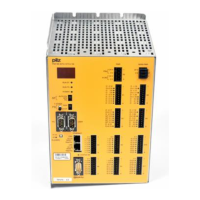
Programmable safety systems from the PSS 3075-3 series have 48 digital
inputs (DI2), 6 of which can be configured as alarm inputs (DIF).
The digital input signals must show a “High” (“1” signal) of 24 VDC (+15 ...
+30 VDC) or a “Low” (“0” signal) of 0 VDC (-3 ... +5 VDC).
LEDs are used as status indicators. An LED lights up as soon as a “1”
signal is present at the input. Inputs have input filters and are galvanically
isolated from the control electronics through optocouplers.
Digital inputs (DI2)
Internal diagnostic circuitry checks the function of the inputs, including the
optocoupler. If an error occurs, the PSS will switch to a STOP condition,
switch off the outputs and send a message to the CPU-display.
Alarm inputs (DIF)
The CPU program cycle will be interrupted if there is a signal change at an
alarm input. Depending on the configuration, rising, falling or both types of
pulse edges may trigger an alarm. Only those alarms triggered by a signal
change from “1” to “0” are safety-related. As soon as an alarm signal
(signal change) occurs at one of the alarm inputs, the signal is sent to the
CPU through a hardware connection. The CPU determines which input
triggered the alarm and, if the pulse edge is configured as active, calls up
the relevant alarm OB. The user can program whatever measures are
necessary into this alarm OB (see “FS System Description”).
Internal diagnostic circuitry checks the function of the inputs. If an error
occurs, the PSS will switch to a STOP condition, switch off the outputs and
send a message to the CPU-display. The input filter and optocoupler can
be tested using test pulses.


 To Next Page
 Loading...