22
Using wireless flash shooting:
optical transmission
Notes:
• Master flash refers to the camera flash on a camera. Slave
flash refers to flashes controlled by the master flash.
• The master flash can control all of the slave flashes using
wireless.
Canon flash overview
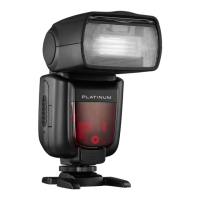
Your Canon flash supports the wireless flash application and
functions as either a master or a slave flash. As a master flash, it
can control Canon speedlites, such as 580EXII and 600EX-RT. As a
slave flash, it can be controlled by the wireless signals from
Canon speedlites, such as 580EXII, 600EX-RT, and from the
commanders on Canon cameras, such as 7D/60D/600D.
Any flash settings (for example, flash exposure compensation,
high-speed sync, FE lock, FEB, Manual flash, or Auto-flash) on the
master flash are automatically sent to the slave flashes. So the
only thing you need to do is to set the master flash to ETTL
mode.
You can set up three slave groups for Auto-flash shooting to
create various lighting effects.
Your flash can work in Auto-flash (E-TTL), Manual flash, and OFF
modes when set as a master flash.
Nikon flash overview
Your Nikon flash is compatible with the Nikon Creative Lighting
System (CLS). It can function as either an optic wireless master or
slave flash. As a master flash, it can control Nikon speedlights (for
example, SB-900 and SB-910 via wireless). As a slave flash, it can
be controlled by the wireless signals of Nikon speedlights (for
example SB-900 and pop-up flash commanders on Nikon
cameras (for example, D7100/D7000/D800).
You can set up three slave groups for Auto-flash shooting to
create various lighting effects.
Any flash settings for the slave flashes on the master flash in
Auto-flash, Manual, or Stroboscopic mode are automatically sent
to the slave flashes. All you need to do is to set the master flash
for each slave group without making any settings on the slave
flashes during the shooting.
Your flash can work in Auto-flash, Manual, Stroboscopic, or OFF
flash modes when set as a master flash.


 To Next Page