PN-0908073 Rev. 11 7-92
PS 164-2
THE ART OF WELDING
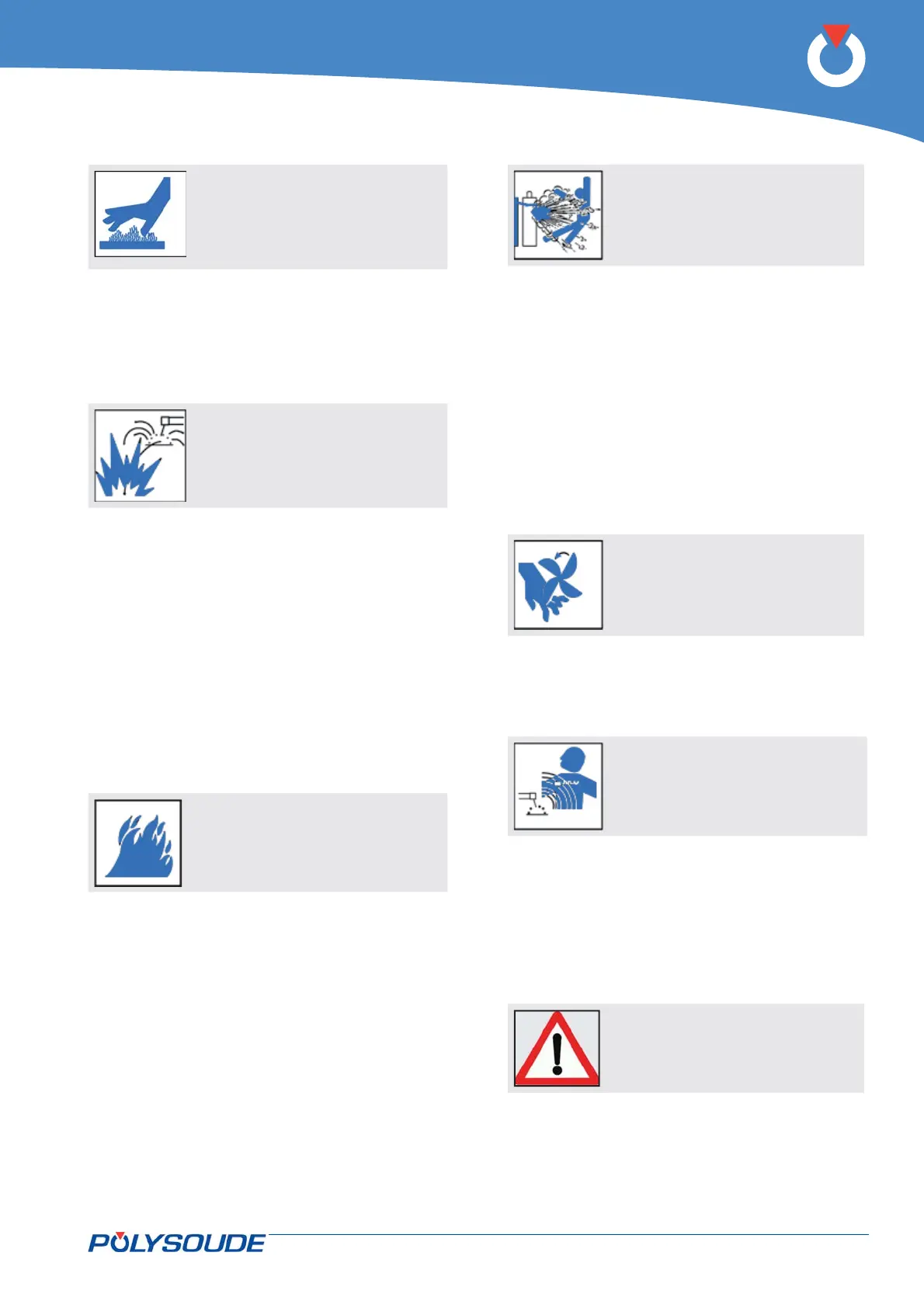
Warning: hot parts – Risk
of burn
• Do not touch welded or torch cut pieces. When
handling hot workpieces, use adequate tools and/
or wear thick and isolating welding gloves, avoid-
ing any burn.
• Welded parts must cool down before handling or
further weld operations.
Risk of eye or skin burn
caused by fl ying sparks
• Wear gloves or leather gauntlets to protect hands
and lower arms.
• Wear an apron or gaiters to protect the legs,
knees and feet.
• Carry a mask (strapped to the head, handheld or
electronic) or glasses equipped with an adequate
fi lter
• Use shielding curtains to protect staff working
nearby.
• Wear cotton or woollen clothes with long sleeves,
without oil or lubricant marks - avoid synthetic
fabrics.
• Wear a scarf around your neck and close the col-
lar of your clothing.
• Wear safety boots made for welders.
Risk of overheating, fi re
• Keep the installation in good condition, especially
the supply cables and the current return cable.
• Keep a minimum distance of 6 m between the
welding equipment and any greasy, explosive or
dusty substance.
• Use shielding curtains to protect staff working
nearby.
Risk of explosion
These risks are caused by using and handling gas
bottles and fl ying sparks.
• Never use damaged gas bottles.
• Stock the gas bottles in a well-ventilated room,
allowing access only to authorised staff.
• The temperature limit of 55 °C must be respect-
ed for the storage and use of gas bottles.
• Separate clearly marked empty gas bottles from
new ones.
• Protect gas bottles from extreme temperatures
(freezing, sun, sparks, etc.).
• Inspect connections and hoses periodically.
• Use shielding curtains.
Risk of severe injuries
caused by moving parts
•
• Never place your hands near a fan or other mo–
ving parts.
• Keep all safety devices operational and in safety
mode.
Risk caused by magnetic
fi elds
The distance between the brain and the welding cir-
cuit is a very important parameter.
• Never wind cables around your body or, even
worse, over your shoulders.
• Make it known if you have been fi tted with a
pacemaker. Possible interference must be pre-
vented by special measures in co-ordination
with a physician.
The operator must ensure
that no one is exposed to
dangerous areas


 To Next Page