17
Check with a qualified electrician or service personnel
if the grounding instructions are not completely under-
stood, or if in doubt as to whether the tool is properly
grounded.
Use only 3-wire extension cords that have 3-prong
grounding plugs and 3-pole receptacles that accept
the tool’s plug.
Repair or replace damage or worn cord immediately.
2. Grounded, cord-connected tools intended for use
on a supply circuit having a nominal rating less than
150 volts:
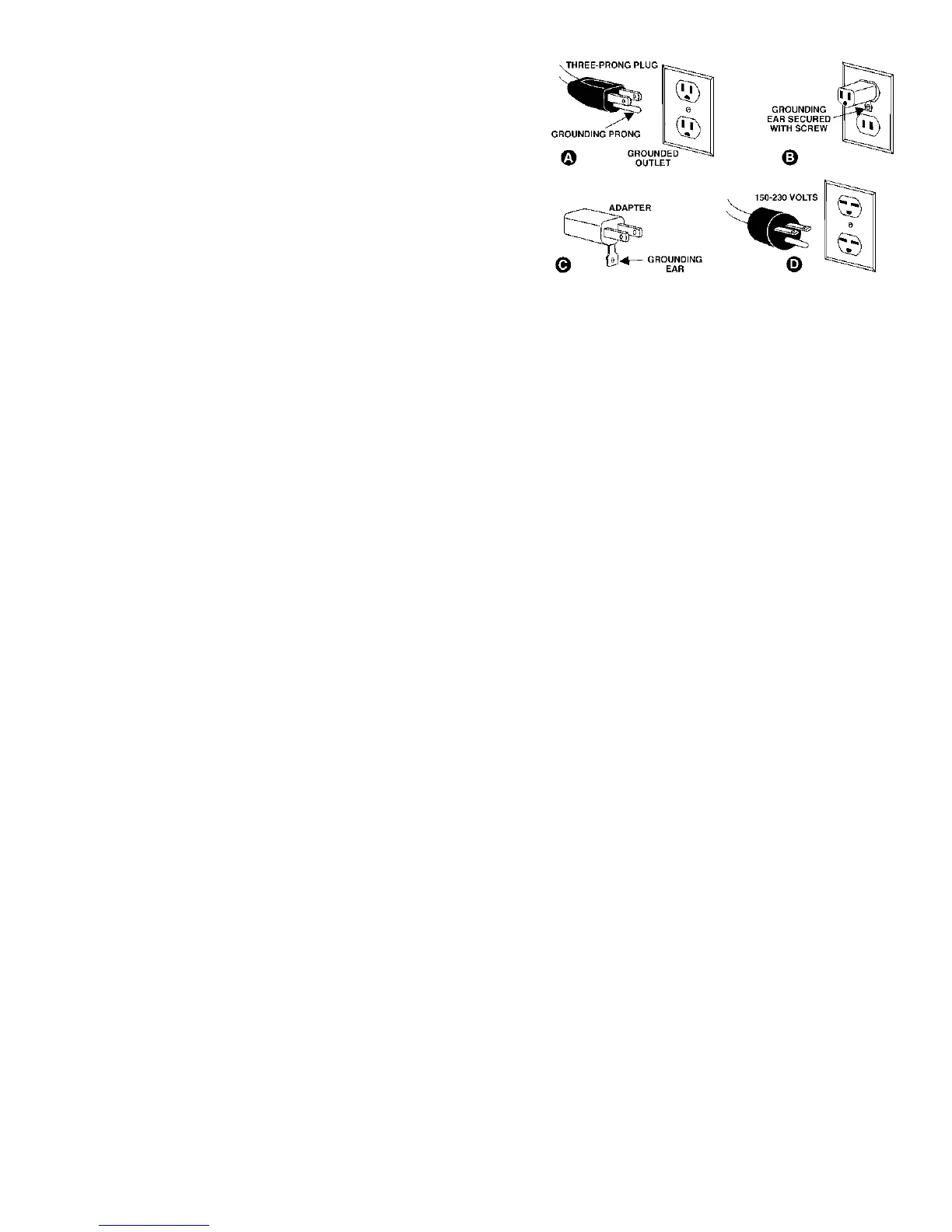
This tool is intended for use on a circuit that has an
outlet that looks like the one illustrated in Figure 23(A).
The tool has a grounding plug that looks like the plug
illustrated in drawing (A).
A temporary adapter, which looks like the adapter il-
lustrated in Fig. 23(B&C), may be used to connect
this plug to a 2-pole receptacle as shown in drawing
(B) if a properly grounded outlet is not available. The
temporary adapter should be used only until a prop-
erly grounded outlet can be installed by a qualified
electrician.* The green-colored rigid ear, lug, and the
like, extending from the adapter must be connected
to a permanent ground such as a properly grounded
outlet box.
*(This adaptor is not applicable in Canada.)
3. Grounded, cord-connected tools intended for use
on a supply circuit having a nominal rating between
150-250 volts, inclusive:
This cord is intended for use on a circuit that has an
outlet that looks like the one illustrated in Fig. 23(D).
The tool has a grounding plug that looks like the plug
illustrated in drawing (D). Make sure the tool is con-
nected to an outlet having the same configuration as
the plug. No adapter is available or should be used
with this tool. If the tool must be reconnected for use
on a different type of electric circuit, the reconnection
should be made by qualified service personnel and
after reconnection, the tool should comply with all lo-
cal codes and ordinances. See page 26 for 230V wir-
ing diagram.
FIGURE 23



 To Next Page