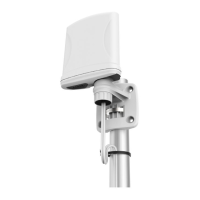
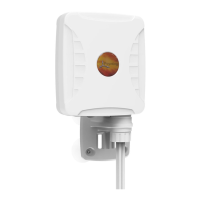
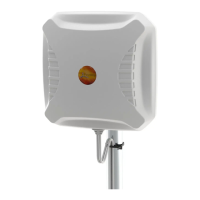
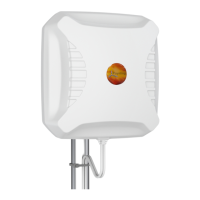
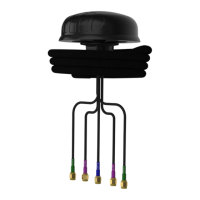
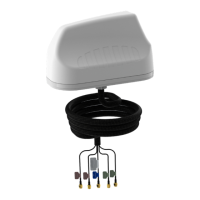
It is recommended to position the antenna at least 4 feet (1.2 m) above or below the level of
the RADAR Antenna and a minimum of 15 feet (4.6 m) away from the high-power short-wave
radars.
The S-Band RADAR operates at frequencies between 2.9 to 3.1 GHz. Since the RIPPLE is
designed to be an ultrawide bandwidth antenna, it can receive signals in the frequency range
from 617 to 6000 MHz. SNR protection for the above S-Band frequencies can only be offered
by the filters in the router’s transceiver. It is therefore prudent to provide as much physical
separation as possible between the radiation envelope of the RADAR and that of the RIPPLE.
Rigid Mounting Position - The mounting platform should be rigid enough and not be
subjected to excessive vibration. The movement of the antenna can be minimized by
installing it at the centre of the vessel. If these conditions can only be partially satisfied, it is
preferred to find the best-compromised installation site between the various considerations.
Ideal Height of Installation - Since the Router/s installed in the RIPPLE will be communicating
with shore-based telecommunication towers, it would be advantageous to install the RIPPLE
as high as possible on the Vessel relative to the waterline. Typical positions will be on a
spreader, +4 feet (1.2m) above the RADAR dome.
If both X-Band and S-Band RADAR systems are installed it would typically be worthwhile to
install them above the X-Band RADAR. In most cases, it will be mounted higher as it is the
smaller Radome of S-Band and X-Band RADAR antennas.
1.2. SAFE ACCESS FROM RADIATION HAZARD
Passive System – The RIPPLE antenna system consists of passive radiating elements, which
are designed to radiate in specific frequency bands. Therefore, the system does not produce
radiation that can be dangerous to any lifeform.
Effective Isotropic Radiated Power (EIRP) – This is a term used to describe the amount of
power that is radiated by an antenna in a specific direction. Antennas are designed to radiate
their output power in a specific direction, that is either omni-directional or uni-directional
radiation. Therefore, antennas increase the concentration of electromagnetic waves that the
human cells would be exposed to.
Although this is taken into consideration when the maximum RF Power output of a router is
specified in the FCC (Federal Communications Commission) specifications. It is
recommended that ‘Radiation Warning Signs’ be placed in strategic locations when there is
a possibility that personnel or passengers on a vessel could come into close contact with
the RIPPLE
Antenna System.
Router Transmitter Radio Frequency Output Power – Cellular (LTE/4G, 5G) router
specifications are governed by regulations stated by a variety of standards in various
countries like FCC in the USA and ETSI in Europe. The standards ensure that the radiated
power from the router is limited to prevent exposure to electromagnetic waves.
In this instance, we are concerned with the RF power output of the router/s transmitter/s
installed in the RIPPLE
.
Radio Frequencies in the range from 3 kHz to 300 GHz are regarded
as the ‘Radio Frequency Spectrum’. The main safety concern as far as RF radiated Power is
concerned, is to protect people from being exposed to too high levels of Electromagnetic


 To Next Page