Level low system
When driving, the conventional
air
levelling system in
this vehicle controls the hei
ght
at three
po
ints, the
front. the
lef
~
rear and the right rear
of
the bus shell.
This vehicle
is
equipped with a suspension system that
consists
of
air springs (pressurized air bags) located
near each wheel. The
amount
of
air in each bag (and
thus the height of the vehicle) is controlled by auto-
matic levelling valves that operate between the chassis
and the axles
of
the vehicle. The three (3) levelling
valves are located as follows:
One
at the front which
controls the
amount
of
air
in
all the front bags, one at
the left rear which controls the left rear
corner
of
the
vehicle and
one
at the right rear which controls the
right rear corner of the vehicle. In normal driving,
these valves
work
automatically to control the chassis
at the
proper
level above the axles, no matter what the
road condition is
or
how
much
weight is put in the
vehicle.
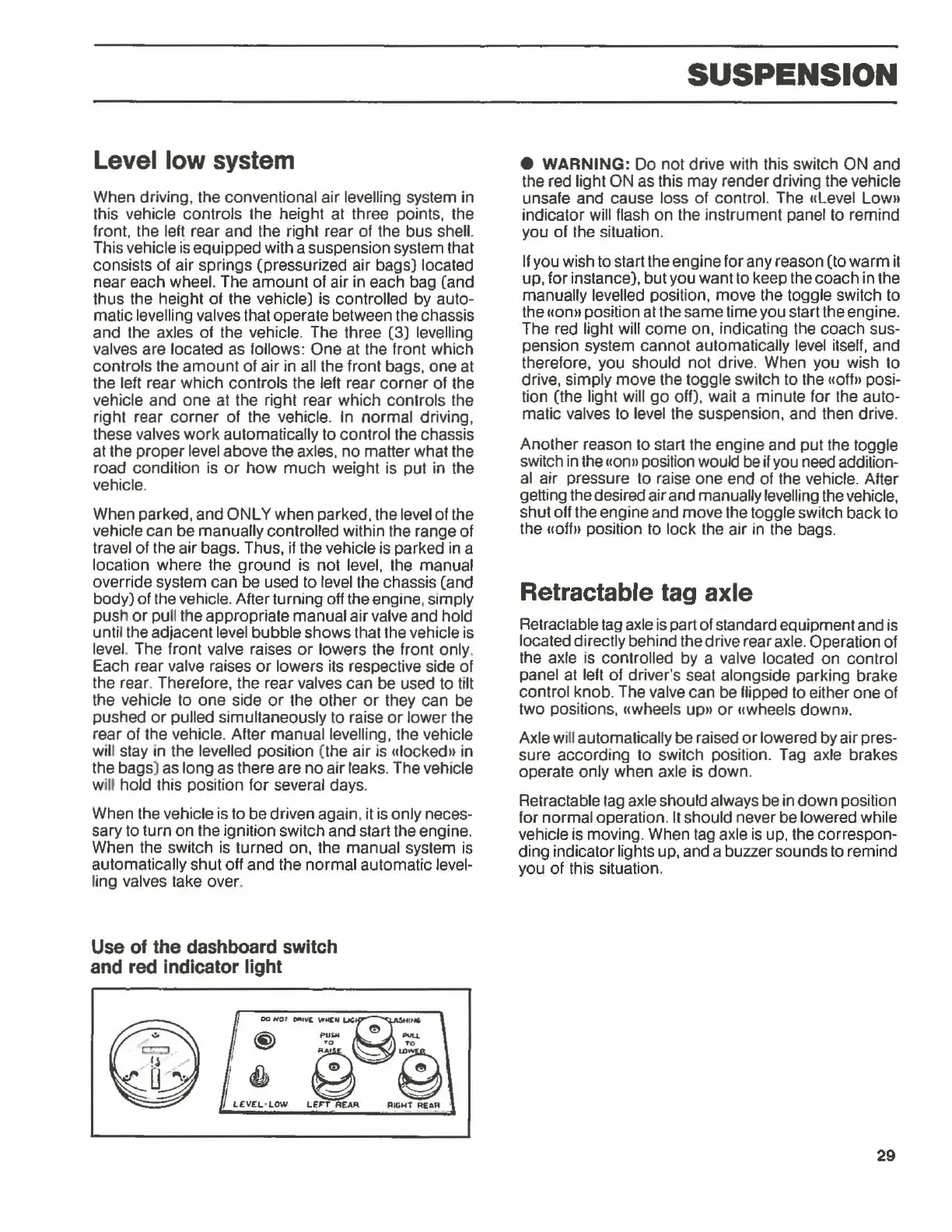
When parked, and ONLY when parked, the level
of
the
vehicle can be manually controlled within the range of
travel
of
the air bags. Thus, if the vehicle is parked
in
a
location where the
ground
is
not
level, the manual
override syst
em
can be used to level the chassis (and
body) of the vehicle. After turning off the engine, simply
push
or
puU the appropriate manual
air
valve and hold
until the adjacent level bubble shows that the vehicle is
level. The front valve raises
or
lowers the front only.
Each rear valve raises
or
lowers its respective side
of
the rear. Therefore. the rear valves can
be
used to tilt
the vehicle to one side
or
the other
or
they can
be
pushed
or
pulled simultaneously to raise
or
lower the
rear
of
the vehicle. After manual levelling, the vehicle
will stay in the levelled position (the air is
<clocked»
in
the bags) as long as there are
no
air
leaks. The vehicle
wilt hold this position
for
several days.
When the vehicle is to be driven again, it is only neces-
sary to turn on the ignition switch and start the engine.
When the switch is turned on, the manual system is
automatically shut off and the normal automatic level-
ling valves take over.
Use
of
the
dashboard
switch
and
red
indicator
light
:
-
-~~
f
lE
V
EL
•
LOW
LEF'T REAR
FlllG~T
RI
AR
_ '
SUSPENSION
• WARNING:
Do
not drive with this switch ON and
the red light ON as this may render driving the vehicle
unsafe and cause loss of control. The
ulevel
Low»
indicator will flash
on
the instrument panel to remind
you
of
the situation.
If you wish to start the engine for any reason (to warm it
up, for instance), but you want to keep the coach in the
manually levelled position. move the toggle switch to
the
«on11
position at the same time you start the engine.
The red light will
come
on
. indicating the coach sus-
pension system cannot automatically level itself, and
therefore, you should not drive. When you wish to
drive, simply move the toggle switch to the uoff» posi-
tion (the light will
go
off). wait a minute
for
the auto-
matic valves to level the suspension. and then drive.
Another reason to start the engine and put the toggle
switch in the
<1on
11
position would
be
if you need addition-
al
air
pressure to raise one end
of
the vehicle. After
getting the desired air and manually levelling the vehicle,
shut off the engine and move the toggle switch back to
the
uofh>
position to lock the air in the bags.
Retractable tag axle
Retractable
tag
axle
is
part
of
standard equipment and is
located directly behind the drive rear axle. Operation of
the axle is controlled by a valve located
on
control
panel at left
of
driver's seat alongside parking brake
control knob. The valve can be flipped to either one
of
two positions, uwheels upn
or
uwheels down».
Axle will automatically
be
raised
or
lowered by air pres-
sure according to switch position. Tag axle brakes
operate only when axle is
down
.
Retractable tag axle should always be in
down
position
for normal operation. It should never be lowered while
vehicle is moving. When tag axle
is
up, the correspon-
ding indicator lights up, and a buzzer sounds to remind
you
of
this situation.
29


 To Next Page