Deceleration
To
use engine as a braking force. shift range selector
to next lower range.
If
vehicle is exceeding maximum
speed for a lower gear. use service brakes to. sl?w
vehicle to an acceptable speed where
transm1ss1on
may be downshifted.
Compared to a manual-shift transmission, an auto-
matic has a longer
cccoast
down11
time. Until you are
accustomed to this characteristic, you may need to
manually downshift to reduce speed.
With a little experience in driving the automatic, the
driver will learn to decelerate a bit sooner
,
or
brake
until automatic downshift occurs. This will reduce the
need for manual downshifting.
O NOTE: On vehicles equipped with a Jacobs brake,
deceleration can be assisted by using the Jacobs brake
switch located on the switch panel. Refer
to
page
20
for
proper operation.
Automatic
transmission
oil
level check
Because transmission oil cools, lubricates and trans-
mits power, it
is
important that proper oil level be main-
tained at
all times.
If
level is too low, converter and
clutches will not receive adequate supply.
If
level is too
high,
oil will foam. causing the transmission to overheat.
To ensure a
long transmission life. transmission oil
level should
be checked at regular service intervals.
Oil
check
procedure
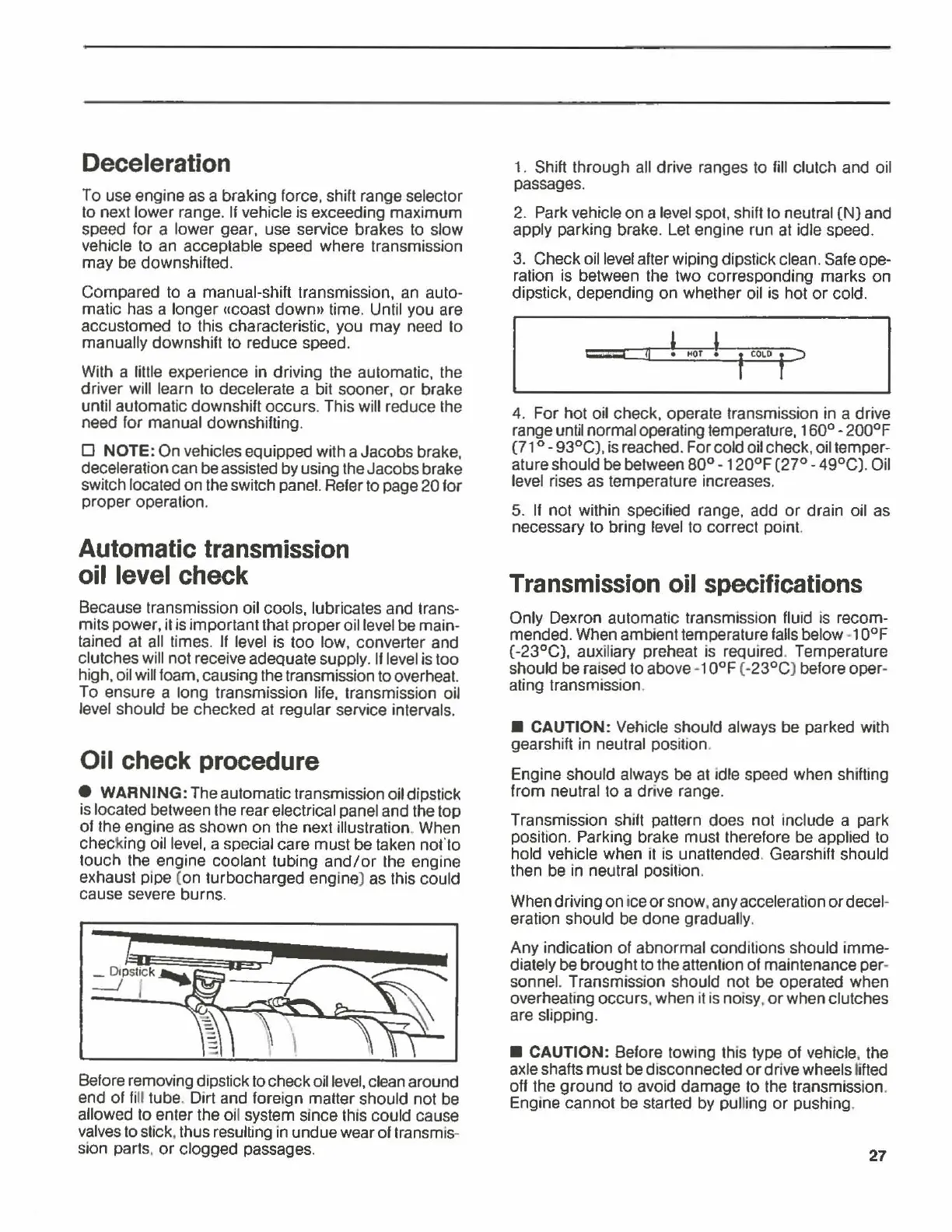
• WARNING: The automatic transmission oil dipstick
is
located between the rear electrical panel and the top
of
the engine as shown on the next illustration.
Wh~n
checking oil level, a special care must be taken not to
touch the engine
coolant tubing
and/or
the engine
exhaust pipe (on turbocharged engine) as this
could
cause severe burns.
_Dr
pstick.ai.....
_;
' ---,..
I
Before removing dipstick to check oil level, clean around
end of
fi
ll
tube. Dirt and foreign matter should not be
allowed to enter the o
il
system since this could cause
valves to stick, thus resulting
in
undue wear of transmis-
sion parts.
or
clogged passages.
1.
Shift through all drive ranges to fill clutch and oil
passages.
2. Park
vehicle on a level spot. shift to neutral
(N)
and
apply parking brake. Let engine run at idle speed.
3.
Check oil level after wiping dipstick clean. Safe ope-
ration
is
between the two corresponding marks on
dipstick, depending on whether
oil is hot
or
cold.
l '
•
~OT
•
4. For hot oil check. operate transmission in a drive
range
until normal operating
temper~ture.
160_
0
-
200°F
(71°
- 93°CJ is reached. For cold oil check,
011
temper-
ature
should
he
between
80°
- 120°F
(27°
- 49°C). Oil
level
rises as temperature increases.
5.
If not within specified range, add
or
drain oil as
necessary to bring
level to correct
point
Transmission
oil
specifications
Only Dexron automatic transmission fluid
is
recom-
mended. When
amb
ient temperature falls below -
10°F
(-23°CJ, auxiliary preheat is required. Temperature
should be raised to above -
10°F
(-
23°C
J before oper-
ating transmission.
• CAUTION: Vehicle should always be parked with
gearshift in
neutral position.
Engine
should always
be
at
idle speed when shi
ft
ing
from
neutral to a
dr
i
ve
range.
Transmission shift pattern does not
include a park
position. Parking brake must therefore be
~pplied
to
hold vehicle when it
is
unattended. Gearshift should
then be
in
neutral position .
When driving on
ice
or
snow, any acceleration
or
decel-
eration should be
done
gradually.
Any indication of abnormal conditions should i
mme-
diately be brought to the attention of maintenance per-
sonnel. Transmission should not be operated when
overheating occurs. when it is
noisy,
or
when clutches
are slipping.
• CAUTION: Before towing this type of vehicle. the
axle shafts
must
be disconnected
or
drive wheels titted
off the ground to avoid damage to the transmission.
Engine cannot be started by
pulling
or
pushing.
27


 To Next Page