AUTOMATIC TRANSMISSION
The operation and driving
of
this type of vehicle equipped
with an automatic transmission is
similar to the operation
and driving
of
a regular automobile automatic trans-
mission.
Proper ranges should be selected for driving
speeds to improve
vehicle performance and control.
The transmission is
fully automatic. Speed ratio of
power converter changes
automatically as vehicle speed
increases and direct-drive goes in and
out
as neces-
sary,
modulated by vehicle speed, and accelerator
position.
TRANSMISSION
®S~~®
:~
NO
0
R0
0
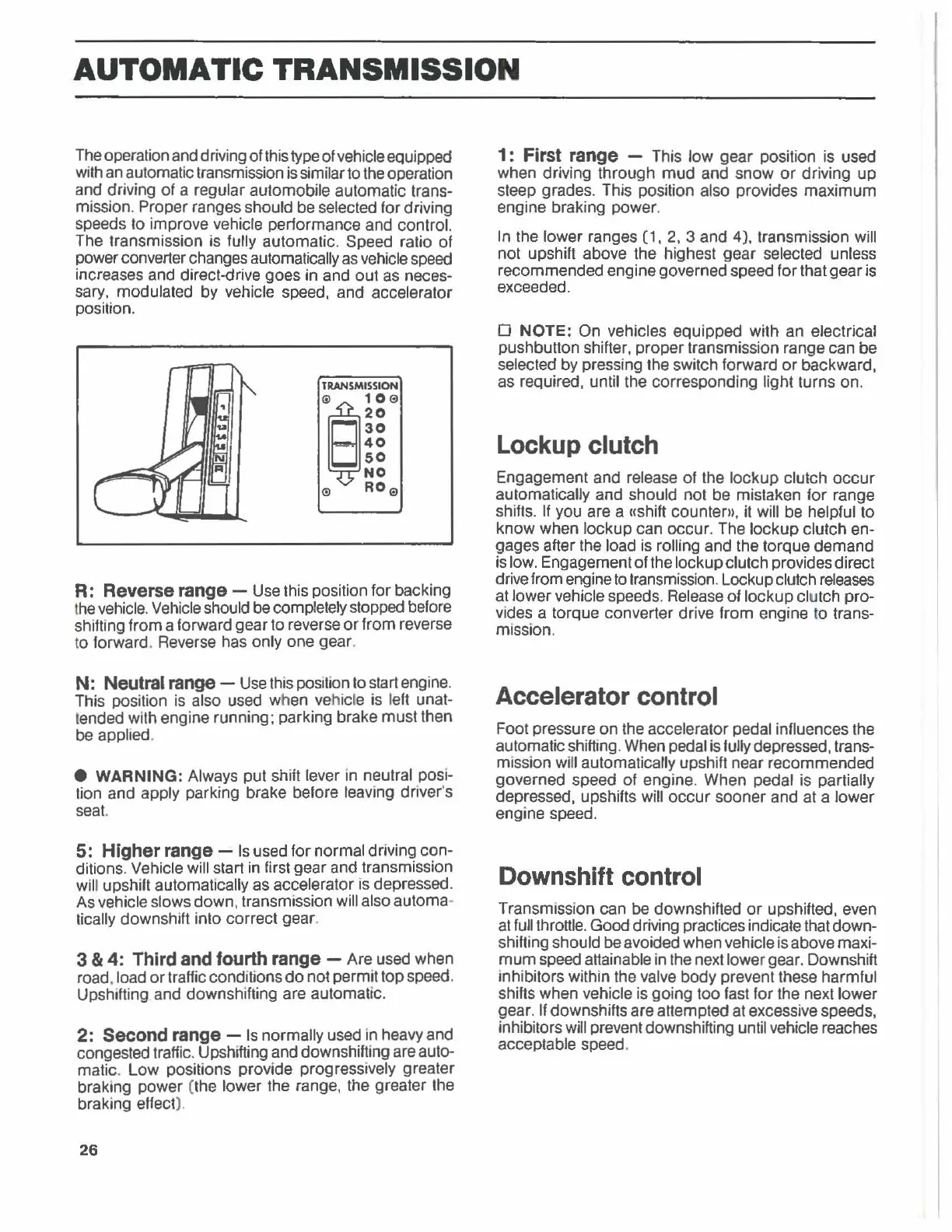
R: Reverse range - Use this position for backing
t
he
vehicle. Vehicle should be completely stopped before
shifting from a forward gear to reverse
or
from reverse
to forward. Reverse has
only one gear.
N:
Neutral
range
- Use this positi
on
to start engine.
This position is
also used when vehicle is left unat-
tended with engine running : parking brake must then
be
applied.
•
WARNING
: Always put shift lever in neutral posi-
tion and
apply parking brake before leavi
ng
driver's
seat.
5: Higher range - Is used for normal
dr
iving
con-
ditions. Vehicle will start in first
gear
and transmission
will upshi
ft
automatically as accelerator is depressed.
As
vehicle slows
down
, transmission will also automa-
tically downshift into correct gear.
3 &
4:
Third
and
fourth
range
- Are used when
road.
load
or
traffic conditions
do
not
permit top speed.
Upshifting and downshifting are automatic.
2:
Second
range - Is normally used in heavy and
congested traffic.
U pshifting and downshifting are auto-
matic.
Low
positions provide progressively greater
braking power (the
lower the range, the greater the
braking effect) .
26
1 : First range - This
low
gear
position is used
when driving
through
mud
and
snow
or
driving
up
steep grades. This position also provides
maximum
engine braking power.
In the lower ranges
(1
,
2,
3 and 4). transmission will
not upshift above the highest
gear
selected unless
recommended engine governed speed for that
gear
is
exceeded.
0
NOTE:
On
vehicles equipped with an electrical
pushbutton shifter,
proper
transmission range can be
selected by pressing the switch forward
or
backward,
as
required, until the corresponding light turns
on
.
Lockup
clutch
Engagement and release
of
the
lockup
clutch
occur
automatically and should
not
be mistaken
for
range
shifts.
If
you are a «shift countern, it will be helpful to
know
when lockup can
occur
. The
lockup
clutch en-
gages after the
load is rolling and the torque
demand
is low. Engagement
of
the lockup clutch provides direct
drive from engine to transmission. Lockup clutch releases
at lower
vehicle speeds. Release
of
lockup clutch pro-
vides a torque converter drive
from
engine to trans-
missi
on
.
Accelerator control
Foot pressure
on
the accelerator pedal influences the
automatic shifting. When pedal is
fully depressed, trans-
mission
will automatically upshift near recommended
governed speed
of
engine. When pedal is partially
depressed, upshifts will
occur
sooner
and at a
lower
engine speed.
Downshift
control
Transmissi
on
can be downshifted
or
upshifted, even
at
full throttle. Good driving practices indicate that down-
shifting
should be avoided
when
vehicle is above
max
i-
mum
speed attainable in the next lower gear. Downshift
inhibitors within the valve body prevent these harmful
shifts when vehicle is
going
too fast for the next lower
gear
. If downshifts are attempted at excessive speeds,
inhibitors
will prevent downshifting until vehicle reaches
acceptable speed.


 To Next Page