40 PI-MAX
®
3 System Manual Version 1.A
and from there to the output node and off of the array for further processing. The process
continues until all charges have been completely transferred out of the array. The imaging
cells are electronically switched off and do not accumulate any charge as the readout
takes place. Because this scheme is less time efficient than that used in the overlapped
mode, the frame rate may be lower in non-overlapped operation than it is in overlapped
operation with the some gating setups.
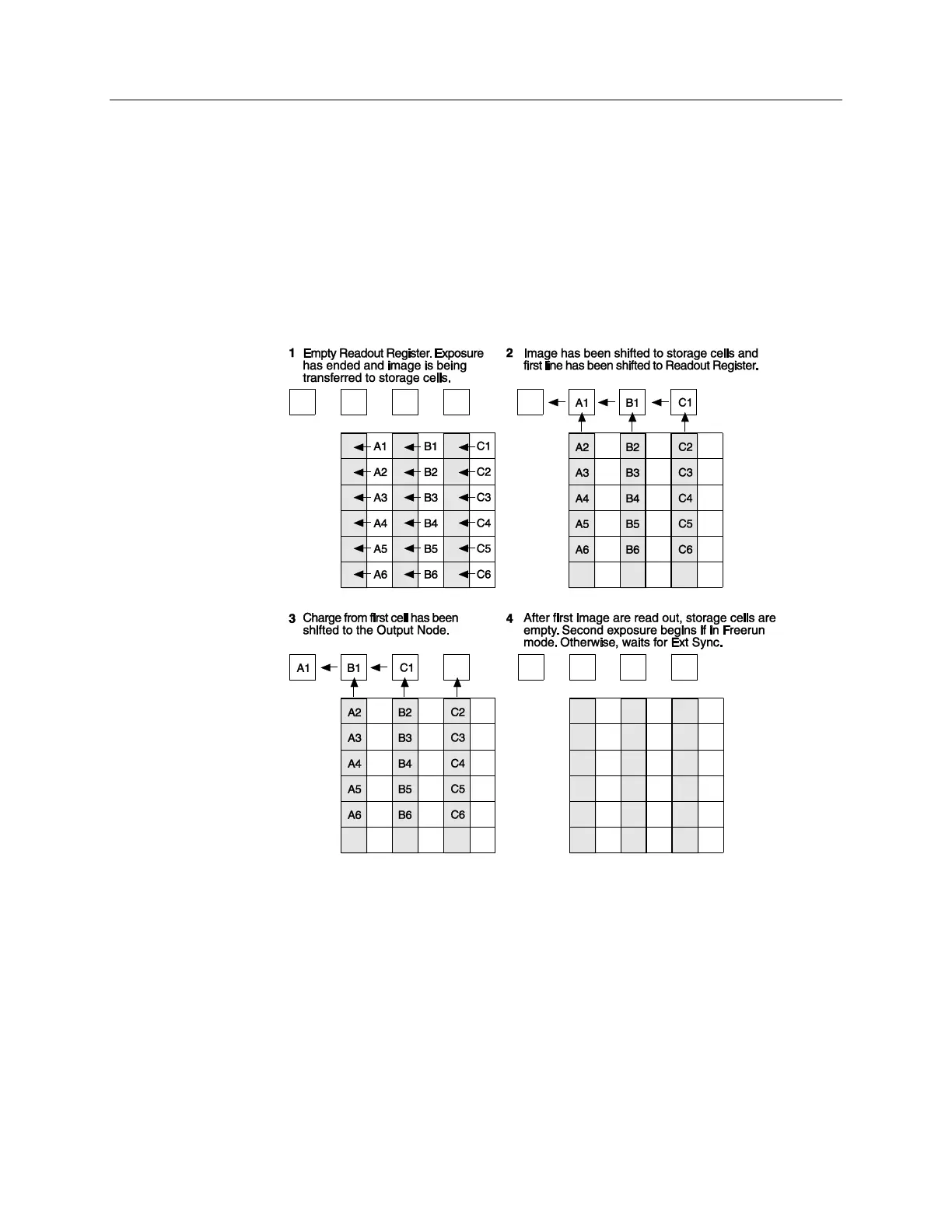
Part 4 of Figure 10 illustrates the situation at the end of the readout. Both the imaging and
storage cells are empty. In internal trigger operation, the imaging cells will be switched
back on immediately, allowing charge accumulation to begin. In Ext Sync operation with
no PreOpen, they are not switched back on until after the External Sync pulse is detected.
Figure 10. Non-Overlapped Mode Exposure and Readout
A subsection of the CCD can be read out at full resolution, sometimes increasing the
readout rate while retaining the highest resolution in the region of interest (ROI).


 To Next Page