Chapter 5 General Operation Factors 41
Readout Rate for Interline
Below are the equations that determine the rate at which the CCD is read out. Tables of
values for CCDs supported at the time of the printing of this manual also appear below.
Assuming the shutter selection is None, the time needed to take an entire frame at full
resolution in non-overlapped timing mode is:
t
R
+ t
exp
(1)
where
t
R
is the CCD readout time,
t
exp
is the exposure time.
The readout time is approximately given by:
t
R
= [N
x
· N
y
· (t
sr
+ t
v
)] + (N
x
· t
i
) (2)
where
N
x
is the smaller dimension of the CCD
N
y
is the larger dimension of the CCD.
t
sr
is the time needed to shift one pixel out of the shift register
t
v
is the time needed to digitize a pixel
t
i
is the time needed to shift one line into the shift register
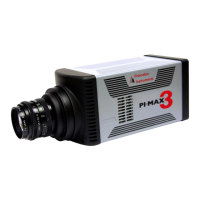
The readout rate in frames per second for the PI-MAX3:1003 Kodak 1024 × 1024
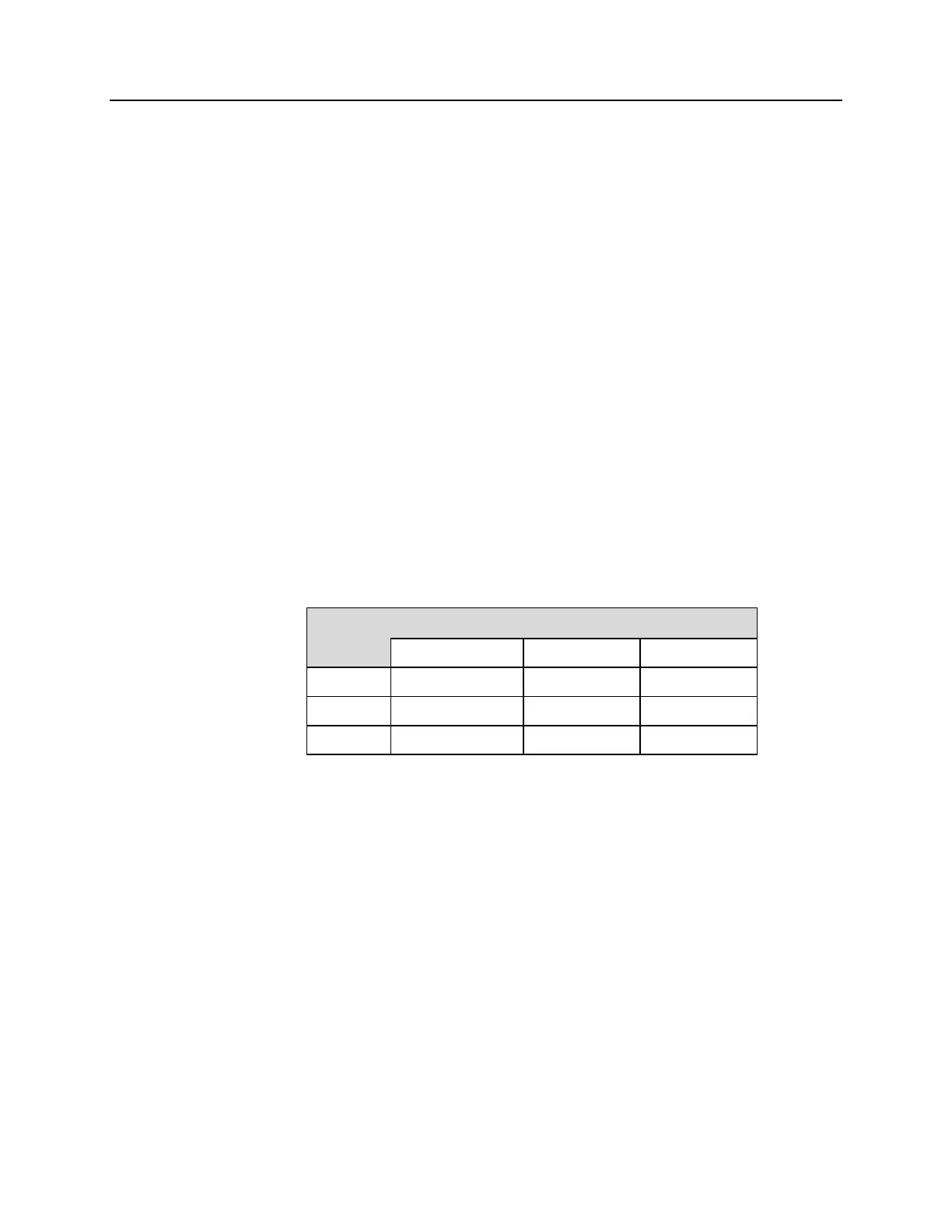
interline array running at 16 MHz is shown in Table 1.
*ROI increased to 202x200 to accommodate GigE rules.
Table 1. Readout Rates for Kodak 1024 × 1024 Array at 16 MHz Dual Port
A subsection of the CCD can be read out at full resolution, sometimes increasing the
readout rate while retaining the highest resolution in the region of interest (ROI).


 To Next Page