48 PI-MAX
®
3 System Manual Version 1.A
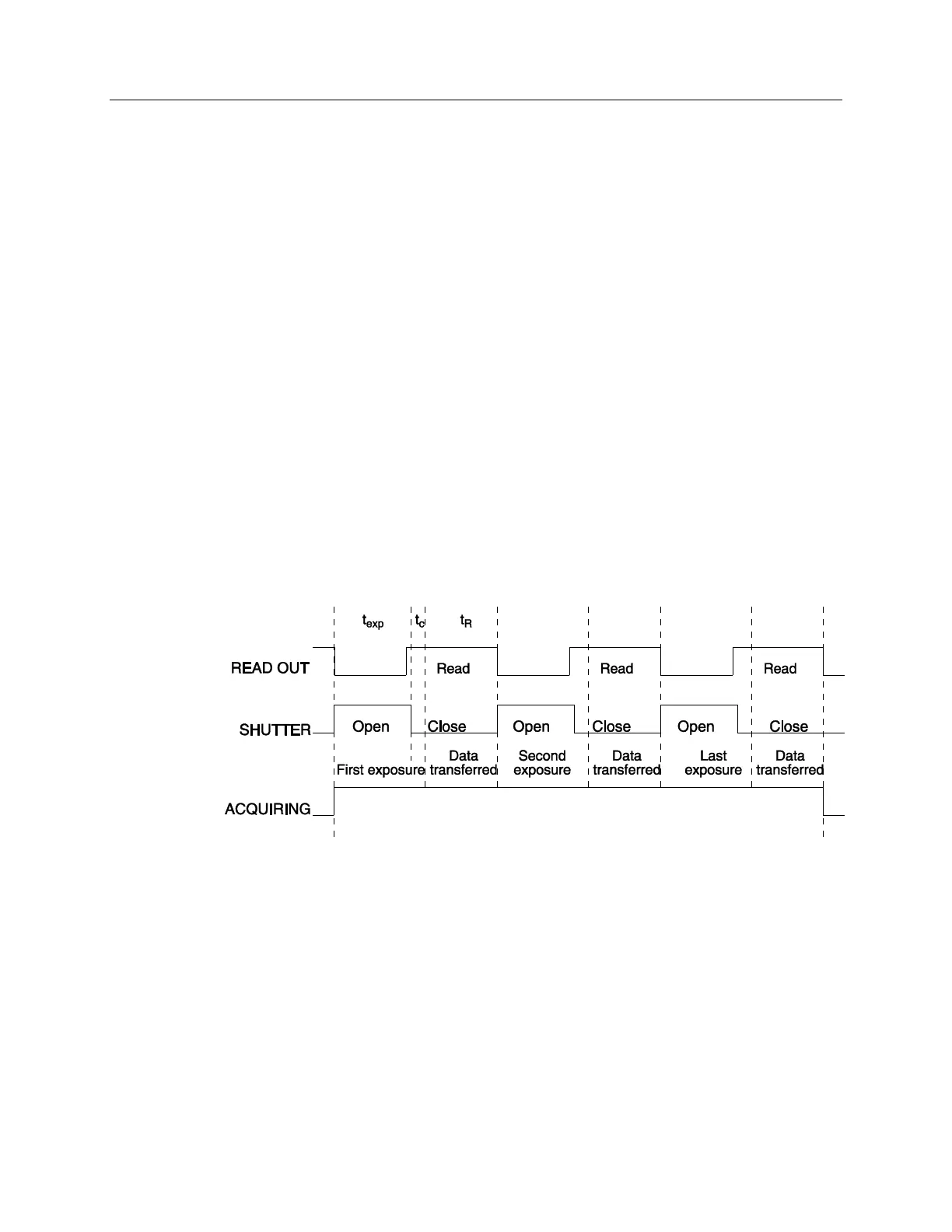
is halted. If a specific number of frames have been programmed, it remains high
until all have been taken and then returns low. Figure 17 assumes 3 frames have
been programmed.
Image Shift: This level is at a logic high while the image is being shifted under
the mask.
Logic 1: The level at the connector is high.
Read Out: It is at a logic high when CCD is being read; otherwise low.
Shutter: This level is at a logic high during the exposure time (signal is
accumulating on the CCD) and can be used to drive an external electro-
mechanical shutter. Contact the factory for more information.
Wait for Trigger: This level is at a logic high when the camera is ready to
acquire and is waiting for an external trigger (through the EXT SYNC connector)
before exposing the CCD. The level goes low when a trigger is detected:
exposure begins. The Wait for Trigger (WFT) signal goes high immediately after
readout or after preopen (if it is active). If continuous cleans is enabled, the
camera will check for a trigger at the EXT SYNC connector before entering a
continuous clean cycle. If none has occurred, a cleaning cycle is initiated and
completed. Before the next cycle begins, the EXT SYNC connector is checked
again, and exposure will start if a trigger has occurred.
When the Invert LOGIC check box is checked, the output is at a logic low when the
action is occurring.
Figure 17. Comparison of READOUT, SHUTTER, and ACQUIRING Logic Output Levels


 To Next Page