6. Operational range
6a) The PL-TREE-COM can be oriented in any direction when operating under 200ft of range.
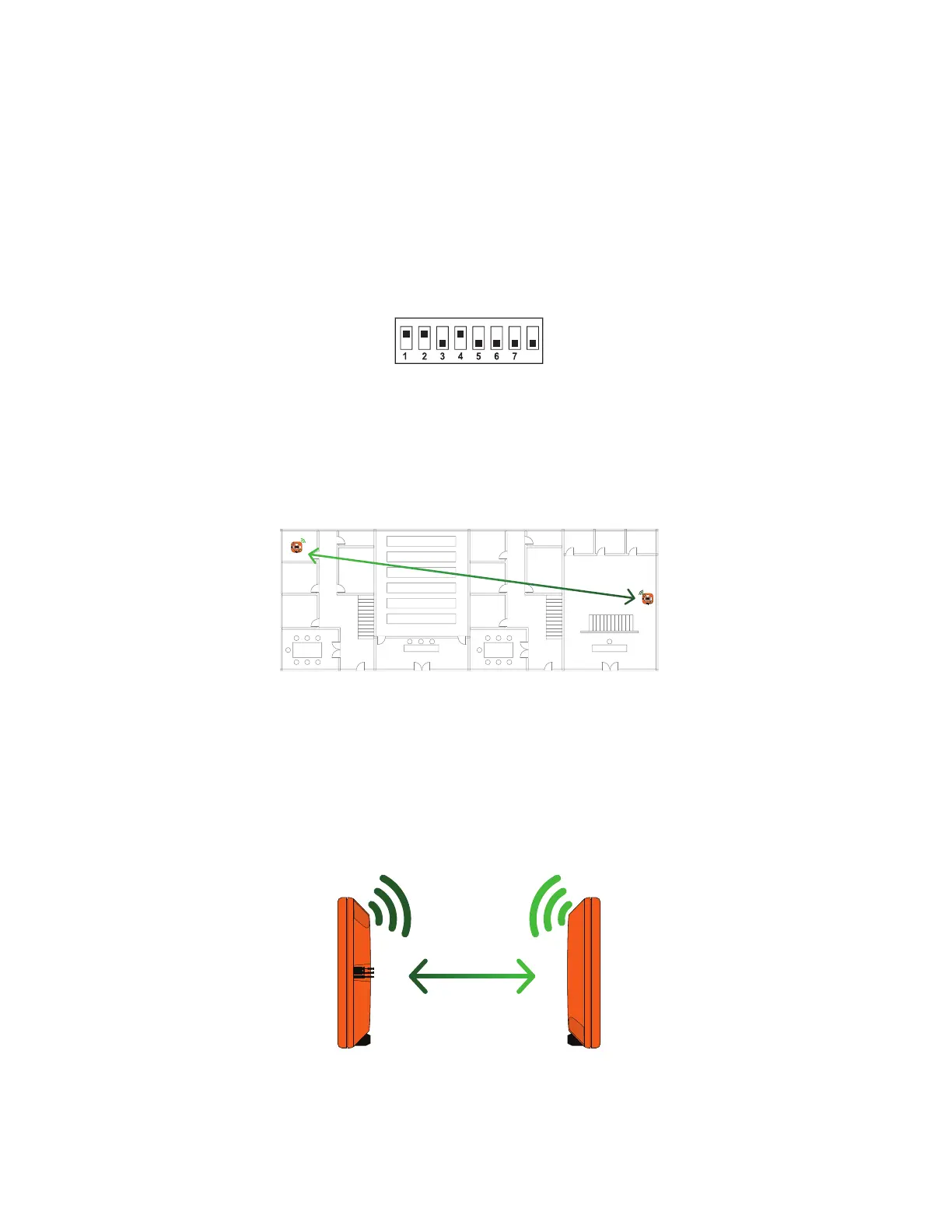
6b) The PL-TREE-COM can cover distances up to 2500 ft when oriented properly. (Figure 4)
Figure 4
2,500 ft
6c) The PL-TREE-COM radio wave pattern is directional, meaning the signal beam, while able to radiate everywhere, will
travel farther in one specic direction. The built-in antenna is aligned with its front cover (face with the lights and
dipswitches). In order to achieve maximum range, or communicate through complex building structure, both PL-TREE-
COM modules communicating together should have their faceplates facing each other. Signal quality (read at the
"LEAF" module) must be at least 30% to achieve proper communication. (Figure 5)
NOTE: Aligning TREE-COM modules face to face is highly recommended for distances beyond 200 ft.
Figure 5
A signal quality
of at least 30% is
required for proper
communication
5. Channel number conguration
AuniquechannelnumberoneachTREE-COMmustbeconguredbysettingtherst7switchesonthechannelnumber
dipswitch block to the desired value.
These switches are numbered from 1 to 7 and represent a binary value from 0 to 64 (0, 1, 2, 4, 8, 16, 32, 64 respectively).
The value of each switch that is in the ON position is added together to form the numerical value of the TREE-COM channel
used.
The example on Figure 3 shows switches 1, 2 and 4 on the ON position. So the corresponding values are 1, 2 and 8, giving
a sum of 11. (1+2+8=11)
TREE-COM modules allow the use of up to 128 channel numbers.
Figure 3
7. Weatherproof enclosures
Should a PL-TREE COM module need to be installed outdoors, we recommend installing it in a plastic or resin NEMA 4 type
enclosure, do not install inside a metal enclosure, since it will block all radio signals.
6-2


 To Next Page
 Loading...