26. February 2024 © Copyright 2024, PROCEQ SA 43
Calibration of the speed of sound on the surface of the test object
This option can be used when the thickness of the test object is not known. However,
the properties of concrete in the near-surface area can differ from those in the volume.
This means that the speed of sound can also differ.
The pulse velocity of signals traveling near the surface of the concrete is determined.
Press the transducer against the surface to make a measurement. Several
measurements can be made using the snapshot key at different locations and an
average value is calculated.
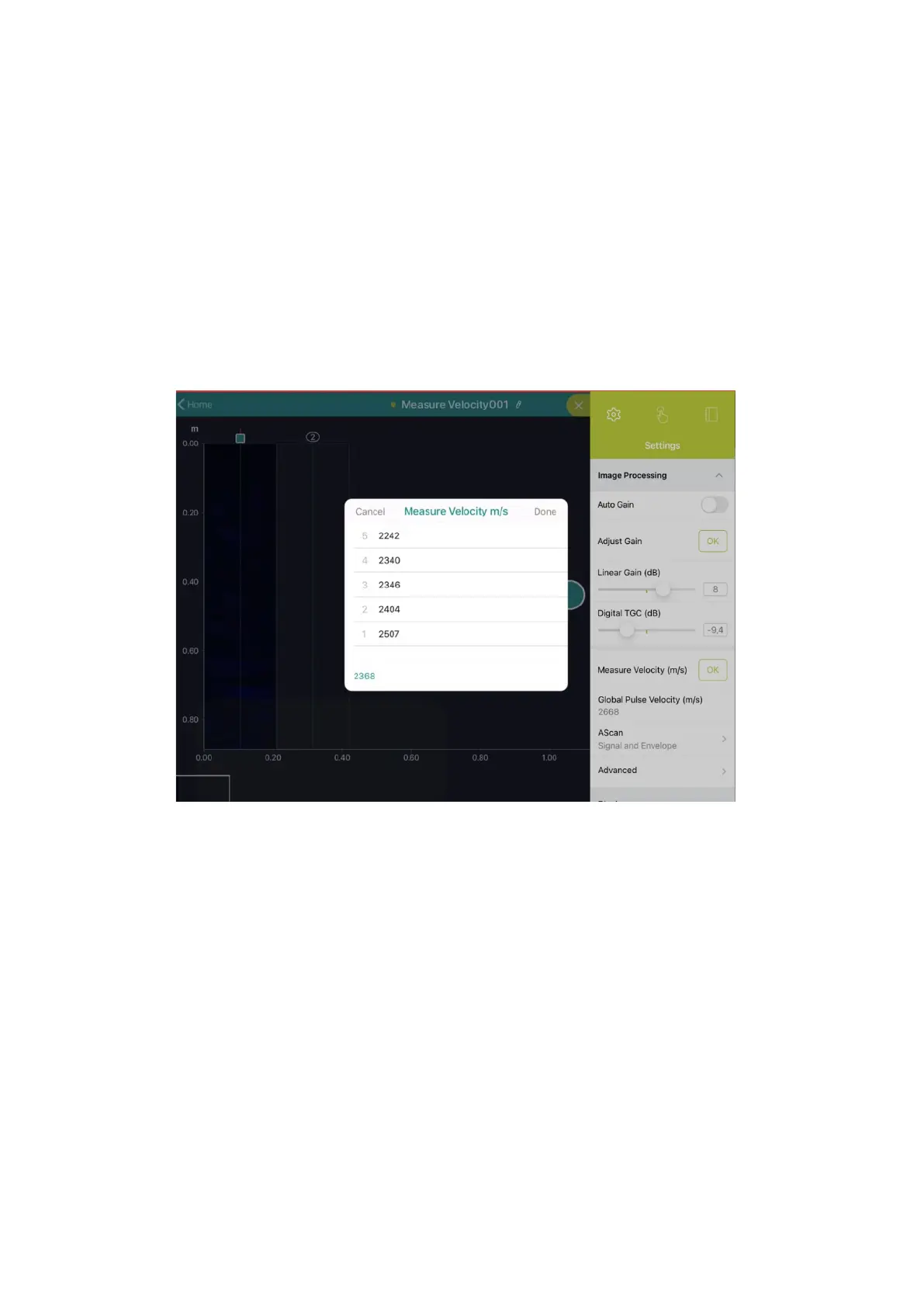
To do so, tap “Measure Velocity”. Then a window will pop up. Perform 5 to 10
measurements in the test area moving the sensor around. The average value will be
stored.
Figure 43: Calibration of the speed of sound in the test object.
Estimation of the speed of sound based on empirical values.
This method should only be used in exceptional cases and requires a good knowledge
of the materials. Increased measurement uncertainties are to be expected.
5.15 Ultrasound Pulse Velocity Determination with Ultrasound Pulse Echo
PD8050 measures shear waves, which are also called S-waves. The velocity of the ultrasound
waves depends on the quality, homogeneity, and density of the material.
Even if it is important to calibrate first the wave velocity in each specific concrete element, you
will always get good images with a typical pulse velocity. Afterward, if you want more precise
depth information, you can calibrate the pulse velocity.



 To Next Page