Note: Only when a valid CTCSS/DCS code is scanned and stopped, press the [MENU] key to store the CTCSS/DCS code and replace the
corresponding CTCSS/DCS code of the current channel or frequency.
6.2 DTMF
DTMF is an in-band signaling method using dual sinusoidal signals for any given code. Originally developed for telephony systems, it has proved
a very versatile tool in many other areas.
In two-way radio systems, DTMF is most commonly used for automation systems and remote control. A common example would be in amateur
radio repeaters where some repeaters are activated by sending out a DTMF sequence (usually a simple single-digit sequence).
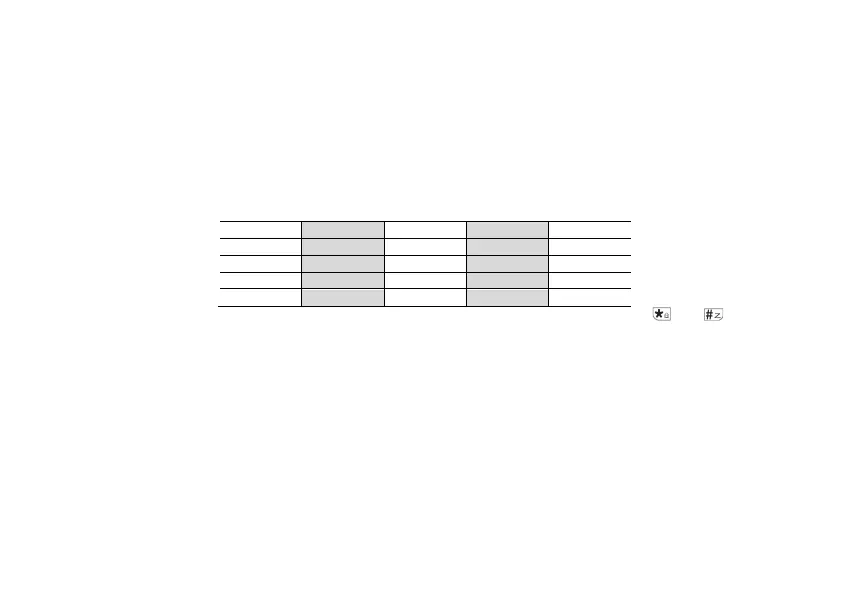
DTMF frequencies and corresponding codes
1209Hz 1336Hz 1477Hz 1633Hz
697Hz 1 2 3 A
770Hz 4 5 6 B
852Hz 7 8 9 C
941Hz * 0 # D
The radios has a full implementation of DTMF, including the A, B, C and D codes. The numerical keys, as well as the and keys
correspond to the matching DTMF codes. The A, B, C and D codes are located in the [MENU], , and [EXIT] keys respectively.
To send DTMF codes, press the key(s) corresponding to the message you want to send while holding down the PTT key.
In general, there are two forms of selective calling in two-way radio systems: Group call, and Private call.
Group call, as the name suggest, is a one-to-many form of communication. Every radio in your working group is configured the same way and
any radio will make contact with every other radio in the group.
Private call, some times also known as paging, is a one-to-one form of communication.
Every radio is programmed with a unique ID code. And only by sending out a matching code can you get that radio to open up to your
transmissions.
6.3 Dual Watch
In certain situations, the ability to monitor two channels at once can be a valuable asset. This can be achieved in one of two ways. You can either
have one receiver in your radio and flip-flop between two frequencies at a fixed interval (known as Dual Watch), or you can equip a radio with



 To Next Page