59
d) Adjusting the backlash
Themanufacturerhasalreadypresetthebacklash.Asarule,nocorrectionisrequired.
However,vibrationsmaycausethexingscrewsintheengine
to become loose after prolonged use. If this occurs, the screws
must be tightened and you must check that the backlash is
correct.
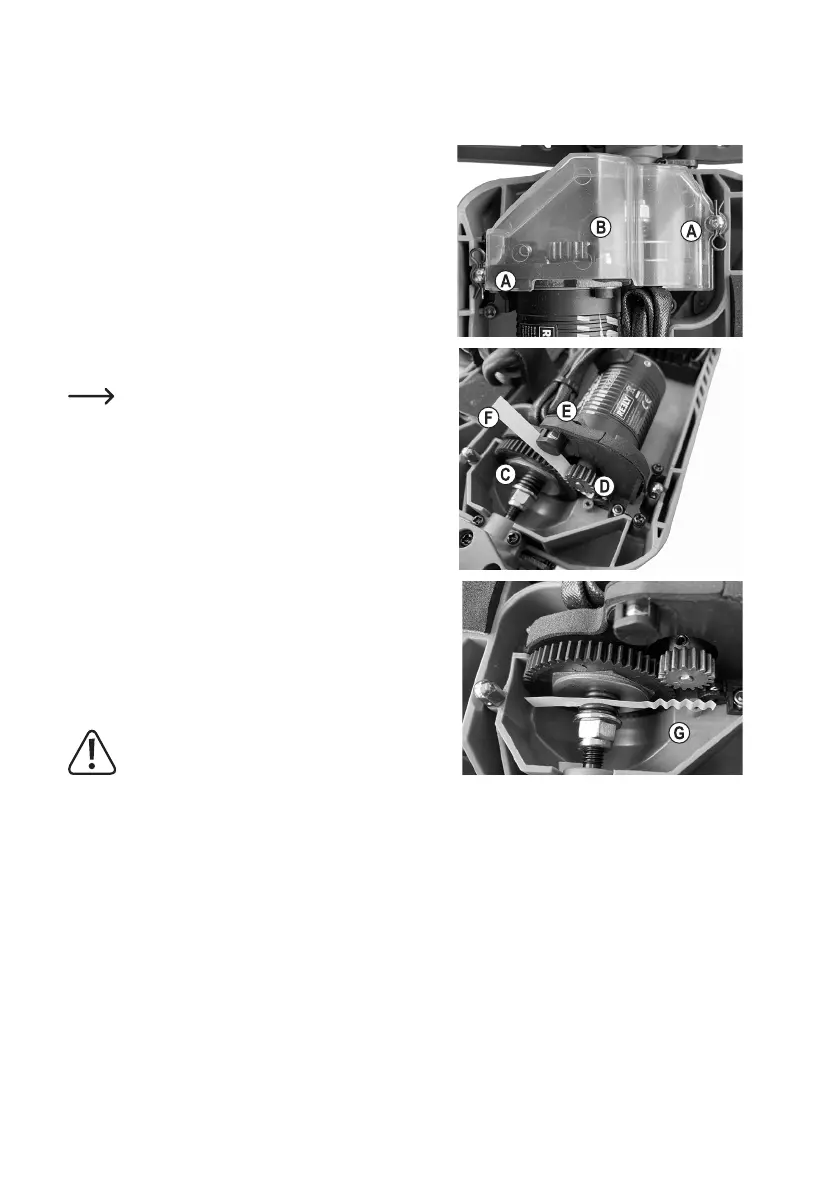
Pull out the two clips (A), then remove the dust cover (B).
Basically, the distance between the main gear (C) and the en-
gine pinion (D) must be as small as possible, but without the
gears running strictly.
Loosentheupperxingscrew(E)oftheenginealittlebit.Gen-
tly slide the engine with the engine pinion (D) in the direction
of the main gear (C).
Theenginemustnotshake;thexingscrewshould
only be loosened enough to allow the engine to
move.
The engine pinion and the main gear will now be engaged
without backlash. However, this is not optimal for the service
life of the gears!
Place a strip of thin paper (F) between the main gear (C) and
theenginepinion(D).Turnthemaingearso thatthepaper
strip (max. 80 g!) is pulled between the two gears.
Thepressureofthepaperpushestheelectricenginebythe
required amount.
Tightenthexingscrew(E)ontheengine.
When you turn the main gear in the other direction to remove
the strip of paper (G), both gears should be at the correct dis-
tance to one another.
Ideally, the engine pinion should be as close as pos-
sible to the main gear whilst ensuring that the cogs
do not touch, as this makes the gears too tight.
If the gears (engine pinion and main gear) are too
far apart, the cogs on the main gear will be damaged by the engine pinion after just a few seconds, which
will void the warranty/guarantee!
However, if the engine pinion presses against the main gear (i.e. there is no clearance between the cogs),
this will decrease performance, increase power consumption (the engine requires lots of power to turn the
main gear) and lead to premature wear.




 To Next Page