53
11. Vehiclecongurationoptions
a) Conguringthecamber
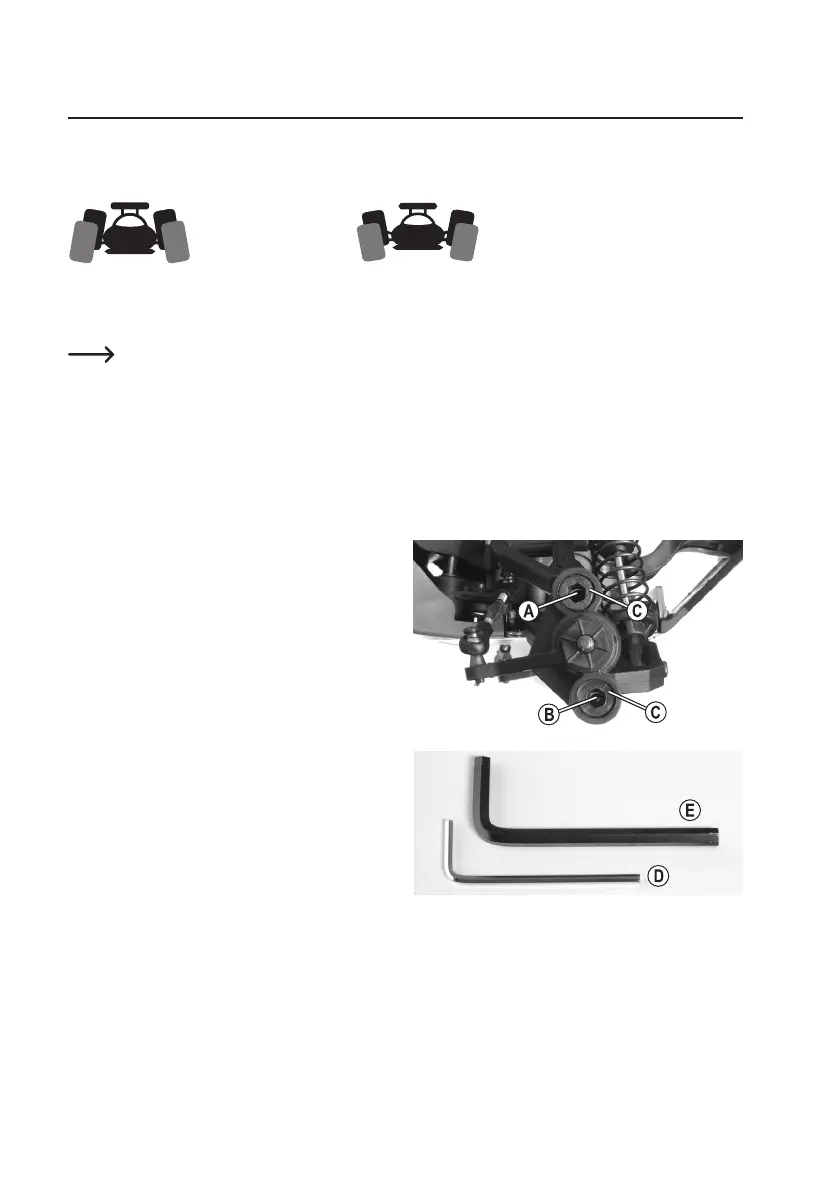
Thecamberistheinclinationofthewheelsasviewedfromthefront(vertical).
Negative inclination Positive inclination
(Topwheeledgepointsinwards) (Topwheeledgepointsoutwards)
Thealignmentofthewheelsisexaggeratedinthetwodiagramstoshowthedifferencebetweennegative
and positive camber. Obviously, such an extreme adjustment should not be made to the model vehicle!
• Anegativecamberonthefrontwheelsincreasesthelateralforcesonthetyreswhenturningcorners.Thismakes
the steering wheel more responsive and reduces the steering force. At the same time, the wheel is pushed onto the
axleleginthedirectionoftheaxis.Thisoffsetsaxialbearingclearanceandresultsinsmootherdriving.
• A negative camber on the rear wheels reduces the tendency of the rear of the vehicle to swing when turning corners.
• In contrast, a positive camber reduces the cornering force on the tyres and is generally not recommended.
Setting the front axle camber:
The"pivotball"suspensiononthefrontaxleconsistsof
a specially shaped steering knuckle, two spherical-head
screws (A) and (B) and two outer plastic set screws (C).
Toadjustthecamber,thespherical-headscrews(A)and
(B) must be turned over a small 2.5 mm hex key (D),
which is inserted through the hole of the set screw (C).
Theplasticsetscrews(C)canbetightenedorloosened
withalarger5mmhexkey(E).Theseareonlyintend-
edfor xingthesteeringknuckletothespherical-head
screws (A) and (B).
Never use force to tighten the set screws (C), as this may
prevent the wheel suspension from moving freely. How-
ever, the set screws (C) must not be too loose, otherwise
the spherical-head screws and the steering knuckle may
wobble.





 To Next Page