60
e) Adjusting the friction clutch
Thefrictionclutchprotectsthegearsagainstoverload(e.g.onnon-slipsurfaces).
In addition, adjusting the friction clutch correctly prevents the vehicle from overturning due to the brushless engine's
high torque.
Themanufacturerhasconguredtheoptimalsetting,thereforeyoudonotnormallyneedtomakeany
changes.
However, very frequent start-ups with full power on a surface with good grip can cause the slip clutch linings to wear
off over time, whereby an adjustment of the slip clutch may possibly be required. Furthermore, professional operators
canadjustthefrictionclutchbasedonthepreferredstartingbehaviouronaspecicsurface.
To adjust the clutch, proceed as follows:
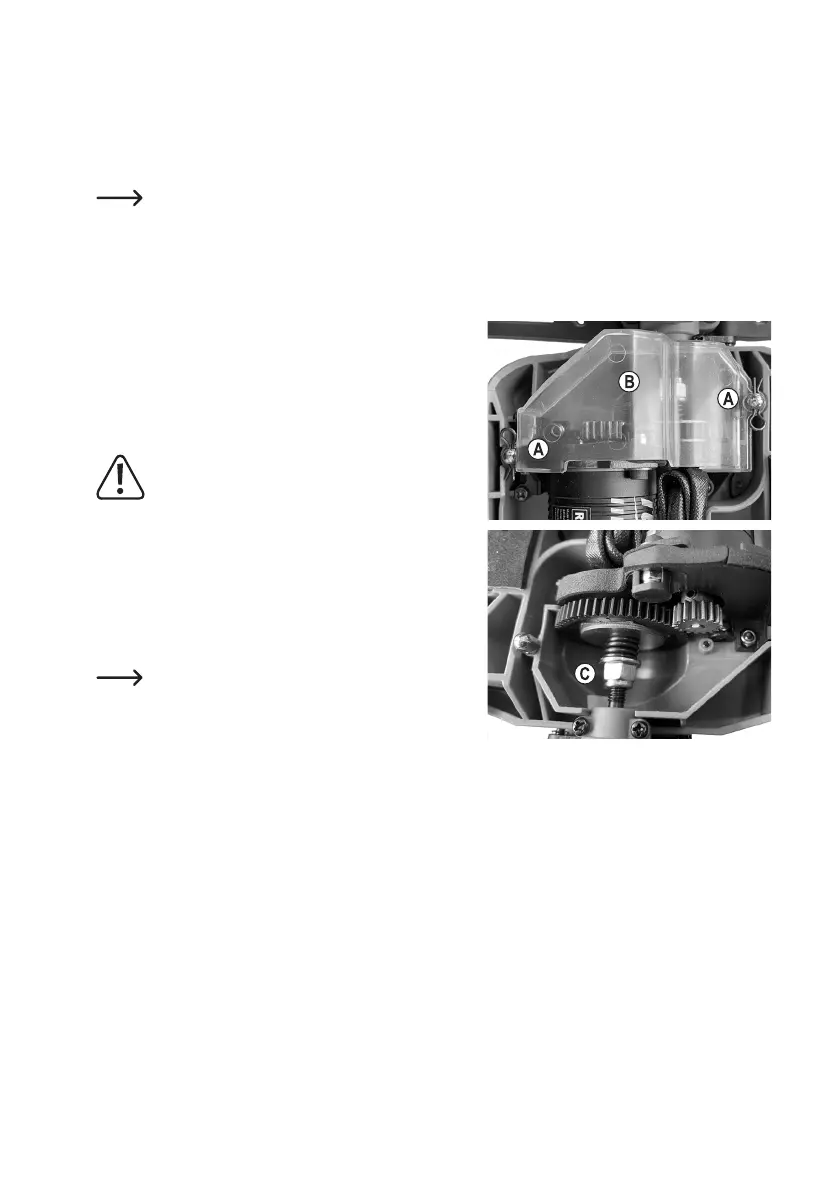
Pull out the two clips (A), then remove the dust cover (B).
Thefrictionclutchcanbeadjustedbyturningthehexnut(C).
Turnthehexnutclockwise(whenviewedfromtherearofthe
vehicle) to increase the drive power to the gearbox, or anti-
clockwise to decrease the power transmission.
If the friction clutch is too tight, the maximum drive
power will be transmitted and the clutch will not func-
tion.
This may damage the differential and the vehicle
may overturn on non-slip surfaces due to the high
torque from the brushless engine.
Ifthefrictionclutchistoo"soft",thisplacessigni-
cant wear on the friction clutch. It also affects ac-
celeration and may prevent the vehicle from moving
(due to spinning of the friction clutch).
Adjust the clutch in very small steps (max. 1/4 turn)
and check how the vehicle responds. Make a note of
each change so that you can revert to the previous
setting if necessary.




 To Next Page