P36E-4 Zero Clearance Direct Vent Gas Fireplace 35
GAS PIPE PRESSURE
TESTING
The appliance must be isolated from the gas
supply piping system by closing its individual
manual shut-off valve during any pressure
testing of the gas supply piping system at
test pressures equal to or less than 1/2 psig.
(3.45 kPa). Disconnect piping from valve at
pressures over 1/2 psig.
The manifold pressure is controlled by a regulator
built into the gas control, and should be checked
at the pressure test point.
Note: To properly check gas pressure, both
inlet and manifold pressures should
be checked using the valve pressure
ports on the valve.
1) Make sure the switch is in the "OFF" position.
2) Loosen the "IN" and/or "OUT" pressure
tap(s), turning counterclockwise with a
1/8" wide fl at screwdriver.
3) Attach manometer to "IN" and/or "OUT"
pressure tap(s) using a 5/16" ID hose.
4) Light the pilot by turning the switch to "ON"
position.
5) The pressure check should be carried out
with the unit burning and the setting should
be within the limits specifi ed on the safety
label.
6) When fi nished reading manometer, turn
off the gas valve, disconnect the hose and
tighten the screw (clockwise) with a 1/8" fl at
screwdriver. Note: Screw should be snug,
but do not over tighten.
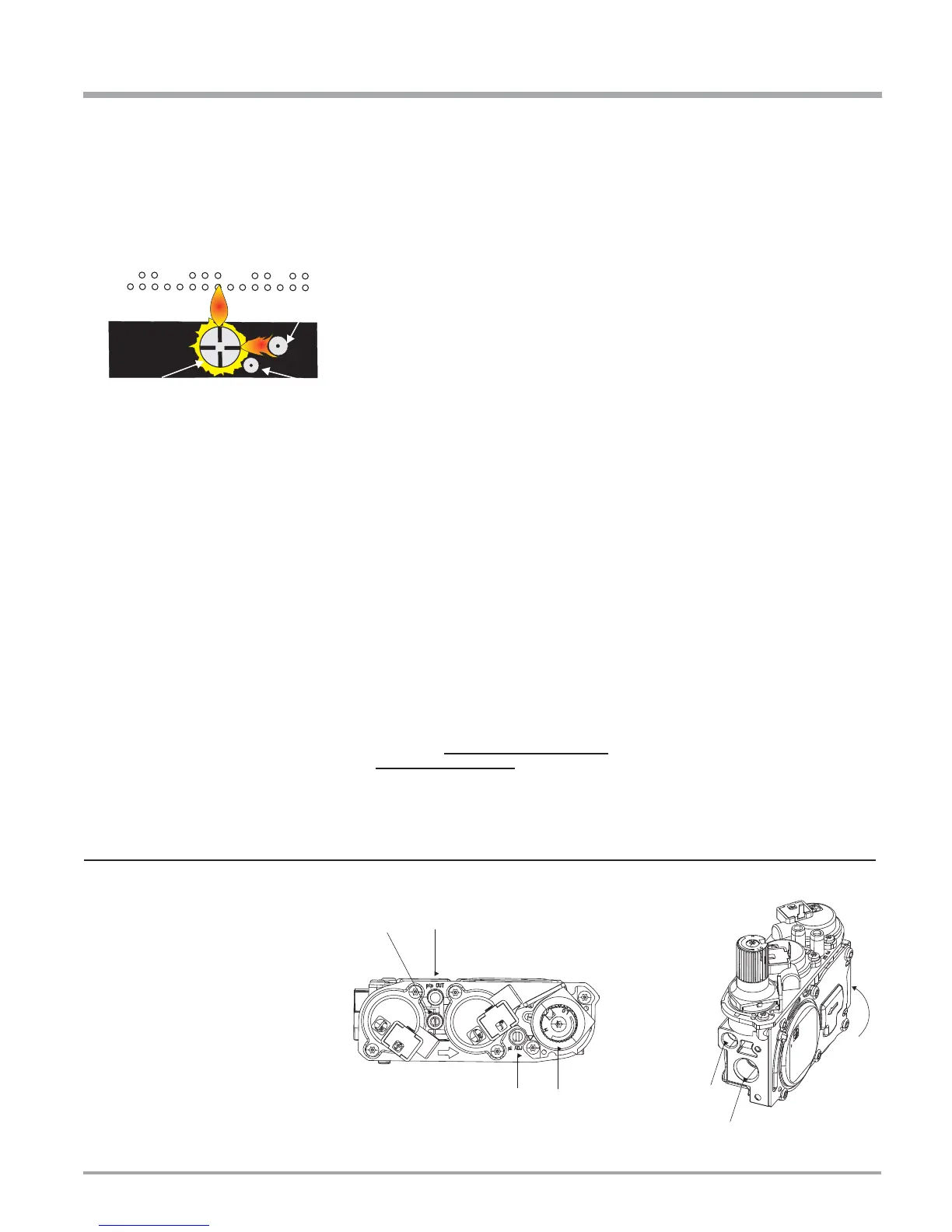
886 S.I.T. VALVE DESCRIPTION
1) Manual high/low adjustment
2) Pilot adjustment
3) Outlet Pressure Tap
4) Inlet Pressure Tap
5) Pilot Outlet
6) Main Gas Outlet
7) Main Gas Inlet
1
3
2
4
5
6
7
HIGH ELEVATION
This unit is approved in Canada for altitude to
4500 ft. (CAN/CGA-2.17-M91). For Natural Gas
installations above 4500 ft. follow current CAN/
CGA-B149.1.
PILOT ADJUSTMENT
Note: If you have an incorrect fl ame pattern,
contact your Regency
®
dealer for
further instructions.
Incorrect fl ame pattern will have small,
probably yellow fl ames, not coming into
proper contact with the rear burner or fl ame
sensor.
Burner
Flame Sensor
Pilot
Ignitor
Periodically check the pilot fl ames. Correct
fl ame pattern has two strong blue fl ames:
1 fl owing around the fl ame sensor and 1
fl owing across the burner (it does not have
to be touching the burner).
INSTALLATION



 To Next Page