3 - SAFETY DEVICES AND EQUIPMENT 50
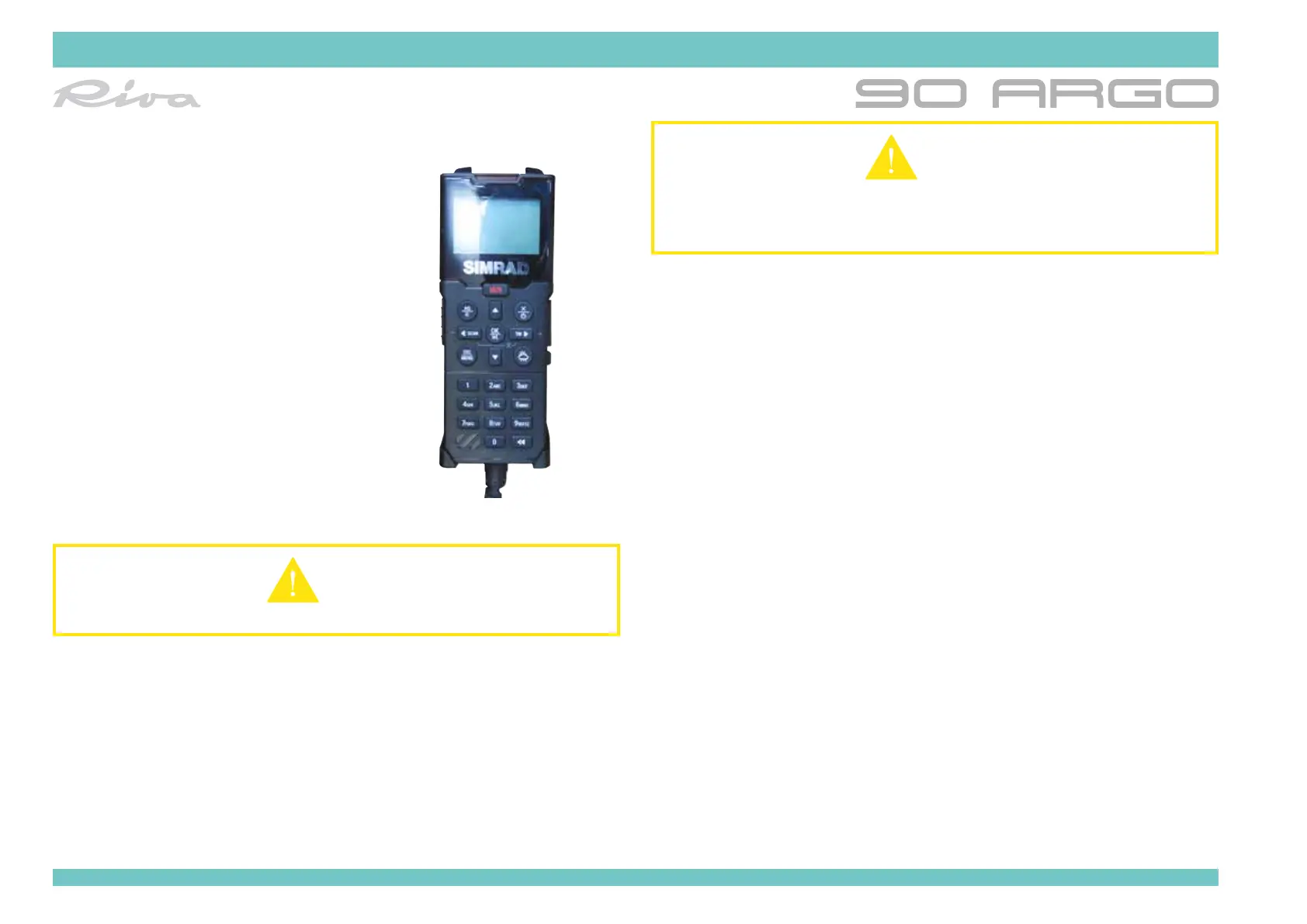
3.3.10 VHF-Radiotelephone (standard)
The VHF device allows communication
on channels dedicated to Port Authority,
rescue and radio stations.
To ask for rescue it is necessary to use
the suitable VHF/FM channel: after each
hour, as a legal rule, follow 6 minutes of
silence, from minute 0 to minute 3 and
from minute 30 to minute 33, so as to
enable a better listening of the distress
communications.
If the VHF is used, the distress call must
be preceded and ended by the wording
“MAYDAY, MAYDAY, MAYDAY”.
It is therefore necessary to give your
position, the yacht’s name, the kind of
damage and the kind of help you require
(medical, mechanical, etc..).
CAUTION
Perform the “MAYDAY” rescue call, only in case of real need.
If, listening to the distress channel, a distress call that has not yet received
an answer is picked up, it is possible to send a “MAYDAY RELAY, MAYDAY
RELAY, MAYDAY RELAY”, forwarding the communication of the person
who requested rescue.
It can in fact happen that the distress call, carried out on the open sea or
by means of a poorly powered sender, is not received by the rescue team.
Acting as a spokesman, you can help the message reach its destination
successfully.
CAUTION
Perform the call “MAYDAY RELAY” only if there is a reasonable certainty
that the message has not been collected by the rescue team so as not to
engage the distress channel uselessly.
The use of the standard procedure avoids making confusion and shortens
the transmission time. In case of danger, use only the phonetic alphabet
recommended.
The VHF device is a vital and important communication line; please remem-
ber some fundamental rules:
• No transmission should be performed without reason;
• Listen before transmission so as to avoid interference with other senders;
• For distress calls, use and hold the best possible wireless contact;
• Always use your call identication or the name of the yacht in order to make
yourself identiable. The use of names or family names is not allowed;
• Send short and clear messages;
• For distress calls it is important to give the yacht’s position, the kind of
danger, the time passed in water, the kind of yacht and the number of
persons involved;
• For other calls, once the contact with the person called has been estab-
lished, transfer the call on an operation channel;
• Cut out transmission if required by a coastal station;
• Retune the radio when the call is ended.



 To Next Page