•
LOCKING
AND
UNLOCKING
THE
MASTER
TUNING:
1.
Press and hold the SET piston.
2.
Turn the Select Knob counter clockwise (left) until the Console Display reads:
MASTER
TUNING
LOCKED
A=440.0
3.
Rotate the Alpha Dial until the Console Display reads
"ADmST
ABLE" or
"MANUAL ADJ ONLY".
4.
Press General Cancel to return
to
the Transposer menu. Note: The Console
Display reads "TRANSPOSER 0 TUNING A =440.
0"
(default setting) when the
Master Tuning
is unlocked
•
ADJUSTING
THE
PITCH:
1.
Make sure the Master Tuning
is
unlocked.
2.
The Console Display reads:
TRANSPOSER
0
TUNING
A =
440.0
3.
Rotate the Alpha Dial to adjust the tuning.
Note: When the organ is turned off, the tuning will return to the default setting
(A
=440.
0).
TEMPERAMENTS
In recent years, there has been a renewed interest
in
authentic interpretation
of
organ
literature written before the adoption
of
Equal Temperament tuning. Until the middle
of
the
18th century, the relative pitches
of
the notes
of
the scale were chosen to favor music written
in
key signatures with few sharps
or
flats~
more remote keys produced varying degrees
of
aural
distress. Many composers
of
the day utilized moderately out
of
tune intervals to evoke
momentary tension to the listener. With the adoption
of
the Equal Temperament ("Well-
Tempered") tuning system, almost universal today,
all
keys became equally out
of
tune, and the
intentions
of
these earlier composers were iost, to some degree.
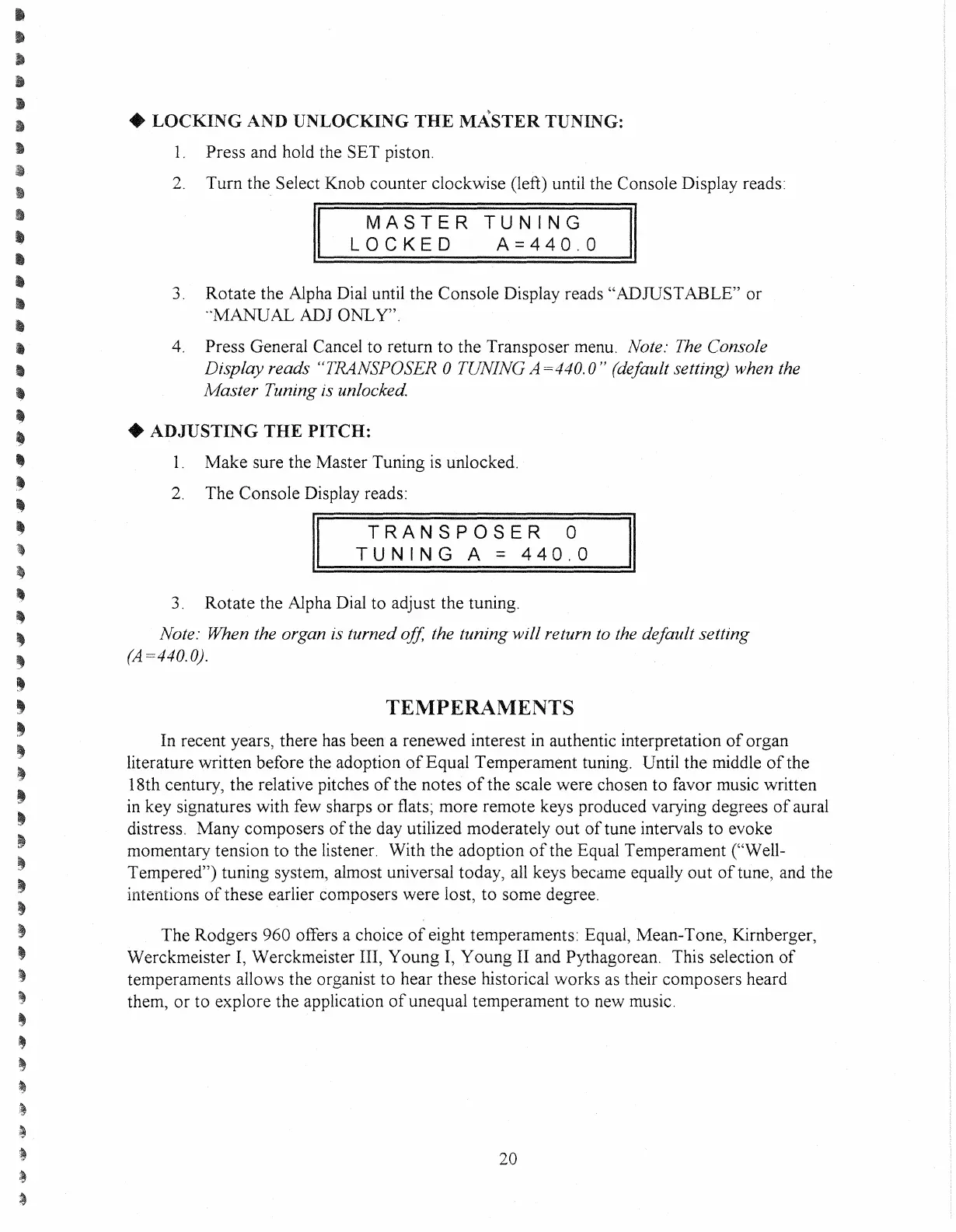
The Rodgers 960 offers a choice
of
eight temperaments: Equal, Mean-Tone, Kirnberger,
Werckmeister
I,
Werckmeister III, Young
I,
Young II and Pythagorean. This selection
of
temperaments allows the organist to hear these historical works
as
their composers heard
them,
or
to explore the application
of
unequal temperament to new music.
20


 To Next Page