EB 3018 EN 7-5
Operation
10. Thread the lock nut (2.2) all the way to
the top toward the stem connector (1.2)
and lock in place (see 'Tightening
torques' in Annex).
Î Adjustment with actuator · See Fig.7-1
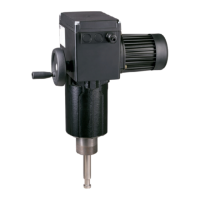
More details on the Type5827-N3 Electric
Actuator in uEB5827-1 and uEB5827-2
as well as on the Type3374 Electric Actua-
tor in uEB8331-3 and uEB8331-4
with Type5827-N3 or Type3374 Actuator
1. Extend the actuator stem (1.1) all the
way to close the restriction (2.7) using
the manual override (4mm hex wrench)
or by applying an electric control signal.
The lock nut (2.2) must be threaded up-
ward against the stem connector (1.2).
2. Loosen the locking screw (2.6) and turn
the set point adjuster (2.3) clockwise ()
as far as it will go to close the restriction
(2.7).
3. Determine the turns required to achieve
the desired ow rate from the adjustment
diagrams (see Table 7-2).
4. Based on a closed restriction, turn the set
point adjuster counterclockwise () to
adjust the ow rate set point.
5. Check the ow rate at the heat meter and
correct it, if necessary.
6. Once the ow rate is set as required,
lock the setting with the locking screw
(2.6).
Manual changes or changes in the control
signal to retract actuator stem now cause the
restriction to open until the ow rate reaches
the adjusted set point.
7.2.3 DN125 to 250
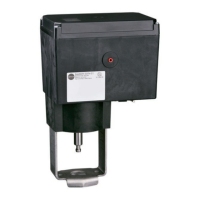
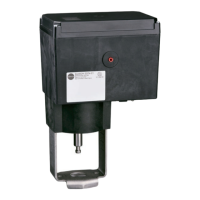
Type3374 Electric Actuator
Î Adjustment without actuator · See
Fig.7-1
1. Thread the lock nut (2.2) upwards to the
top of the rod (2.1).
2. Press the rod (2.1) downward to close
the restriction (2.7).
3. Loosen the locking screw (2.6) and turn
the set point adjuster (2.3) clockwise ()
until the scale reading 0 is located above
the red groove mark (2.5).
4. Thread the lock nut (2.2) downward
against the set point adjuster (2.3). Make
sure that the rod does not get turned by
holding the threaded rod (2.1) stationary
at the attened part using a wrench.
5. Determine the scale divisions required to
achieve the desired ow rate from the
adjustment diagrams (see Table 7-2).
6. Turn the hex nut on the set point adjuster
(2.3) until the previously determined
scale reading is located above the red
groove mark (2.5) on the reference ring.
7. Check the ow rate at the heat meter and
correct it, if necessary.
8. Once the ow rate is set as required,
lock the setting with the locking screw
(2.6).



 To Next Page