1 Design and principle of
operation
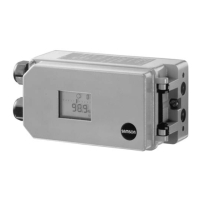
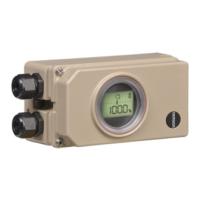
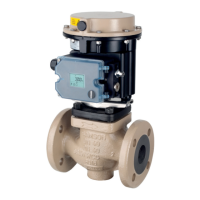
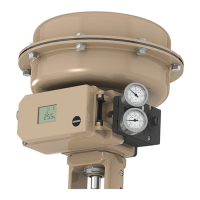
The electropneumatic positioner is attached
to pneumatic control valves. It is used to as
-
sign the valve stem position (controlled vari
-
able x) to the control signal (reference vari
-
able w). The input signal received from a
control system is compared to the travel or
rotational angle of the control valve, and a
pneumatic signal pressure (output vari
-
able y) is produced.
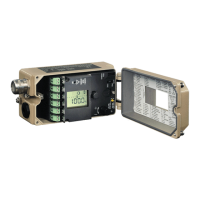
The positioner consists of a travel sensor sys
-
tem proportional to resistance, an analog
i/p converter with a downstream booster
and the electronics unit with microcontroller.
When a deviation occurs, the actuator is
pressurized or vented. If required, the
changes in the signal pressure can be
slowed down by a connectable Q restriction.
The signal pressure supplied to the actuator
can be limited by software or on site to 1.4,
2.4 or 3.7 bar.
A constant air stream to the atmosphere is
created by the flow regulator (9) with a
fixed set point. The air stream is used to
purge the inside of the housing as well as to
optimize the air capacity booster. The i/p
module (6) is supplied with a constant up
-
stream pressure by the pressure regulator
(8) to make it independent of the supply air
pressure.
EB 8384-4 EN 9
Design and principle of operation
Fig. 2 · Functional diagram


 To Next Page
 Loading...