Sea-Bird Dissolved Oxygen Sensor
SBE 43
Sea-Bird Electronics, Inc.
1808 136th Place NE, Bellevue, Washington 98005 USA
Website: http://www.seabird.com
Email: seabird@seabird.com
Telephone: (425) 643-9866
Fax: (425) 643-9954
The SBE 43 sets the oxygen measurement standard for oceanographic research.
The SBE 43 sensor is a Clark polarographic membrane type in which careful choices
of materials, geometry, and sensor chemistry are combined with superior electronics
interfacing and calibration methodology to yield major gains in performance.
Calibration stability is improved by an order of magnitude; the sensor holds
calibration in shipment and requires less frequent calibration.
Calibration drift is caused primarily by chemical processes inside the sensor and
by membrane fouling from ocean contaminants. If the membrane is kept clean,
the steps taken to improve the sensor’s chemical stability yield demonstrated
calibration drift rates of less than 2% over 1000 hours.
Temperature response and corrections are dramatically improved. The largest source
of error in profiling applications is nearly eliminated, and equilibration ‘wait time’ at the
beginning of a profile is reduced to seconds. Profiling accuracy in gradients is dramatically improved.
The chemical and physical processes that underlay the oxygen measurement are very sensitive to temperature. Accurate
characterization of the internal sensor temperatures that control these processes, especially when water temperature is
changing rapidly, is a key accomplishment of this design. Not only does the SBE 43 sensor measure temperature in the
right place: the temperature equilibration time of the entire sensor head has been reduced to a few seconds so that it tracks
the changing water temperature much more faithfully.
Pressure hysteresis is largely eliminated in the upper ocean (1000 meters). Oxygen features are more precisely resolved,
and the agreement in down-and-up profiles reduces the ambiguity about which should be locked to bottle Winklers.
Hysteresis in oxygen measurements is caused by delays in a sensor’s response to changing temperature, pressure — and
oxygen. Slow temperature response and time-mismatch of temperature corrections are responsible for most of the
hysteresis in the upper 1000 meters. These faults have been largely overcome in the SBE 43 design. Hysteresis from
pressure cycling remains a factor below 1000 meters.
Continuous polarization eliminates stabilization wait-time after power-up. The sensor is always ready for immediate use.
Earlier sensors required several minutes to ‘polarize’ following power-up. During that time, sensor readings were inaccurate.
In the SBE 43, micropower electronics and an internal, five-year, board-mounted battery eliminate power-up delay.
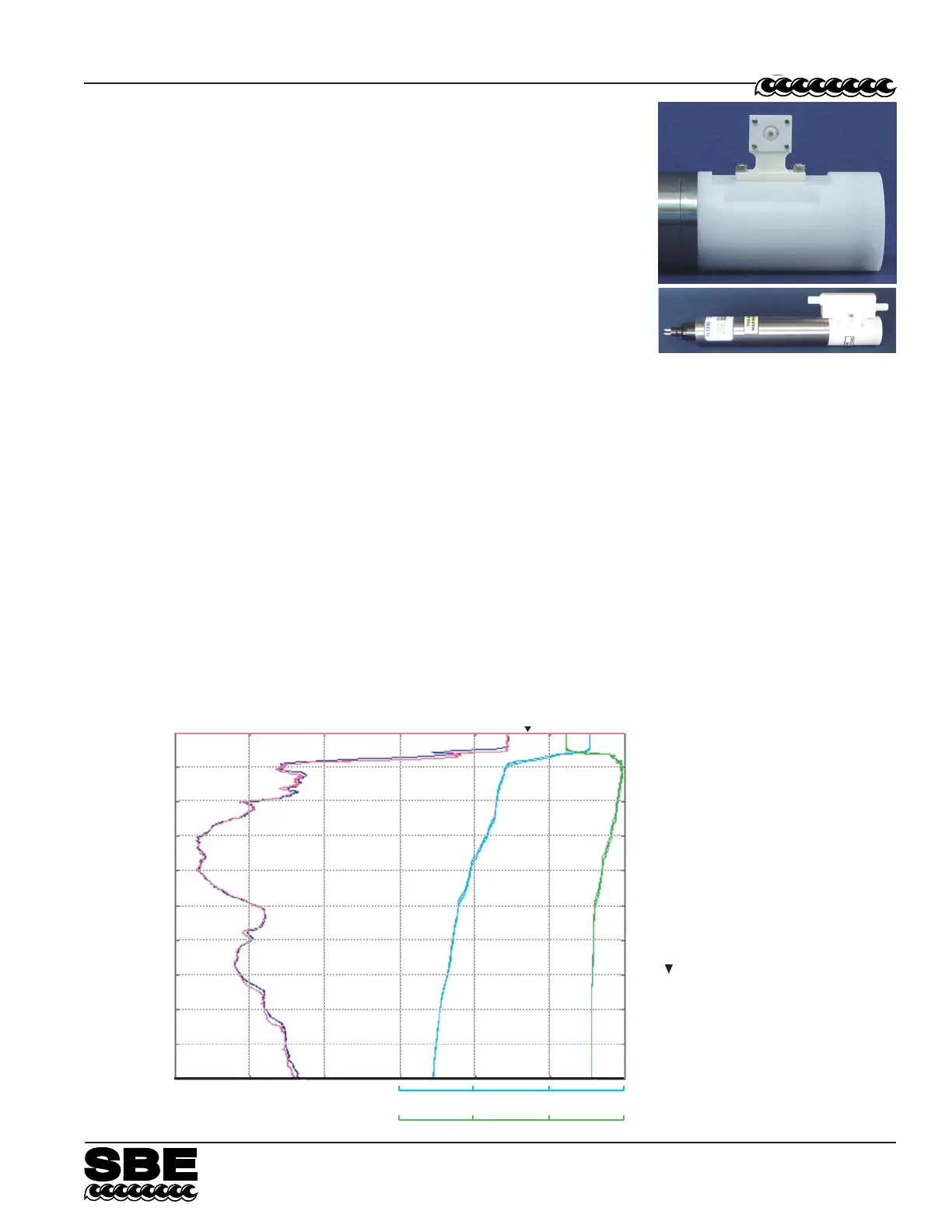
0
200
400
600
700
900
100
300
500
800
1000
Pressure [db]
Salinity, PSS-78
32
35
Temperature, ITS-90 [C]
0
30
Oxygen [ml/l]
0.00
6.00
Upcast
Downcast
Oxygen
Temperature
Salinity
Equatorial Pacific
2° 0.9’ N, 110° 2.2’ W
25 Oct 2000
24 Hz SBE 911plus data; oxygen
measurements were time shifted
6 seconds relative to pressure
to account for water transit time
through TC Duct and plumbing.
No other processing was
performed.
surface oxsat = 4.7 ml/l
147


 To Next Page