English
26
1MΩ.Alternatively,thedifferential-current
method in combination with measuring the
PEconductorcurrentcanbeused.Avalueof
3.5mAmustnotbeexceededineithercase.
To perform these measurements, connect the
charging coupler to a test adapter for vehicle
simulation according to EN 61851-1. The meas-
urements
mustbeperformedinadapterstateC
.
The differential-current measurement must
be performed at the connection point of the
charging system’s supply cable in the building’s
electrical cabinet.
i
Depending on the measuring instrument
used, it might not be possible to perform
the following measurement on the
adapter. In this case, perform the test at
the connection terminals.
• Testing the switch-off condition in the event of a
short circuit (Z
L-N
)
To perform these measurements, connect the
charging coupler to a test adapter for vehicle
simulation according to EN 61851-1. The meas-
urementsmustbeperformedinadapterstateC.
Performthemeasurementsatthetestadapter’s
measuringsockets.Thevaluesinaccordancewith
theselectedcircuitbreakermustbeobserved.
• Testing the switch-off condition in the event of
the RCD tripping
To perform these measurements, connect the
charging coupler to a test adapter for vehicle
simulation according to EN 61851-1. The meas-
urementmustbeperformedinadapterstateC.
Performthemeasurementatthemeasuring
socketsofthetestadapterusingasuitable
measuring instrument. The values in accordance
withtheselectedRCDandthenetworkmustbe
observed.
• Testing the integrated DC residual current
detection
To perform these measurements, connect the
charging coupler to a test adapter for vehicle
simulation according to EN 61851-1. The meas-
urementsmustbeperformedinadapterstateC.
Performthemeasurementsatthetestadapter’s
measuringsocketsusingasuitablemeasuring
instrument. The charging system must discon-
nect the charging coupler from the mains when
theresidualcurrentexceeds6mADC.Thefault
display on the charging system must respond.
1.6 Information about signs, symbols
and labelling
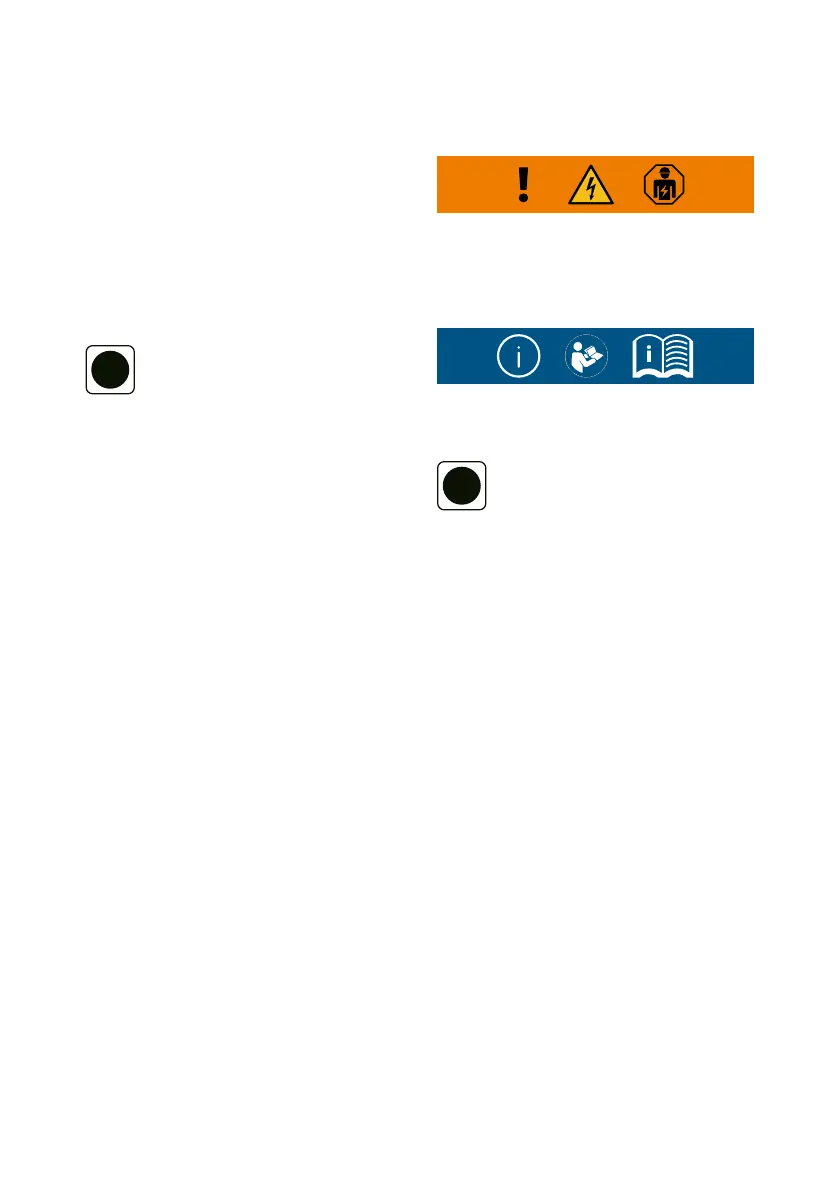
Hazard warning:
Information about a possibly hazardous situation
thatcouldbefatalorresultinsevereinjuriesifthe
safetymeasuresarenotobserved.Allworkistobe
performedbyskilledpersonnelonly.
Note:
Moreinformationisavailableintheoperating
instructions.
i
Note:
supplementary information.
1.7 Protective devices
The following components (Fig. XVI) are protective
devices:
1 housing, 2 charging cable, 3 protective cover,
4chargingcoupler
Checking the protective devices
» 1.Visuallyinspecttheprotectivedevicesfor
damage before every charging process.
» 2.Haveaqualiedelectricianperformthe
electrical function tests at regular intervals in
compliance with the national regulations.
1.8 Type plate, front illumination and
blocking device
1.8.1 Type plate
YoucanndthetypeplateoftheWallboxasshown
in Fig. XVI no 2.
1.8.2 Front illumination
• The front illumination (Fig. XVI no. 1) indicates
the operating state of the charging system. Refer
to the operating instructions for details of the
operating states.
• The charging process starts automatically as
soon as the charging coupler is inserted and the
vehicle requests the charging process.



 To Next Page
 Loading...