Programming and Operating 4
Shield Fire, Safety and Security Ltd.
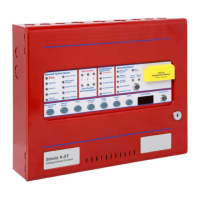
Shield A-XT Releasing Fire Control Panel - Installation and Operation Manual SEXTCP-OM
Revision E01.00
51 of 127
Relays of the Shield A-XT Releasing Fire Control Panel are common and not programmable and include:
Calibrating the Releasing Circuit
Calibrate the releasing circuit by adjusting the EXTING. MON. potentiometer on the front-panel of the of the Shield
A-XT Releasing Fire Control Panel. Adjust the EXTING MON setting to provide supervision of the “EXTING.”
output with the field wiring complete.
To perform the calibration:
Trouble Relay The trouble relay is normally energized and will de-energise upon any trouble condition
including total loss of power.
Local Fire Relay The local fire relay energizes during activation of a fire condition on any zone or by pressing
the sound alarm button in level 2 on the fascia. The relay remains activated until the alarm is
silenced or the fire control panel is reset.
Fire Relay The fire relay energizes during activation of a fire condition on any zone or by pressing the
sound alarm button in level 2 on the fascia. The relay remains activated until the fire control
panel is reset.
1st Stage Alarm The first stage alarm operates during activation of a zone that has been configured to
contribute to the releasing decision and de-activates when the fire control panel has been
reset. This relay also operates during activation of the manual release switch.
2nd Stage Alarm The second stage alarm relay operates when the fire control panel enters the activated
condition and de-activates when the fire control panel has been reset from the released
condition. The fire control panel can enter the activated condition and operate the second
stage relay when the releasing countdown timer has started.
Extract Relay The extract relay operates when the Ac option is selected at access level 2. This process
vents releasing gases from a room and prevents gases from being vented during discharge.
1 Verify that the EXTING voltage output is in the range of (-0.2 to -1.0 volts).
(If not, check field wiring and polarity of EOLD.)
2 Verify that, when activated, the voltage drop from the EXTING output terminals to the releasing device (and
EOLD) is less than the permitted 2.4 volts.
3 If the panel is indicating an active Releasing Trouble, turn the Exting Mon adjustment clockwise until the
Releasing Trouble clears.
4 If the panel is indicating no Releasing Trouble, turn the Exting Mon adjustment counter-clockwise until the
Releasing Trouble activates.
5 Once at this threshold, turn the Exting Mon adjustment one full turn clockwise.
6 Verify that a short circuit at the releasing device results in a Releasing Trouble indication at the panel.


 To Next Page