Mark VII Restored Manual - V1.02 – Donated without cost to the world-wide Shopsmith Community - Everett L. Davis 2016 22
CROSS BEVELING
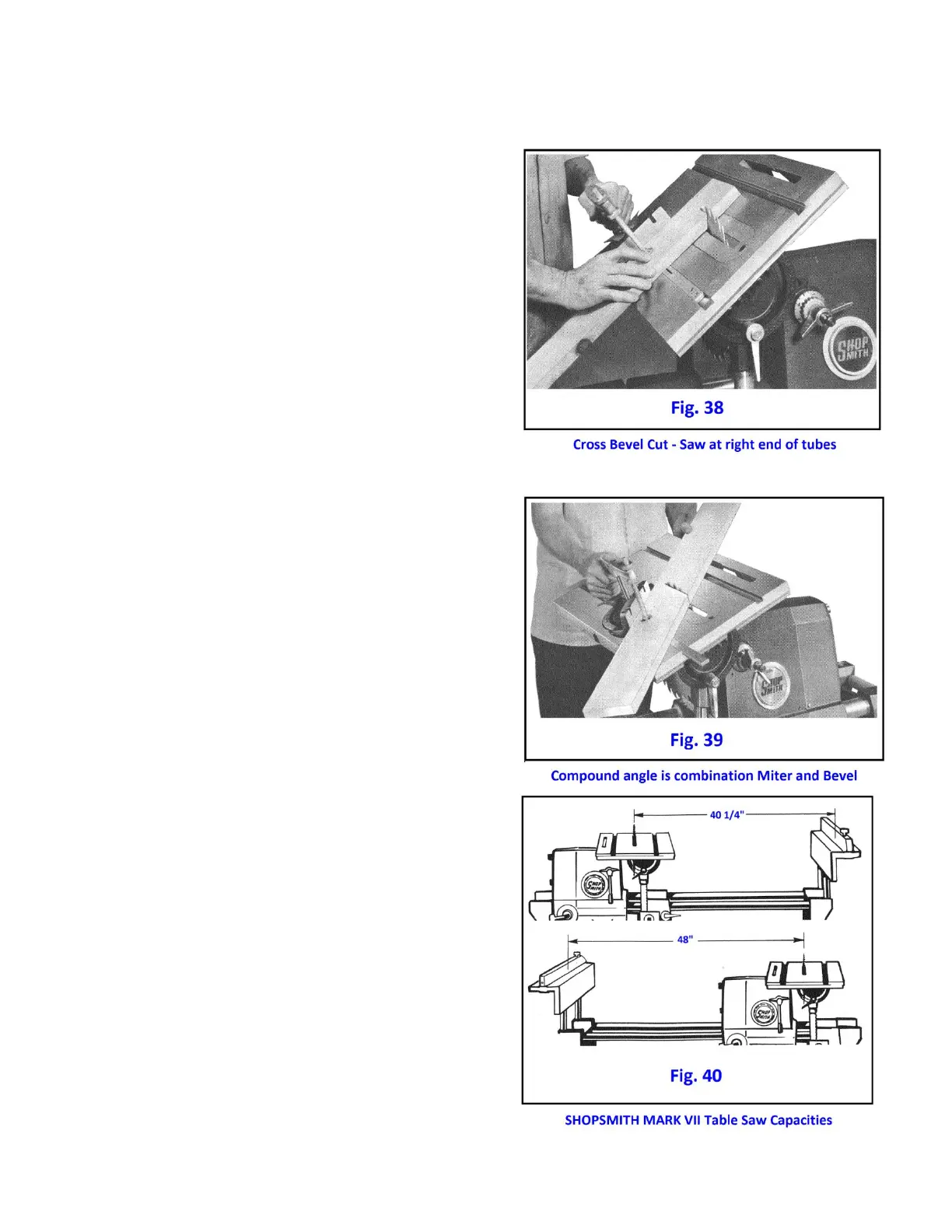
Bevel cuts made across the grain also require a table tilt.
The pass, however, is made with the miter gauge as in
crosscutting. When the work piece is long, lock the
headstock and table at the right end of the way tubes
(Fig. 38). Length of work is then limited only by the
distance between floor and ceiling.
COMPOUND ANGLE CUTS
Any type of framework with slanting sides requires a
combination of miter gauge setting and table tilt (Fig.
39). The settings are determined by the work angle
required and must be very exact. This is one of the more
difficult cuts to accomplish but only because more care
is required to obtain the extreme accuracy needed.
THE EXTENSION TABLE
The SHOPSMITH extension table provides additional
support when crosscutting long pieces and affords a
maximum blade-to-fence dimension of 48" (Fig. 40).
Even more than 48" can be obtained by removing the
insert and advancing the quill. The full 48" is obtained
with the extension table mounted at the left side of the
tubes and the headstock and saw table locked at the
right end of the tubes (Fig. 41).



 To Next Page