Mark VII Restored Manual - V1.02 – Donated without cost to the world-wide Shopsmith Community - Everett L. Davis 2016 43
SANDING TO LENGTH
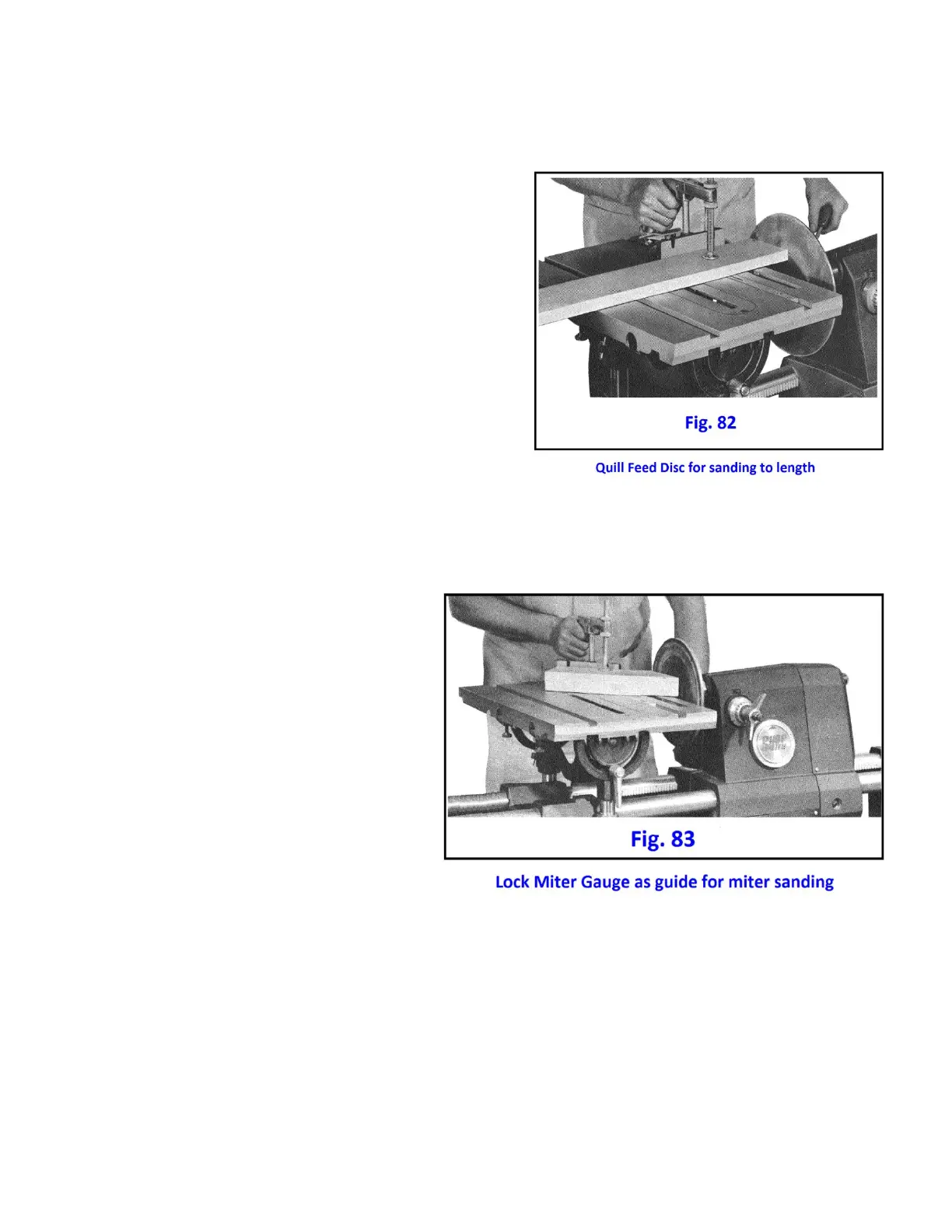
Hold the work with miter gauge safety grip and advance
quill for fine feed (Fig. 82). Duplicate pieces are quickly
and easily sanded to exact length by the following
method: Lock the table about 1/2" away from the disc.
Set the rip fence on the table or extension table,
depending on length of work. Lock miter gauge in place to
act as a guide for the work. Place one work piece on the
table and sand to the exact length required by feeding the
disc into it.
Turn off machine and extend disc to butt against sanded
piece. Set depth control dial and lock the feed stop. Then
sand each piece by placing in jig formed by miter gauge
and rip fence and feeding disc forward.
FEED SLOWLY - NEVER FORCE THE DISC INTO THE WORK.
MITER SANDING
The best way to get perfect miters is to saw
the pieces about 1/16" oversize and sand
them to exact length (Fig. 83). Lock the
miter gauge in place after it has been set to
the angle needed. Place and hold the work
firmly against the miter gauge and feed the
disc forward.
ANGULAR SANDING
For bevels and cross miters tilt the table to
the angle needed and sand as you would any
other piece. Always tilt the table to form an
open angle with the disc. If you tilt the other
way there is the possibility, especially with
thin pieces, that the work will grab between
the edge of the table and the disc.
To sand compound angles set the miter gauge and table to the same angles used to cut the pieces on the saw.



 To Next Page