Features and functions 09/02
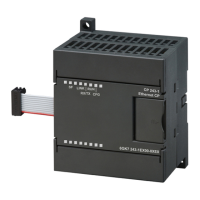
CP 243-1
14 J31069-D0428-U001-A1-7618
S7 communication
The S7 services, XPUT and XGET, are used for data exchange between two con-
trollers. Here, the CP 243-1 can be implemented as both a client and a server.
Communication between a CP 243-1 and an OPC server running on a PC/PG is
based on the S7 services, READ and WRITE. In this case, the CP 243-1always
acts as the server. Other S7 services, such as the service that automatically que-
ries which objects are currently present in an S7-200 (DBs, ...), are not supported.
The following data types or data areas are supported by the CP 243-1:
CP 243-1 as client:
Read and write access:
• The data type is always BYTE
• Only variables can be accessed on the local system.
• The memory areas that are accessible on the partner system when an S7-200
is acting as a partner are inputs, outputs, flags and variables.
• The memory areas that are accessible on the partner system for an S7-300 or
an S7-400 are inputs, outputs, flags and data areas.
CP 243-1 as server:
Write access:
• The data type is BOOL, BYTE, WORD or DWORD
• Accessible memory areas on the local system are inputs, outputs, variables,
flags and status bits.
Read access:
• The data type is BOOL, BYTE, WORD or DWORD
• Accessible memory areas on the local system are inputs, outputs, variables,
flags, system areas and status bits.
Communication with STEP 7 Micro/WIN 32
The CP 243-1 is always the server for communication between a CP 243-1 and
STEP 7 Micro/WIN 32. In this case, STEP 7 Micro/WIN 32 always acts as client.
I/O bus communication
All data areas of the S7-200 CPU can always be accessed. Read and write access
is independent of whether the CPU is in the RUN, TERM or STOP state.


 To Next Page
 Loading...